Global Supply, Demand and Price Developments Impacting Solar Manufacturing in Europe

premium account

Recording of Wednesday, May 07, 2025 | The smarter E Europe Conferences 2025 | Conference Program | Language: English | Duration: 13:01 .

European Solar Market Faces Challenges Amidst Aggressive Chinese Investment and Policy Differences

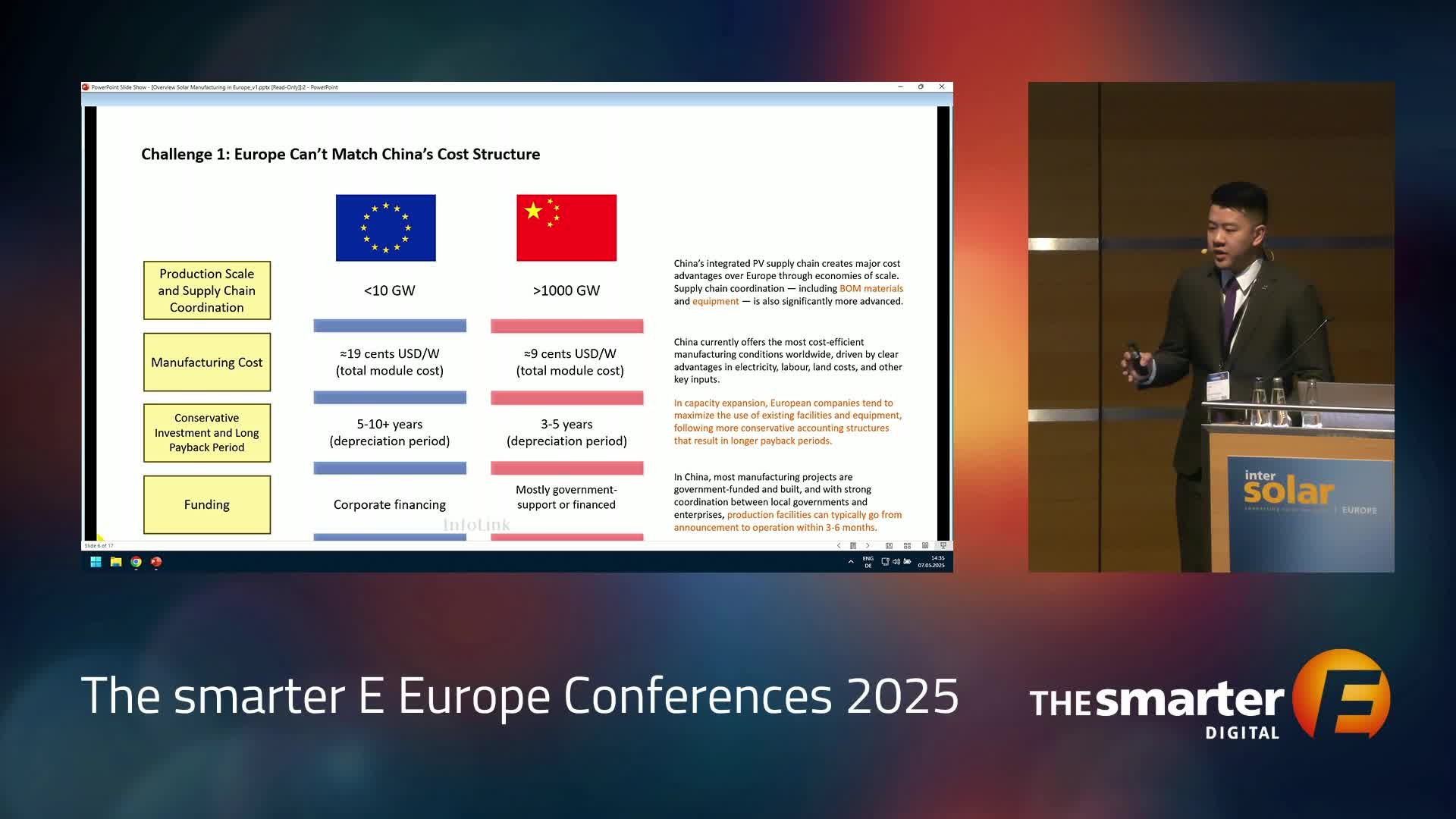
The speaker discusses the challenges and strategies related to solar energy production, focusing on European and Chinese markets. It highlights Europe's commitment to solar products but notes a disparity in capacity utilization compared to China. The aggressive investment strategies of Chinese companies, supported by government funding, contrast with the financial struggles faced by European producers. Two key strategic approaches are identified: "push" (tariffs) and "pull" (incentives), which countries like Turkey, Saudi Arabia, India, and the US have adopted successfully. However, Europe lacks a unified framework for enhancing production capacity despite some national initiatives like SASADIS policies. The text emphasizes that while Europe is a significant market for solar technology due to its size and standards-setting capabilities—such as low-carbon benchmarks—it faces competition from other regions leading in research efficiency metrics such as NREL's records in the US or emerging PV technologies globally. Ultimately it suggests balancing imports with local manufacturing could address long-term sustainability goals without sacrificing job creation or energy independence within Europe’s evolving renewable landscape.

Automated summarization by AI Conver

Alan Tu
Solar Analyst
InfoLink Consulting Co,. Ltd.
China

Amid rising geopolitical tensions, Europe's dependence on imported solar products continues to grow. While the European solar market is growing, domestic manufacturers across the entire value chain are struggling, losing market share, shutting down facilities, or exiting the sector due to declining profitability. So far, support from Brussels and national governments has been insufficient and too slow to create the conditions needed for a revival of European solar manufacturing. Now, hopes are pinned on the Net Zero Industry Act (NZIA), which aims to boost local production through domestic content requirements in auctions and public procurement. This session will provide: Update on the European solar manufacturing landscape across the value chain Cost-competitiveness analysis of European solar manufacturers Insights into policy support, investment opportunities, and start-up potential for European PV manufacturing High-level panel discussion on the future of solar manufacturing in Europe.

Further Talks of this session:

Speaker

Dries Acke
Deputy CEO
SolarPower Europe
Belgium

Video is not available.

Speaker

Dries Acke
Deputy CEO
SolarPower Europe
Belgium

To Talk

Speaker

Prof. Dr. Peter Fath
CEO
RCT Solutions GmbH
Germany

To Talk

Speaker

Jennifer Karle
Policy Officer
DG GROW, European Commission
Belgium

Ing. Stefano Lorenzi
CEO
3SUN
Italy

Prof. Dr. Peter Fath
CEO
RCT Solutions GmbH
Germany

Katharina Eickelberg
Senior Vice President Global Communication & Sustainability
SMA Solar Technology AG
Deutschland

Katharina David
Co-CEO
K2 Systems GmbH
Germany

To Talk

Further Content
Renate Egan, Executive Director of ACAP
What’s Next in PV Cell and Module Tech

The smarter E Podcast Episode 244 | Language: English

November 27, 2025

UNSW and ACAP drive advances in solar tech. Prof. Renate Egan shares new PV research and how innovation will shape the industry in 2026.

The smarter E Europe Conferences 2025
Digital Tools for Planning and Monitoring: Insights from Mozambique

Wednesday, May 07, 2025, 02:00 pm - 03:30 pm

The smarter E Europe Conferences 2025 | Conference Program

premium account

This session explores how digitalization is revolutionizing off-grid energy projects, enabling scalability and efficiency in underserved areas. Experts will discuss cutting-edge solutions based on the use and application of digital tools to support planning, development, and operations ultimately enhancing affordability. Attendees will gain insights into leveraging digital tools for optimized planning and project management, customer engagement, monitoring, and sustainable growth. Real-world case studies will highlight successful implementations, showcasing how technology bridges the gap between innovation and impact in energy access.

Webinar Collection
Kenya’s Solar Landscape 2025: Policy Shifts, Market Signals, and Opportunities for Scalable PV Deployment

December 2, 2025

free account

Join our free webinar on December 2 and learn about the current situation of the Kenyan solar industry, its opportunities, and challenges.

The smarter E Europe Conferences 2025
Optimizing Island Energy Systems: Modeling Hydrogen Integration in the Asia-Pacific

Wednesday, May 07, 2025, 02:00 pm - 03:30 pm

The smarter E Europe Conferences 2025 | Conference Program

premium account

This session explores how digitalization is revolutionizing off-grid energy projects, enabling scalability and efficiency in underserved areas. Experts will discuss cutting-edge solutions based on the use and application of digital tools to support planning, development, and operations ultimately enhancing affordability. Attendees will gain insights into leveraging digital tools for optimized planning and project management, customer engagement, monitoring, and sustainable growth. Real-world case studies will highlight successful implementations, showcasing how technology bridges the gap between innovation and impact in energy access.

The smarter E Europe Conferences 2025
Panel Discussion of of the Session Off-Grid: When Will Off-Grid PV Follow the Affordability Trend?(BSW)

Wednesday, May 07, 2025, 04:00 pm - 05:30 pm

The smarter E Europe Conferences 2025 | Conference Program

premium account

Photovoltaic prices have fallen continuously in recent years - a trend that should translate into a growing market for off-grid solutions. Declining costs are crucial for rural electrification in particular, making sustainable energy supply economically viable in remote regions. However, so far many of these price advantages have not yet reached the people that need them most. Do existing framework conditions to foster rural electrification still work in this new market reality? Which measures are needed to ensure that cost reductions reach our target group? This session discusses strategies for improving the availability of low-cost off-grid solutions, financing and innovative business models. A look at successful practical examples shows which political, economic and technological levers need to be pulled to make off-grid PV accessible on a large scale.

You are using an outdated browser

The website cannot be viewed in this browser. Please open the website in an up-to-date browser such as Edge, Chrome, Firefox, or Safari.