State of Policy and Market of Storage in Germany

Premium Account

Recording of Tuesday, June 18, 2024 | The smarter E Europe | Conference Program | Language: English | Duration: 8:19 .

German Energy Policy Shifts: Reduced Hydrogen Targets, New Storage Strategy, and Capacity Mechanism Announced

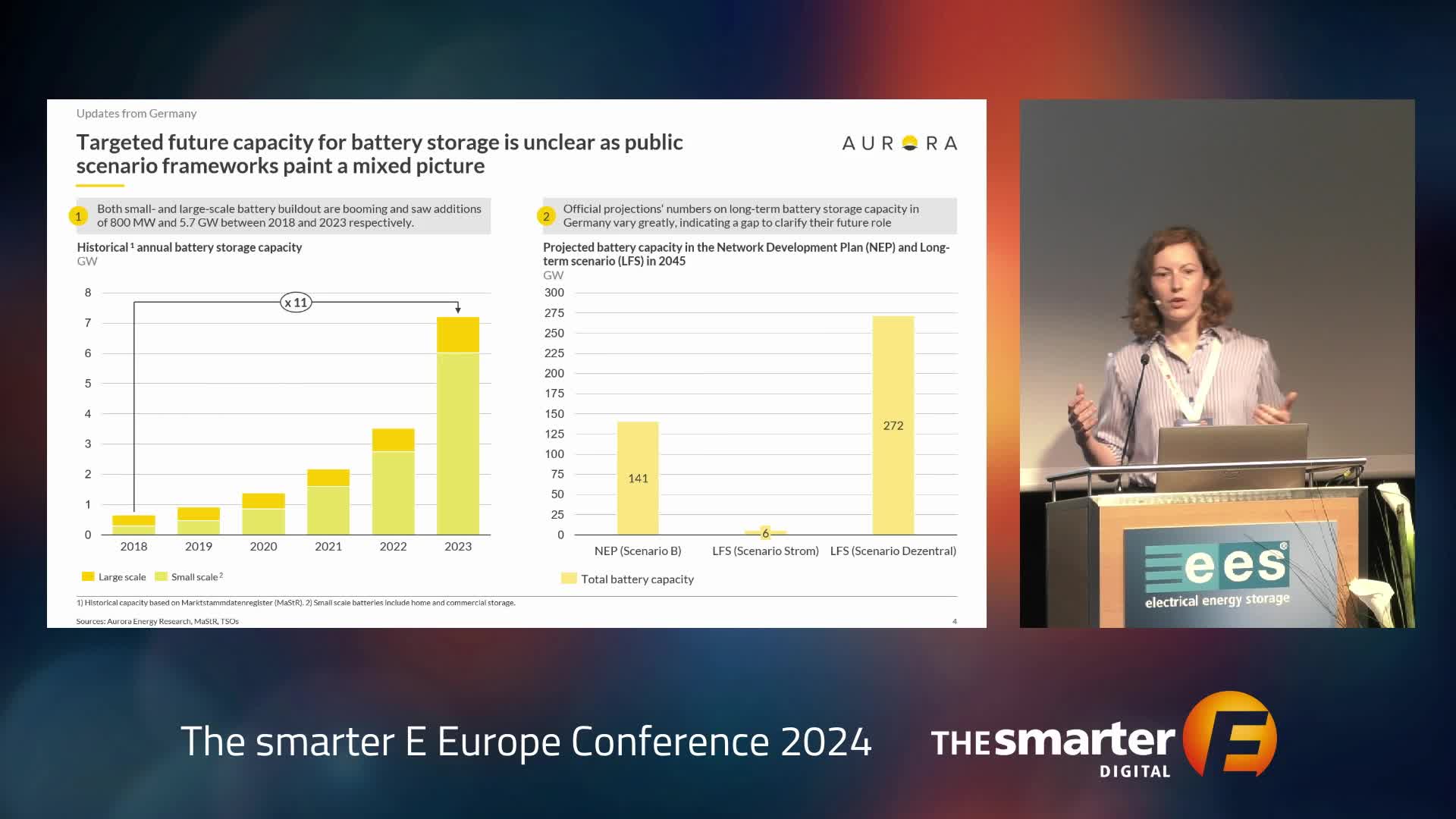
Claudia Günther, leader of Aurora's Northwestern research team, provides an update on Germany's evolving energy policy and battery storage landscape. Over the past year, significant changes have occurred in government strategy. Initially ambitious plans for over 20 gigawatts of hydrogen-fueled gas assets were scaled back to 10 gigawatts by early 2023. Additionally, a new capacity mechanism set to be implemented by 2028 signifies a major shift from previous policies that maintained the energy market as the sole capacity reserve. Battery storage has seen substantial growth in Germany with an elevenfold increase in capacity over five years driven largely by behind-the-meter installations and utility-scale assets. Despite this growth, there are no definitive official targets for future battery capacity; guiding scenarios suggest potential capacities ranging from negligible additions to more than 270 gigawatts by 2045. The German government's newly released storage strategy outlines numerous initiatives including regulatory improvements for hybrid renewable-battery systems, facilitated through recent legislative packages like the solar package passed by parliament. Another focus is market-based procurement of ancillary services influenced heavily by EU legislation under the clean energy package which could yield high revenues for battery storage initially. In summary: while positive steps are being taken towards better integration and support for battery storage within Germany’s energy framework; clear long-term objectives remain undefined.

Automatisierte Zusammenfassung durch AI Conver

Claudia Günther
Research Lead
Aurora Energy Research
Germany

In the first quarter of 2023, the EU Commission produced a veritable torrent of favorable policy proposals, with the Electricity Market Reform (EMR) at its core and backed by recommendations to the EU Member States to ensure the more wide-spread deployment of energy storage. At the last ees Europe Conference, we discussed these proposals in detail - but what has happened since then? What actions and measures have followed and how effective will they be in unlocking the potential of energy storage?In this panel, we will discuss the state of implementation of the EU energy storage policy, what has gone well, what has not, and what more should be done.

Further Talks of this session:

Speaker

Lars Stephan
Senior Manager Policy & Market Development
Fluence
United Kingdom

To Talk

Speaker

Elodie Perret
Head of EU Affairs
BayWa r.e.
Belgium

To Talk

Speaker

Luz Carmen Perez Sanchez
Head of CAPEX Management
Iberdrola
Spain

To Talk

Speaker

Aleksandra Radwanska
Country Manager Next Kraftwerke Poland
Next Kraftwerke GmbH
Germany

To Talk

To Talk

Speaker

Lars Stephan
Senior Manager Policy & Market Development
Fluence
United Kingdom

To Talk

Weiterführende Inhalte
Gaëtan Masson and Delfina Muñoz
The Challenge in Turning Europe’s PV Research into an Industrial Reality

The smarter E Podcast Episode 266 | Language: English

October 1, 2026

Europe leads in solar research but lags in manufacturing. Jonathan Gifford explores industrial policy and tandem tech with experts.

Thaddäus Kreisig
Stack ’Em Up: Germany’s Big Battery Inflection Point – with Thaddäus Kreisig

The smarter E Podcast Episode 265 | Language: English

September 16, 2026

Discover how Germany's solar surge is driving a gigawatt-scale battery boom, the revenue models making projects viable, and the hurdles ahead.

The smarter E Europe Conference 2023
The Future Role of Flexibility Support Schemes and Their Impact on the Storage Industry in Europe

Tuesday, June 13, 2023, 02:30 pm - 04:00 pm

The smarter E Europe Conference 2023 | Conference Program

The pressing need to mitigate the impact of climate change and to deal with the ongoing energy crisis requires a new regulatory framework in Europe. This is why the European Commission has presented a legislative proposal for the adaptation of the EU Electricity Market Design in Q1 2023. But how would this new framework impact the energy storage market? How would the provision of flexibility be encouraged? How would existing entry barriers for energy storage be further reduced? In this panel, representatives from the EU, utilities, IPPs and storage providers will be discussing whether the new market design is suitable for incentivizing both the necessary energy storage installations and ideas for future improvements.

The smarter E Europe Conference 2023
NAS Batteries for Long-Duration Stationary Energy Storage

Tuesday, June 13, 2023, 04:30 pm - 06:00 pm

The smarter E Europe Conference 2023 | Conference Program

kostenfreier Account

Technology is the key to battery storage markets developing at a rapid pace. Just look at the way system costs have dropped drastically in recent years as a result of progress in the development of battery materials and battery cells and advancement in storage system technology.In the diverse stationary markets in particular, opportunities for technological alternatives to the lithium-ion battery are being opened up. In this session, you can hear from experts directly about current progress in the development of specific battery technologies and learn about the impact those battery technologies are set to have on the market for electrical energy storage systems in the near future.

Publications
European Market Outlook for Battery Storage 2025–2029

Comprehensive analysis of Europe’s battery storage market – now available for download

Sie verwenden einen veralteten Browser

Die Website kann in diesem Browser nicht angezeigt werden. Bitte öffnen Sie die Website in einem aktuellen Browser wie Edge, Chrome, Firefox oder Safari.