State of Play on EU Storage Policy & Regulatory Framework

premium account

Recording of Tuesday, June 18, 2024 | The smarter E Europe | Conference Program | Language: English | Duration: 10:39 .

EU Urged to Enhance Energy Storage Policies for Renewable Integration Amid New Electricity Market Design Reforms

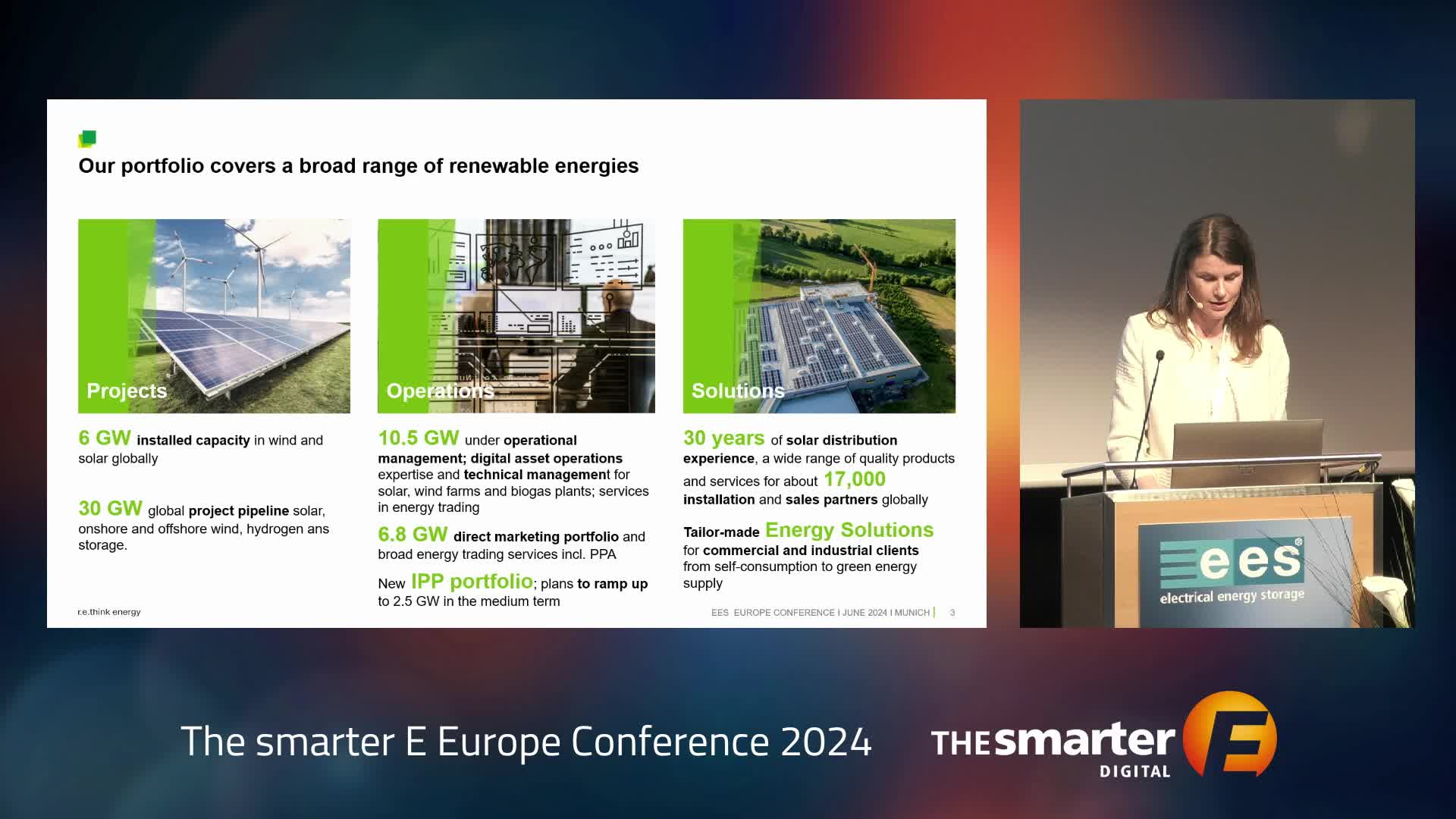
The speaker, who has a decade and a half of experience in the renewable energy sector with organizations such as EDF Renewables, presents Byvari—an entirely renewables-focused global energy solutions provider. They emphasize the increasing importance of storage and flexibility within EU political agendas to support renewable energy integration. Initially highlighted by the Clean Energy Package, which defined storage rules ensuring non-discriminatory treatment for flexibility measures like demand response and storage. However, subsequent initiatives such as RepowerEU did not prioritize storage sufficiently despite heightened renewable targets. In March 2023, an EU Commission strategy on storage offered recommendations (e.g., removing double taxation) but fell short of proposing concrete regulations. The December 2023 agreement on new electricity market design aimed to stabilize post-energy crisis volatility and included provisions for integrating renewables through better market access and grid functioning reforms. Crucially, this reform underscores that member states must assess national-level flexibility needs regularly while establishing indicative non-fossil flexibility targets; however, it lacks strong CO2 emission limits to incentivize further investment in storage. Moving forward requires enhancing equal access for all flexible resources within markets via system operators' procurement primarily through competitive means—a critical step supported by ongoing network code developments focused on aggregation across Europe’s power systems.

Automated summarization by AI Conver

Elodie Perret
Head of EU Affairs
BayWa r.e.
Belgium

In the first quarter of 2023, the EU Commission produced a veritable torrent of favorable policy proposals, with the Electricity Market Reform (EMR) at its core and backed by recommendations to the EU Member States to ensure the more wide-spread deployment of energy storage. At the last ees Europe Conference, we discussed these proposals in detail - but what has happened since then? What actions and measures have followed and how effective will they be in unlocking the potential of energy storage?In this panel, we will discuss the state of implementation of the EU energy storage policy, what has gone well, what has not, and what more should be done.

Speaker

Lars Stephan
Senior Manager Policy & Market Development
Fluence
United Kingdom

To Talk

Speaker

Claudia Günther
Research Lead
Aurora Energy Research
Germany

To Talk

Speaker

Luz Carmen Perez Sanchez
Head of CAPEX Management
Iberdrola
Spain

To Talk

Speaker

Aleksandra Radwanska
Country Manager Next Kraftwerke Poland
Next Kraftwerke GmbH
Germany

To Talk

To Talk

Speaker

Lars Stephan
Senior Manager Policy & Market Development
Fluence
United Kingdom

To Talk

Further Content
Webinar
EEG Reform & Grid Package – What prospects and potential does Photovoltaics have beyond 2027?

September 18, 2026

New rules for solar and energy storage: The planned EEG reform for 2027 could fundamentally reshape the support framework and market conditions. Join our webinar in cooperation with BSW-Solar to find out what opportunities and challenges these changes may bring to the industry.

Publications
European Market Outlook for Battery Storage 2025–2029

Comprehensive analysis of Europe’s battery storage market – now available for download

The smarter E Europe Conference 2023
Zinc-Ion Batteries: The Key to Sustainable Energy Storage in Europe

Tuesday, June 13, 2023, 04:30 pm - 06:00 pm

The smarter E Europe Conference 2023 | Conference Program

free account

Technology is the key to battery storage markets developing at a rapid pace. Just look at the way system costs have dropped drastically in recent years as a result of progress in the development of battery materials and battery cells and advancement in storage system technology.In the diverse stationary markets in particular, opportunities for technological alternatives to the lithium-ion battery are being opened up. In this session, you can hear from experts directly about current progress in the development of specific battery technologies and learn about the impact those battery technologies are set to have on the market for electrical energy storage systems in the near future.

The smarter E Europe Conference 2023
NAS Batteries for Long-Duration Stationary Energy Storage

Tuesday, June 13, 2023, 04:30 pm - 06:00 pm

The smarter E Europe Conference 2023 | Conference Program

free account

Technology is the key to battery storage markets developing at a rapid pace. Just look at the way system costs have dropped drastically in recent years as a result of progress in the development of battery materials and battery cells and advancement in storage system technology.In the diverse stationary markets in particular, opportunities for technological alternatives to the lithium-ion battery are being opened up. In this session, you can hear from experts directly about current progress in the development of specific battery technologies and learn about the impact those battery technologies are set to have on the market for electrical energy storage systems in the near future.

The smarter E Europe Conference 2023
Technology Innovation vs. Market Design Innovation - What Will Come First To Help Long-Duration Energy Storage in the EU? - The Vanadium Redox Flow Battery Case

Tuesday, June 13, 2023, 02:30 pm - 04:00 pm

The smarter E Europe Conference 2023 | Conference Program

free account

The pressing need to mitigate the impact of climate change and to deal with the ongoing energy crisis requires a new regulatory framework in Europe. This is why the European Commission has presented a legislative proposal for the adaptation of the EU Electricity Market Design in Q1 2023. But how would this new framework impact the energy storage market? How would the provision of flexibility be encouraged? How would existing entry barriers for energy storage be further reduced? In this panel, representatives from the EU, utilities, IPPs and storage providers will be discussing whether the new market design is suitable for incentivizing both the necessary energy storage installations and ideas for future improvements.

You are using an outdated browser

The website cannot be viewed in this browser. Please open the website in an up-to-date browser such as Edge, Chrome, Firefox, or Safari.