Battery Size Versus Fast Charging - Key Insights From Our Electric Vehicle Simulation Analysis

premium account

Recording of Wednesday, June 19, 2024 | The smarter E Europe | Conference Program | Language: English | Duration: 10:45 .

Researcher Carolina Poupinha Presents Study on Impact of Battery Size on Electric Vehicles' Costs, Emissions, and User Convenience at International Transportation Panel

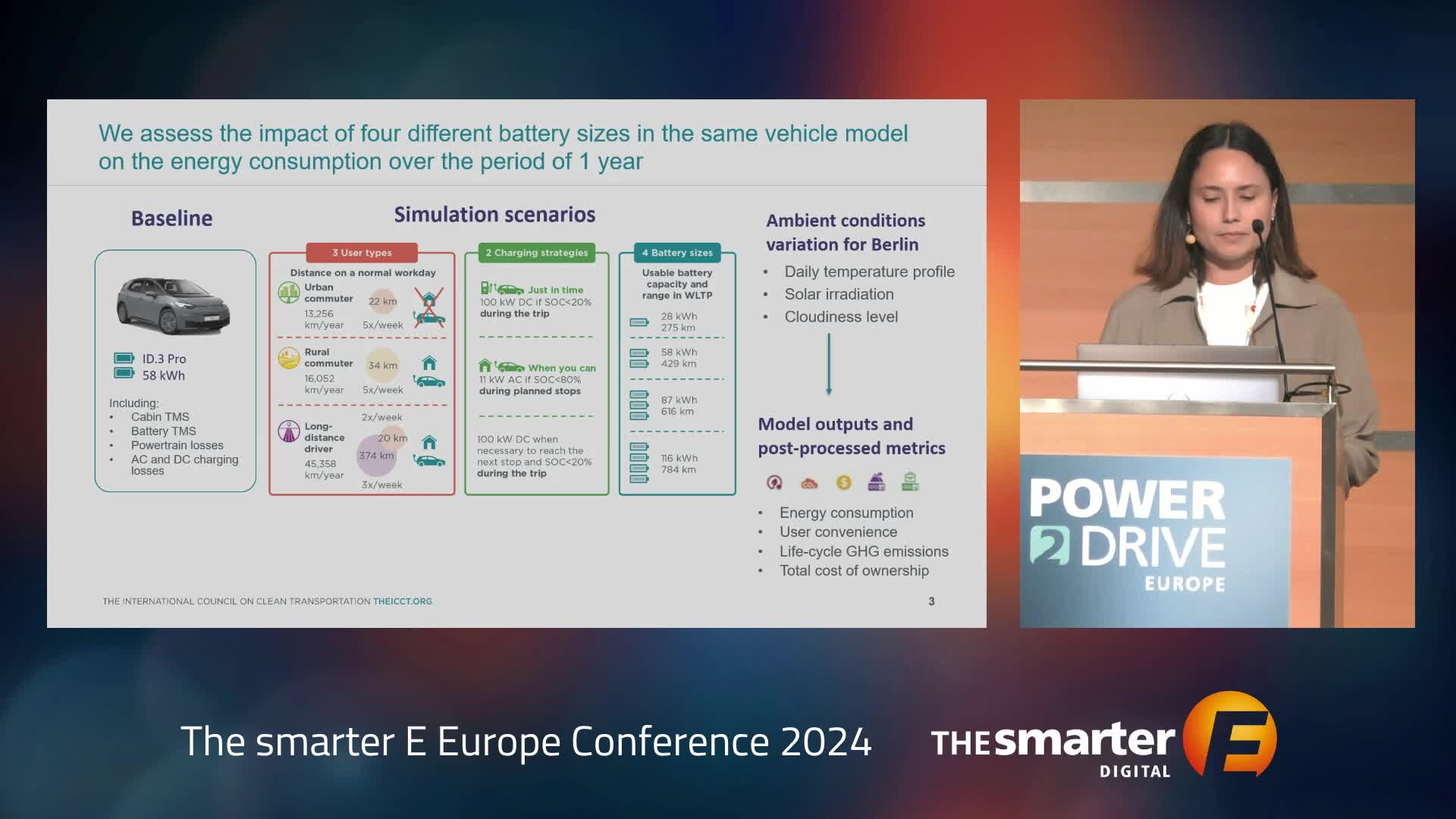
Marie Rajon Bernard introduced Carolina Rodrigues Poupinha, an associate researcher at the ICCT (International Council on Clean Transportation). Poupinha presented her study titled "The Bigger the Better," which explores how battery size impacts electric vehicles (EVs) regarding total cost of ownership, energy consumption, and greenhouse gas emissions. The study aims to address user-vehicle interface concerns and charging infrastructure impacts. Poupinha highlighted that while EVs are crucial for decarbonization targets, increasing vehicle range often results in heftier batteries, leading to higher greenhouse gas emissions from a life cycle perspective. A survey revealed 57% of participants preferred a 500 km range due to "range anxiety." This issue could be tackled either by enlarging battery capacity or improving fast-charging capabilities. A year-long simulation analysis was conducted on different scenarios involving variations in user types (urban commuter, rural commuter, long-distance driver), charging strategies ("just-in-time" vs. opportunistic charging), and battery sizes ranging from 28 kWh to 116 kWh capacities. Results showed increased energy consumption with larger batteries led to higher greenhouse gas emissions and costs. User convenience remained largely unchanged except for long-distance drivers needing fewer charge stops on occasional trips but no significant difference otherwise. Poupinha concluded smaller batteries coupled with robust charging infrastructure might offer environmental benefits without compromising user convenience significantly.

Automated summarization by AI Conver

Carolina Rodrigues Poupinha
Associate Researcher
ICCT (International Council on Clean Transportation)
Germany

Be involved in an exciting session on the future of sustainable e-mobility. We will explore the key role of charging infrastructure and its contribution to a greener future. Learn from research experts and industry leaders how battery size affects power consumption and convenience, and why we need smaller cars and more charging stations. Session topics include smart charging for a greener and cheaper grid, empowering sustainability with battery storage, AI revolutionizing fleet energy usage, and charging event optimization.The aim of this session is to provide an overview of measures to make e-mobility more sustainable when it comes to charging infrastructure and to initiate discussions between participants that will continue throughout the conference. Don't miss your chance to shape the e-mobility charging landscape of tomorrow!

Further Talks of this session:

Speaker

Marie Rajon Bernard
Researcher
ICCT (International Council on Clean Transportation)
Germany

To Talk

Speaker

Marie Rajon Bernard
Researcher
ICCT (International Council on Clean Transportation)
Germany

To Talk

Speaker

Dr. Julia Hildermeier
Senior Associate EU
Regulatory Assistance Project (RAP)
Belgium

To Talk

Speaker

Uwe Augustat
Head of Vertical Solutions
Siemens AG
Germany

To Talk

Speaker

Florian Lüft
Head of Business Development
Univers
France

To Talk

To Talk

Speaker

Conference Partner

Marie Rajon Bernard
Researcher
ICCT (International Council on Clean Transportation)
Germany

To Talk

Further Content
Thomas Raffeiner and Petrouschka Werther
What EV Acceleration Means for the Grid

The smarter E Podcast Episode 260 | Language: English

July 9, 2026

Cars as batteries on wheels: Thomas Raffeiner and Petrouschka Werther discuss how V2G and smart charging turn EVs into critical grid assets.

Power2Drive Europe Conference 2023
Panel Discussion: PwC eMobility Leadership Dialogue

Wednesday, June 14, 2023, 09:00am–10:30am

The smarter E Europe Conference 2023 | Conference Program

free account

The Transition to technology-enabled mobility and sustainable zero-emission ecosystem offers an immense opportunity and equally operational challenges. The session provides a view on both global and regional market potentials and trends, as well as recommendations on how to identify realized profitable value pools. Recommendations are underpinned by PwC analytic data as well as real life case studies to guide e-mobility stakeholders towards the development of a reliable and sustainable EV-energy-ecosystem, operational excellence and profitable business models.

Thaddäus Kreisig
Stack ’Em Up: Germany’s Big Battery Inflection Point – with Thaddäus Kreisig

The smarter E Podcast Episode 265 | Language: English

September 16, 2026

Discover how Germany's solar surge is driving a gigawatt-scale battery boom, the revenue models making projects viable, and the hurdles ahead.

Intersolar Middle East Conference 2026
Towards Net Zero: Decarbonizing C&I Sector in MENA with Solar Leasing

Tuesday, September 01, 2026, 04:45 pm

Intersolar Middle East Conference 2026 | Conference Program

premium account

Gain firsthand insights from landmark solar developments transforming the Middle East and North Africa. This session showcases large-scale project successes, innovative technologies, and lessons learned, highlighting how strategic partnerships and bold investments are advancing regional energy goals and setting new benchmarks for global renewable deployment.

Power2Drive Europe Conference 2023
Developing Sustainable E-Mobility Ecosystems

Wednesday, June 14, 2023, 09:00 am - 10:30 am

The smarter E Europe Conference 2023 | Conference Program

free account

The Transition to technology-enabled mobility and sustainable zero-emission ecosystem offers an immense opportunity and equally operational challenges. The session provides a view on both global and regional market potentials and trends, as well as recommendations on how to identify realized profitable value pools. Recommendations are underpinned by PwC analytic data as well as real life case studies to guide e-mobility stakeholders towards the development of a reliable and sustainable EV-energy-ecosystem, operational excellence and profitable business models.

You are using an outdated browser

The website cannot be viewed in this browser. Please open the website in an up-to-date browser such as Edge, Chrome, Firefox, or Safari.