Charting the High-Voltage Evolution: How 800V-Capable Vehicles and 800V Chargers Are Being Adopted Across Europe and the USA EV Charging Markets

premium account

Recording of Tuesday, June 18, 2024 | The smarter E Europe | Conference Program | Language: English | Duration: 17:24 .

Robert Fisher of SBD Automotive Discusses the Shift to 800-Volt Architectures in EVs and Challenges with Backward Compatibility and Supply Chain Limitations

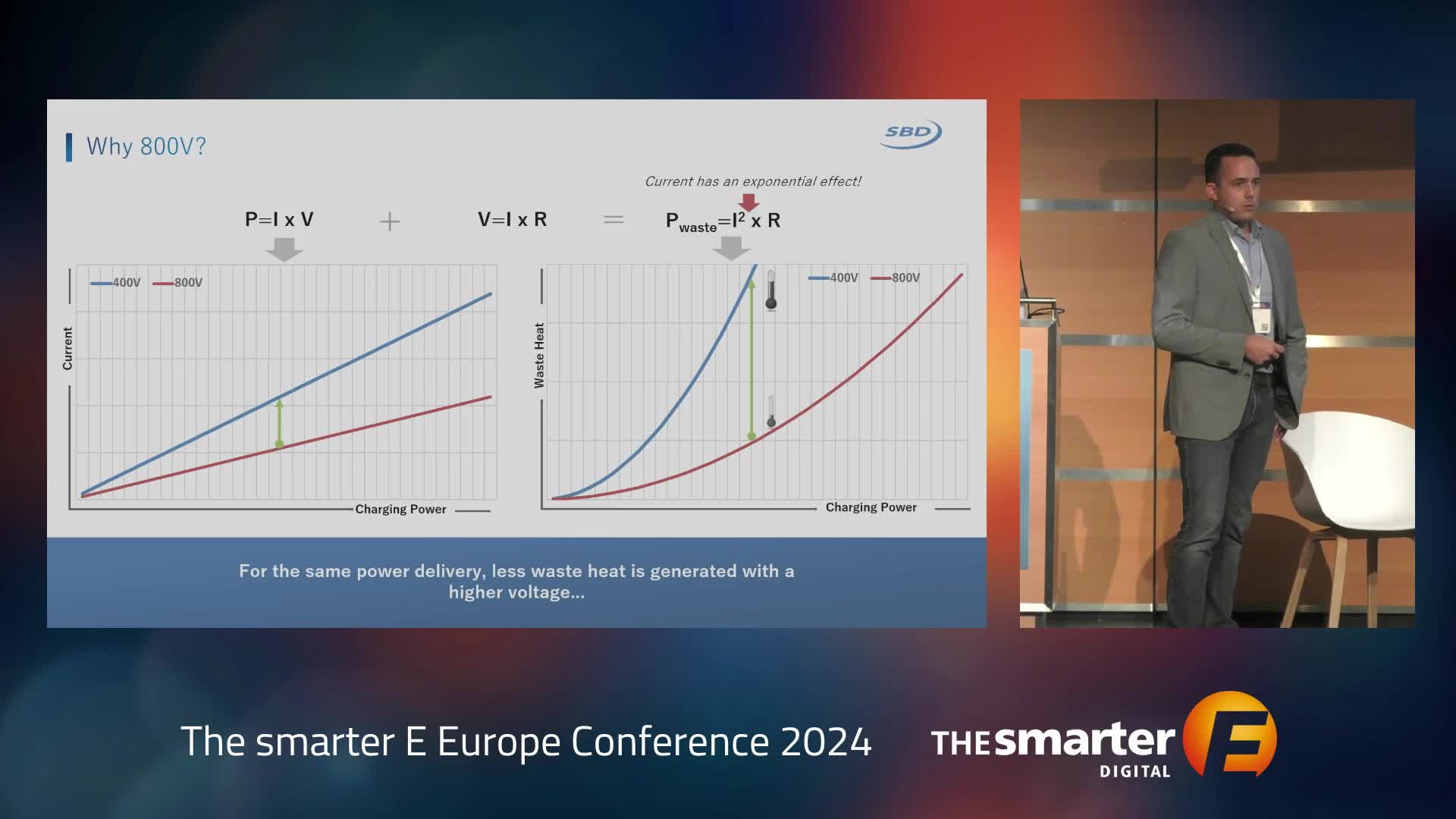
Robert Fisher from SBD Automotive, a global consulting firm specializing in emerging automotive technologies, presented on 800-volt architectures and their significance for the industry. Most current electric vehicle (EV) systems run on 400 volts; however, the shift to 800 volts brings notable advantages. The power law indicates that doubling voltage cuts current in half while drastically reducing wasted heat per Ohm’s law. This reduction translates into smaller, lighter motors with fewer cooling requirements and faster charging times due to less heat generation during charging. Despite these benefits, several challenges impede widespread adoption of 800-volt systems: existing supply chains are geared towards 400-volt components; backward compatibility issues require additional equipment for mixed-voltage scenarios; and regional discrepancies further complicate transitions—Europe is advancing rapidly toward higher voltages while other regions lag behind or use different standards like China’s prevalent 750 volts. Solutions exist but involve complexities such as battery reconfiguration devices to allow dual-voltage integration or DC-DC converters for voltage conversion.

Automated summarization by AI Conver

Robert Fisher
Principal - EV
SBD Automotive Germany GmbH
Germany

Discover the latest trends in electrification in key markets around the world, with a focus on vehicle sales and charging infrastructure. Discover how high-voltage architectures are revolutionizing charging stations and vehicles, and their implications for the auto industry. Researchers will highlight global EV and charging markets and their projected growth. Join us for a series of expert-led presentations and interactive Q&A sessions.

Further Talks of this session:

Speaker

Robert Fisher
Principal - EV
SBD Automotive Germany GmbH
Germany

To Talk

Speaker

Francisco Quiroga
Ambassador
Embassy Mexico
Germany

To Talk

Speaker

Steven Van Arsdale
Autofacts Lead Analyst
PwC
Germany

To Talk

Speaker

Jeanne Buee
Research Analyst
Rho Motion
United Kingdom

To Talk

Speaker

Robert Fisher
Principal - EV
SBD Automotive Germany GmbH
Germany

To Talk

Further Content
The smarter E Europe Conferences 2026
Panel Discussion of the Session: User Success Stories and Best Cases

Tuesday, June 23, 2026, 02:30 pm

The smarter E Europe Conferences 2026 | Conference Program

premium account

For more than two decades, Norway has been steadily building a marketplace for electric transport. Having started out with inexpensive short-range electric cars and household charging sockets, Norway has now moved to mass-market solutions where fast charging (DC) and grid balancing (AC) plays an ever more vital role. With more than 1,000,000 electric cars and over 10,000 fast chargers in a relatively small market, Norway offers a rare early view of large-scale electrification. Over the past decade, electric cars have seen substantial improvements, which is now making it easier for new markets to advance electrification. At the same time, Norway has to deal with challenges years before other markets do. Yet despite different starting points, we can see that most markets are facing the same core challenges. From grid-smart charging strategies to innovative business models, there are excellent examples of best practices emerging elsewhere in Europe. What will the next thing in electrification be, both in mature and in emerging markets? And what will be possible when the right people and companies come together, sharing knowledge, solving common problems and accelerating the shift to cleaner mobility?

Gautham Ram Chandra Mouli, Ruben Valiente
Beating the Blockade with EVs and Batteries

The smarter E Podcast Episode 253 | Language: English

April 16, 2026

Flexibility as a hedge: How V2G and battery storage reduce fossil fuel reliance and turn electric transport into a strategic asset for grid stability.

James Allston, Marko Topič
Keep Calm and Deploy Solar (and Batteries)

The smarter E Podcast Episode 254 | Language: English

April 30, 2026

How European businesses use solar, batteries and EV fleets to manage volatile power prices and explore the future of perovskite solar.

Marcel Rümenapf
Will Soaring Fuel Costs Make eMobility Mass Market? – With Marcel Rümenapf

The smarter E Podcast Episode 256 | Language: English

May 28, 2026

Siemens’ Marcel Rümenapf explains why eMobility is becoming a strategic advantage for European logistics fleets.

The smarter E Europe Conferences 2026
Integrated Truck Charging: Challenges & Solutions Towards Zero-Emission Freight

Tuesday, June 23, 2026, 11:30 am

The smarter E Europe Conferences 2026 | Conference Program

premium account

The electrification of heavy-duty transport is more than just a goal - the transformation is already underway. But scaling up also means having to solve the big challenges: How can we build charging networks that keep pace with fleet electrification without overburdening grids or budgets? What innovations in AI, energy storage and smart infrastructure can turn today's pilot projects into tomorrow's industry standard? And how can OEMs, logistics operators and energy providers align their strategies to make zero-emission freight profitable rather than just possible? From truck manufacturers and charge point operators to logistics innovators and energy experts, this dynamic panel brings together the leaders driving change. We will dive into the real-world solutions making an impact now, like modular charging hubs that grow with demand, fleets and energy optimization solutions powered by AI and smart grid integration that cuts costs and boosts reliability. We will also ask the hard questions: Where are the gaps in collaboration, technology or policy that could slow progress, and how do we close these gaps?

You are using an outdated browser

The website cannot be viewed in this browser. Please open the website in an up-to-date browser such as Edge, Chrome, Firefox, or Safari.