EnBW Mobility+ Business Professional - The 360° Fleet Solution Translator

Premium Account

Recording of Friday, May 09, 2025 | The smarter E Europe | Exhibition Program | Language: English | Duration: 13:05 .

EnBW Expands E-Mobility Network with 1,500 New DC Charge Points and Fleet Services Across Europe

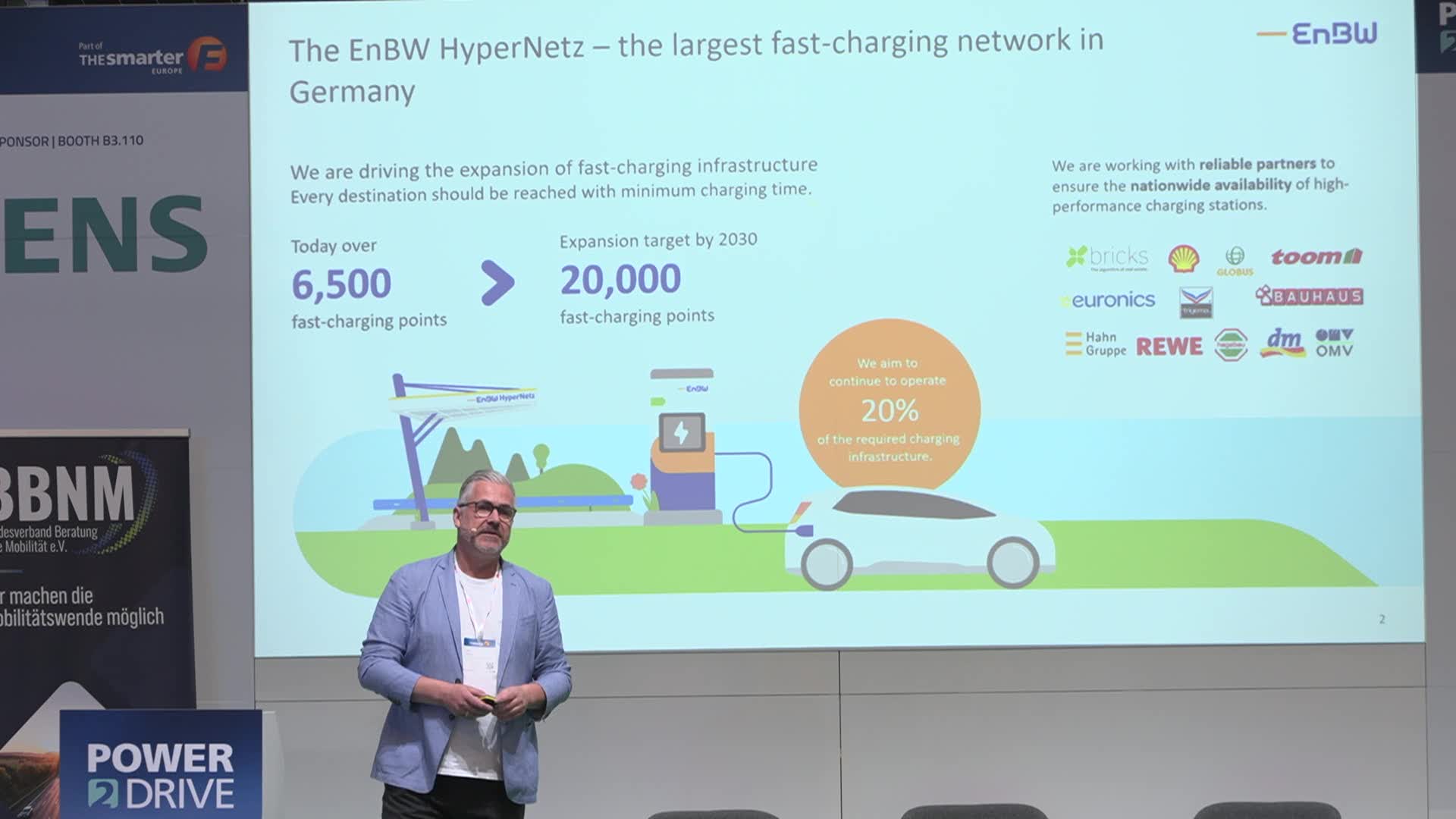
EnBW, Germany's second-largest energy supplier and a significant player in e-mobility since 2014, has established an extensive network of DC charge points. As the largest charge point operator in both Germany and Austria, EnBW manages over 1,500 DC charging stations with plans to expand into Turkey through partnerships like Alpetronic. Their strategy focuses on strategic locations such as retail areas for frequent use without time concerns about car charging and emphasizes rapid recharging capabilities along major routes with high-power stations owned by them. Beyond being a mobility provider across Europe—with access to more than 800,000 charge points—EnBW offers tailored solutions for fleet managers via their Smart Mobility Portal which includes comprehensive billing and usage data management tools. The company also collaborates on innovative digital order processes for home-based charging setups ensuring convenience and transparency in reimbursement systems. This holistic approach integrates public infrastructure development while supporting private sector needs through robust B2B services aimed at enhancing electric vehicle adoption within fleets amidst growing market demands. Peter's expression of gratitude is acknowledged twice succinctly; this repetition underscores its sincerity despite lacking specific details about what prompted it.

Automatisierte Zusammenfassung durch AI Conver

Peter Siegert
Account Manager Fleet Electromobility
EnBW

E-mobility doesn't stop at the charging point - that's where it truly begins. Whether it's company fleets, public charging payments, or infrastructure in multi-family buildings: only smart services make electric mobility practical, efficient, and economically viable.This session explores essential questions: What role do integrated fleet solutions play for businesses? How can user convenience and regulatory compliance be balanced in charging processes? Which technologies enable both stable grid integration and seamless charging experiences? And why are partnerships increasingly shaping the success of entire business models?From real-world EV range to neighborhood charging infrastructure - this session connects vision with practice and shows how mobility and fleet services are accelerating the shift to electric mobility.

Further Talks of this session:

Speaker

Christopher Lu

To Talk

Speaker

Marcus Zacher
Chief editor
Elektroautomobil

To Talk

Video is not available

Video is not available

Speaker

Andreas Blin
Director Segments & Partnerships - CPOs Fuel & Convenience
ChargePoint

To Talk

Speaker

Conrad Hammer
Head of the Federal-State-Municipal Coordination Team
National Center for Charging Infrastructure
NOW GmbH

To Talk

Weiterführende Inhalte
Thomas Raffeiner and Petrouschka Werther
What EV Acceleration Means for the Grid

The smarter E Podcast Episode 260 | Language: English

July 9, 2026

Cars as batteries on wheels: Thomas Raffeiner and Petrouschka Werther discuss how V2G and smart charging turn EVs into critical grid assets.

The smarter E Europe Conferences 2026
Lessons From a Recycler in a First-Moving Market

Tuesday, June 23, 2026, 02:30 pm

The smarter E Europe Conferences 2026 | Conference Program

Premium Account

For more than two decades, Norway has been steadily building a marketplace for electric transport. Having started out with inexpensive short-range electric cars and household charging sockets, Norway has now moved to mass-market solutions where fast charging (DC) and grid balancing (AC) plays an ever more vital role. With more than 1,000,000 electric cars and over 10,000 fast chargers in a relatively small market, Norway offers a rare early view of large-scale electrification. Over the past decade, electric cars have seen substantial improvements, which is now making it easier for new markets to advance electrification. At the same time, Norway has to deal with challenges years before other markets do. Yet despite different starting points, we can see that most markets are facing the same core challenges. From grid-smart charging strategies to innovative business models, there are excellent examples of best practices emerging elsewhere in Europe. What will the next thing in electrification be, both in mature and in emerging markets? And what will be possible when the right people and companies come together, sharing knowledge, solving common problems and accelerating the shift to cleaner mobility?

The smarter E Europe Conferences 2026
Vehicle to Grid: From Idea to Reality

Tuesday, June 23, 2026, 02:30 pm

The smarter E Europe Conferences 2026 | Conference Program

Premium Account

For more than two decades, Norway has been steadily building a marketplace for electric transport. Having started out with inexpensive short-range electric cars and household charging sockets, Norway has now moved to mass-market solutions where fast charging (DC) and grid balancing (AC) plays an ever more vital role. With more than 1,000,000 electric cars and over 10,000 fast chargers in a relatively small market, Norway offers a rare early view of large-scale electrification. Over the past decade, electric cars have seen substantial improvements, which is now making it easier for new markets to advance electrification. At the same time, Norway has to deal with challenges years before other markets do. Yet despite different starting points, we can see that most markets are facing the same core challenges. From grid-smart charging strategies to innovative business models, there are excellent examples of best practices emerging elsewhere in Europe. What will the next thing in electrification be, both in mature and in emerging markets? And what will be possible when the right people and companies come together, sharing knowledge, solving common problems and accelerating the shift to cleaner mobility?

The smarter E Europe Conferences 2026
How Optimized Lifetime Site Economics and Architecture Guaranteeing Lowest Cost per KW/H and Highest Up-Time and Reliability

Tuesday, June 23, 2026, 02:30 pm

The smarter E Europe Conferences 2026 | Conference Program

Premium Account

For more than two decades, Norway has been steadily building a marketplace for electric transport. Having started out with inexpensive short-range electric cars and household charging sockets, Norway has now moved to mass-market solutions where fast charging (DC) and grid balancing (AC) plays an ever more vital role. With more than 1,000,000 electric cars and over 10,000 fast chargers in a relatively small market, Norway offers a rare early view of large-scale electrification. Over the past decade, electric cars have seen substantial improvements, which is now making it easier for new markets to advance electrification. At the same time, Norway has to deal with challenges years before other markets do. Yet despite different starting points, we can see that most markets are facing the same core challenges. From grid-smart charging strategies to innovative business models, there are excellent examples of best practices emerging elsewhere in Europe. What will the next thing in electrification be, both in mature and in emerging markets? And what will be possible when the right people and companies come together, sharing knowledge, solving common problems and accelerating the shift to cleaner mobility?

The smarter E Europe Conferences 2026
Policy Guidelines and the Experiences of Electric Vehicle Drivers

Tuesday, June 23, 2026, 02:30 pm

The smarter E Europe Conferences 2026 | Conference Program

Premium Account

For more than two decades, Norway has been steadily building a marketplace for electric transport. Having started out with inexpensive short-range electric cars and household charging sockets, Norway has now moved to mass-market solutions where fast charging (DC) and grid balancing (AC) plays an ever more vital role. With more than 1,000,000 electric cars and over 10,000 fast chargers in a relatively small market, Norway offers a rare early view of large-scale electrification. Over the past decade, electric cars have seen substantial improvements, which is now making it easier for new markets to advance electrification. At the same time, Norway has to deal with challenges years before other markets do. Yet despite different starting points, we can see that most markets are facing the same core challenges. From grid-smart charging strategies to innovative business models, there are excellent examples of best practices emerging elsewhere in Europe. What will the next thing in electrification be, both in mature and in emerging markets? And what will be possible when the right people and companies come together, sharing knowledge, solving common problems and accelerating the shift to cleaner mobility?

Sie verwenden einen veralteten Browser

Die Website kann in diesem Browser nicht angezeigt werden. Bitte öffnen Sie die Website in einem aktuellen Browser wie Edge, Chrome, Firefox oder Safari.