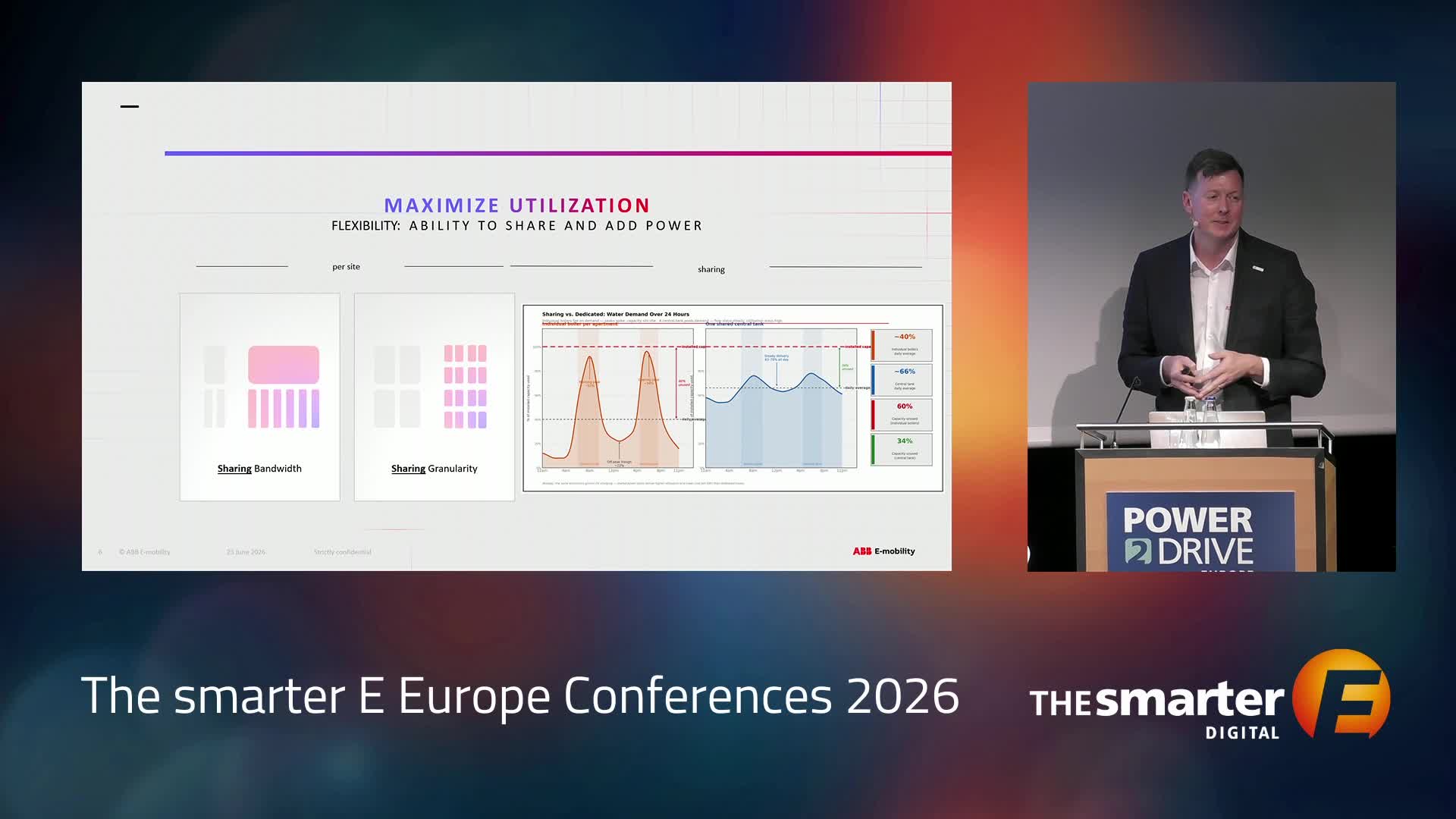
Recording of Tuesday, June 23, 2026 | The smarter E Europe Conferences 2026 | Language: English | Duration: 12:43 .
Achieving an optimal cost per kilowatt hour for electric vehicle (EV) charging is essential for expanding EV production in Europe and North America. Significant challenges in the EV industry include securing capital due to competition with data centers, high risks, and uncertain returns. Strategies to minimize risk and enhance returns focus on critical operational factors such as operational expenditure, energy loss, and equipment downtime. Effective energy delivery in EV charging requires matching energy supply with actual demand, particularly during peak requirements. Infrastructure for EV chargers often faces underutilization issues, resulting in wasted investments and financial losses. Maintaining high uptime is crucial; a 1% decrease in availability can lead to substantial downtime losses. Additionally, investment in durable hardware and standardized site blueprints can enhance operational efficiency and user confidence. The discourse also emphasizes the need for adaptable platform architecture to address both current challenges and future opportunities in energy delivery.
Automated summarization by AI Conver
Speaker
Christopher Thompson
Head of Product & Portfolio Marketing
ABB E-Mobility GmbH
Switzerland
For more than two decades, Norway has been steadily building a marketplace for electric transport. Having started out with inexpensive short-range electric cars and household charging sockets, Norway has now moved to mass-market solutions where fast charging (DC) and grid balancing (AC) plays an ever more vital role. With more than 1,000,000 electric cars and over 10,000 fast chargers in a relatively small market, Norway offers a rare early view of large-scale electrification. Over the past decade, electric cars have seen substantial improvements, which is now making it easier for new markets to advance electrification. At the same time, Norway has to deal with challenges years before other markets do. Yet despite different starting points, we can see that most markets are facing the same core challenges. From grid-smart charging strategies to innovative business models, there are excellent examples of best practices emerging elsewhere in Europe. What will the next thing in electrification be, both in mature and in emerging markets? And what will be possible when the right people and companies come together, sharing knowledge, solving common problems and accelerating the shift to cleaner mobility?
Further Talks of this session:
Speaker
Ståle Frydenlund
Senior Advisor / Test Manager
Norwegian EV Association
Speaker
Alexandra Aarvold Rastad
Advisor
Norwegian EV Association
Norway
Speaker
Paul Pschierer-Barnfather
EV Charging Solutions Expert
Zaptec Charger AS
Norway
Speaker
Nassir Farooq
CEO
EV Hub
Norway
Speaker
Marte Stamland
Business Development Manager
Hydrovolt
Norway