From Standalone Projects to Hybrid Power Plants: Co-Location of PV and Storage in Practice

premium account

Recording from Tuesday, October 13, 2026 | Intersolar Summit Romania | Language: English | Duration: 70:09 .

From Standalone Projects to Hybrid Power Plants: Co-Location of PV and Storage in Practice

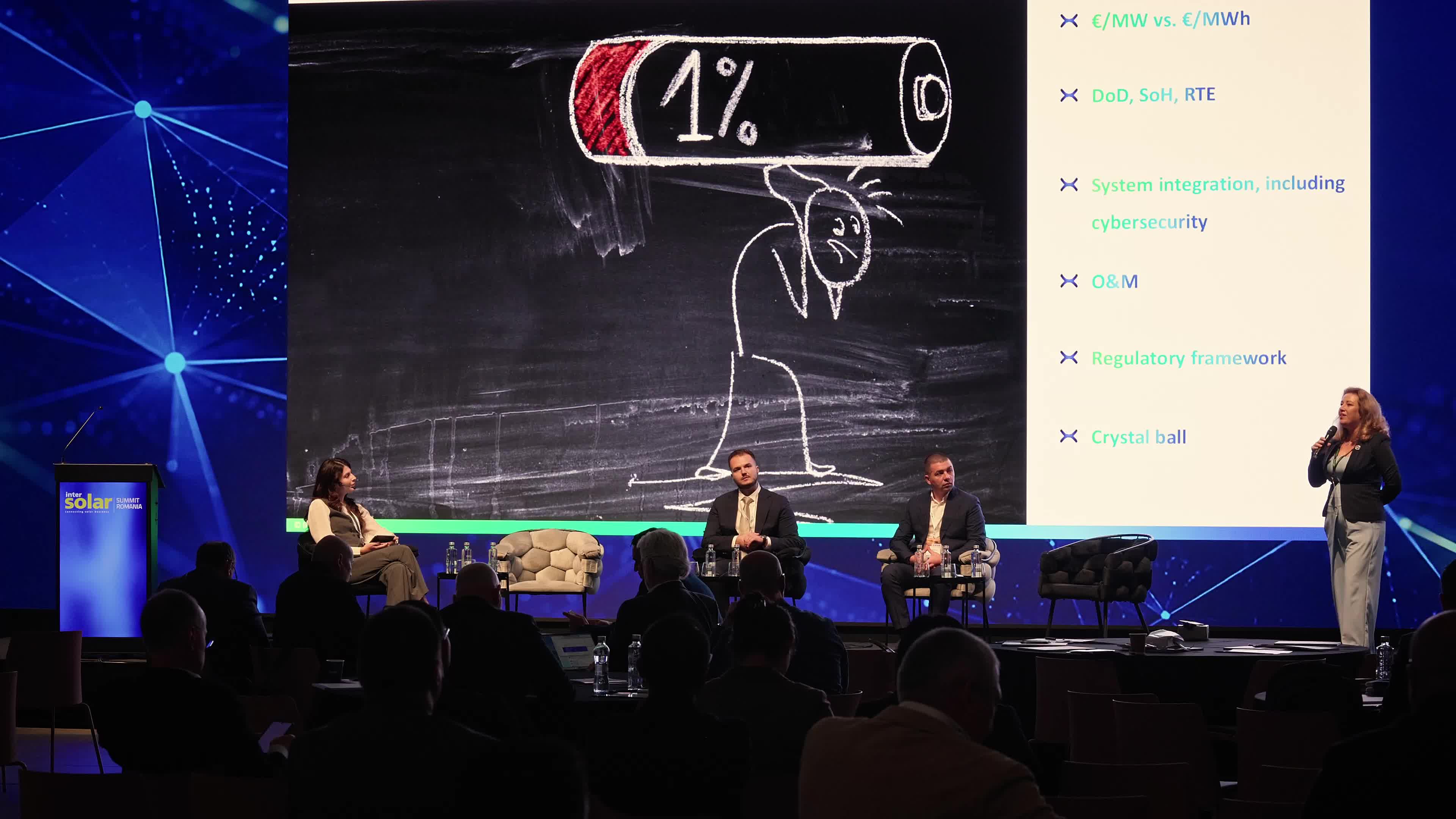
Vasiliki Sionti, Advisory Senior Associate at Aurora Energy Research, moderated a discussion with Mariyana Yaneva, Chief Operating Officer at IPS; George-Alexandru Drobot, Managing Director at SUNOTEC; and Paul Moldovan, Founder at Parapet. Yaneva described Bulgaria’s battery-storage expansion, explaining how solar growth, midday price declines and evening peaks created a need for storage, while funding, permitting reforms and market rules helped drive installations to 6 gigawatts of battery power by the end of September. She said storage has helped move surplus solar energy into evening demand, supported solar capture prices and reduced negative-price days, while emphasizing that investors must account for operating costs, performance under site conditions, cybersecurity, maintenance and changing regulations. Drobot presented SUNOTEC’s approach to integrated energy systems, arguing that coordinated engineering, grid infrastructure, storage and lifecycle management matter more than delivering disconnected assets; he highlighted long-term service agreements, capacity and availability guarantees, efficiency, augmentation and grid-code compliance. In the panel, the speakers discussed risks at the PV-BESS interface, including grid connection, control systems, SCADA integration and divided responsibilities among suppliers, and stressed that projects should be designed for future market and grid requirements rather than only for rapid commissioning. Yaneva said future hybrid projects will depend on partnerships across hardware, software and operations, and pointed to grid-forming inverters, local capabilities, public engagement and coupling generation with demand such as data centers as areas to consider. In closing, the speakers recommended careful design, independent engineering review, planning for long-term operation and maintenance, and choosing a reliable grid connection.

Automated summarization by AI Conver

Speaker

Vasiliki Sionti
Advisory Senior Associate
Aurora Energy Research

Mariyana Yaneva
Chief Operating Officer
IPS

George-Alexandru Drobot
Managing Director
SUNOTEC

Paul Moldovan
Founder
Parapet

Increasing grid congestion, rising price volatility, and growing requirements for system stability are driving the development of photovoltaic projects in combination with battery storage systems.

In fast-growing markets such as Romania in particular, the co-location of PV and BESS is gaining importance against the backdrop of increasing grid constraints, higher solar penetration, and greater market volatility. This session highlights PV + BESS co-location as a key development trend in the market.

Topics include technical design strategies, key economic decision factors, and regulatory frameworks for hybrid projects. A central focus is the question of under what local conditions co-location improves bankability, and how can project developers successfully transition from traditional PV plants to hybrid assets.

Further Content
Publications
From Module To Integrated System: These Trends Are Shaping The Solar Industry In 2026

October 2, 2026

The 2026 Intersolar whitepaper highlights solar energy as the dominant power source, all-in-one systems, and key European market trends.

David Wortmann and Salomé Perperot
New Policy Reforms Could Shrink Germany’s Solar Market

The smarter E Podcast Episode 267 | Language: English

October 15, 2026

How will upcoming EEG reforms reshape Germany’s solar market? David Wortmann and Salomé Perperot discuss the energy shift and batteries.

Intersolar Middle East Conference 2026
Cybersecurity in the Digital Energy Transition: Building Resilient Energy Systems

Wednesday, September 02, 2026, 01:15 pm

Intersolar Middle East Conference 2026 | Conference Program

premium account

Discover how advanced digital technologies are transforming solar operations. This session explores AI-driven analytics, IoT-enabled monitoring, and blockchain-based transparency to optimize performance, streamline maintenance, and enhance profitability. Learn how smart grids and data intelligence are shaping the next generation of efficient, resilient solar energy systems.

Intersolar Middle East Conference 2026
Welcome & Keynote: Policy, Regulation & Finance

Wednesday, September 02, 2026, 02:30 pm

Intersolar Middle East Conference 2026 | Conference Program

premium account

This session explores how effective policy frameworks, streamlined regulations, and innovative financing solutions can work together to accelerate the global expansion of solar energy. Bringing together perspectives from policymakers, investors, and industry leaders, it will examine how supportive regulatory environments reduce investment risk, attract private capital, and enable the successful development of solar and hybrid energy projects. Through best practices, emerging funding mechanisms, and real-world case studies, participants will gain practical insights into mobilizing capital, fostering investor confidence, and creating the conditions for sustainable growth across both established and emerging solar markets.

Intersolar Middle East Conference 2026
Harnessing DC Connections: The Hidden Risks of PV Systems

Thursday, September 03, 2026, 12:45 pm

Intersolar Middle East Conference 2026 | Conference Program

premium account

Explore strategies for maximizing the resilience, performance, and sustainability of solar assets throughout their entire lifecycle. This session brings together best practices in resilient system design, advanced monitoring, predictive operations and maintenance (O&M), and asset lifetime optimization with circular economy approaches such as PV panel recycling, battery repurposing, and ESG-driven business strategies. Learn how innovation, digitalization, and evolving regulations are helping the industry improve reliability, extend asset value, recover critical materials, and reduce environmental impact while creating more sustainable and profitable solar ecosystems.

You are using an outdated browser

The website cannot be viewed in this browser. Please open the website in an up-to-date browser such as Edge, Chrome, Firefox, or Safari.