Recording of Tuesday, June 18, 2024 | The smarter E Europe | Conference Program | Language: English | Duration: 18:52 .
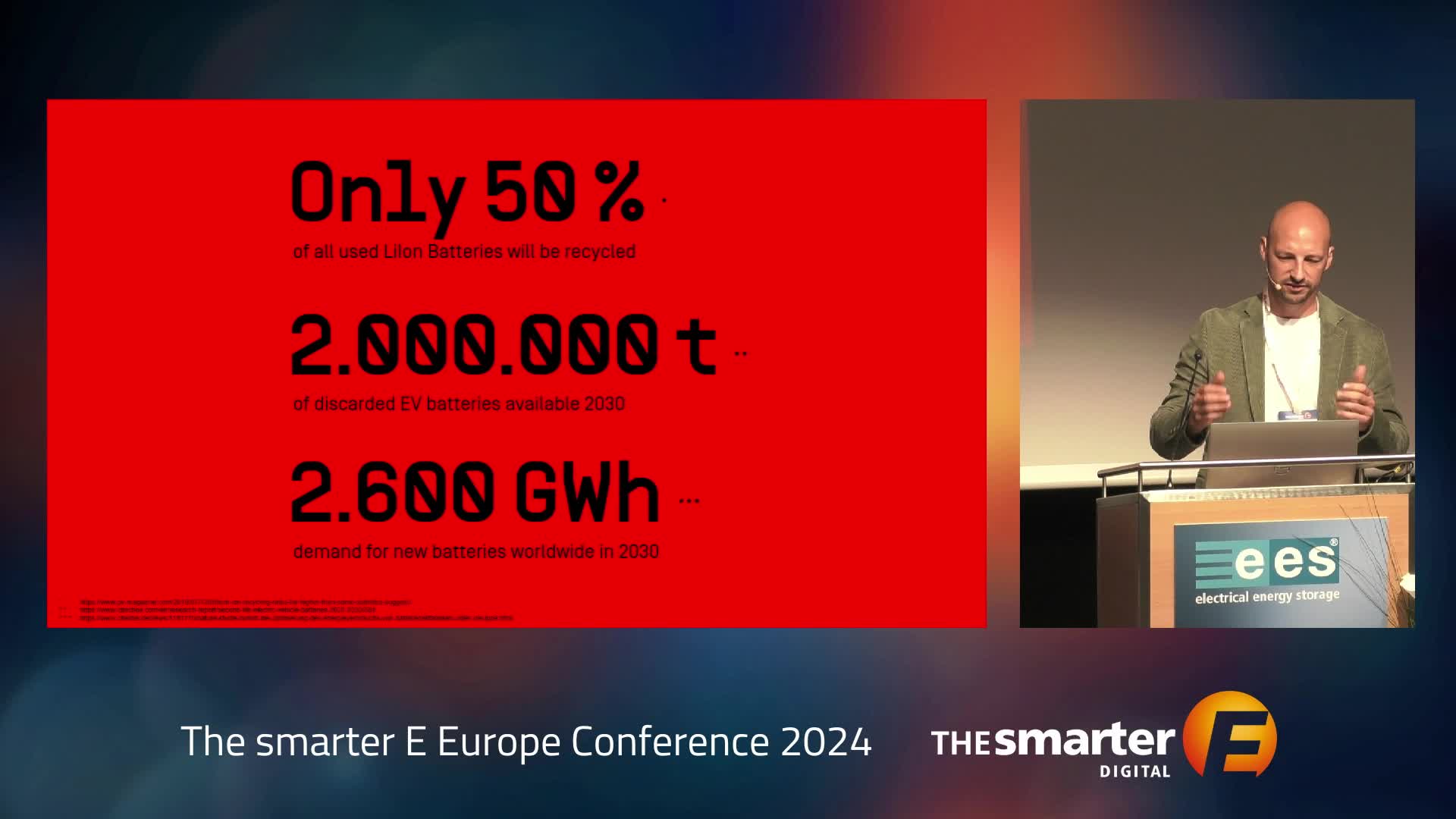
The discussion emphasizes the importance of sustainable energy storage, particularly through second-life batteries derived from electric vehicles (EVs) and other machines. e.battery systems has entered this field to promote a circular economy and reduce CO2 emissions as global energy consumption continues to rise. The process involves repurposing used lithium-ion batteries, whose recycling rates currently stand at about 50-60%, although more are expected by 2030. Safety tests have shown that second-life batteries can be as safe—or even safer—than new ones due to higher burn temperatures and stable gas emissions. Environmental impact studies reveal multiple benefits with minor drawbacks compared to first-life batteries. However, widespread adoption faces several challenges including regulatory hurdles, economic uncertainties around warranties for used products, social acceptance issues, and limited technical data provided by original equipment manufacturers (OEMs). To address these challenges, eBattery System employs multi-level inverter technology developed in partnership with a Munich-based company. This approach allows them to use entire battery modules without disassembly while ensuring accurate State of Health (SOH) assessments through sophisticated software algorithms within a rapid testing framework. Moreover, the innovative multi-level inverter simulates sinus curves effectively despite varying SOHs among individual cells; thus optimizing performance reliably across mixed-battery configurations.
Automated summarization by AI Conver
Christopher Schöpf
CSO
e.battery systems AG
Austria
The storage industry is being driven by needs from a wide range of areas: lower prices, longer life, second life of EV batteries, higher efficiencies and much more. Innovations in technology are providing answers to these questions. In this session, you will learn what innovations are coming next.
Further Talks of this session:
Speaker
Roman Stübler
Head of R&D ESS
VARTA Storage GmbH
Germany
Speaker
Iola Hughes
Head of Research
Rho Motion
United Kingdom
Speaker
Roman Alberti
Managing Director
Voltfang GmbH
Germany
Speaker
Conor Power
Product Line Director
Analog Devices
Ireland
Speaker
Roman Stübler
Head of R&D ESS
VARTA Storage GmbH
Germany