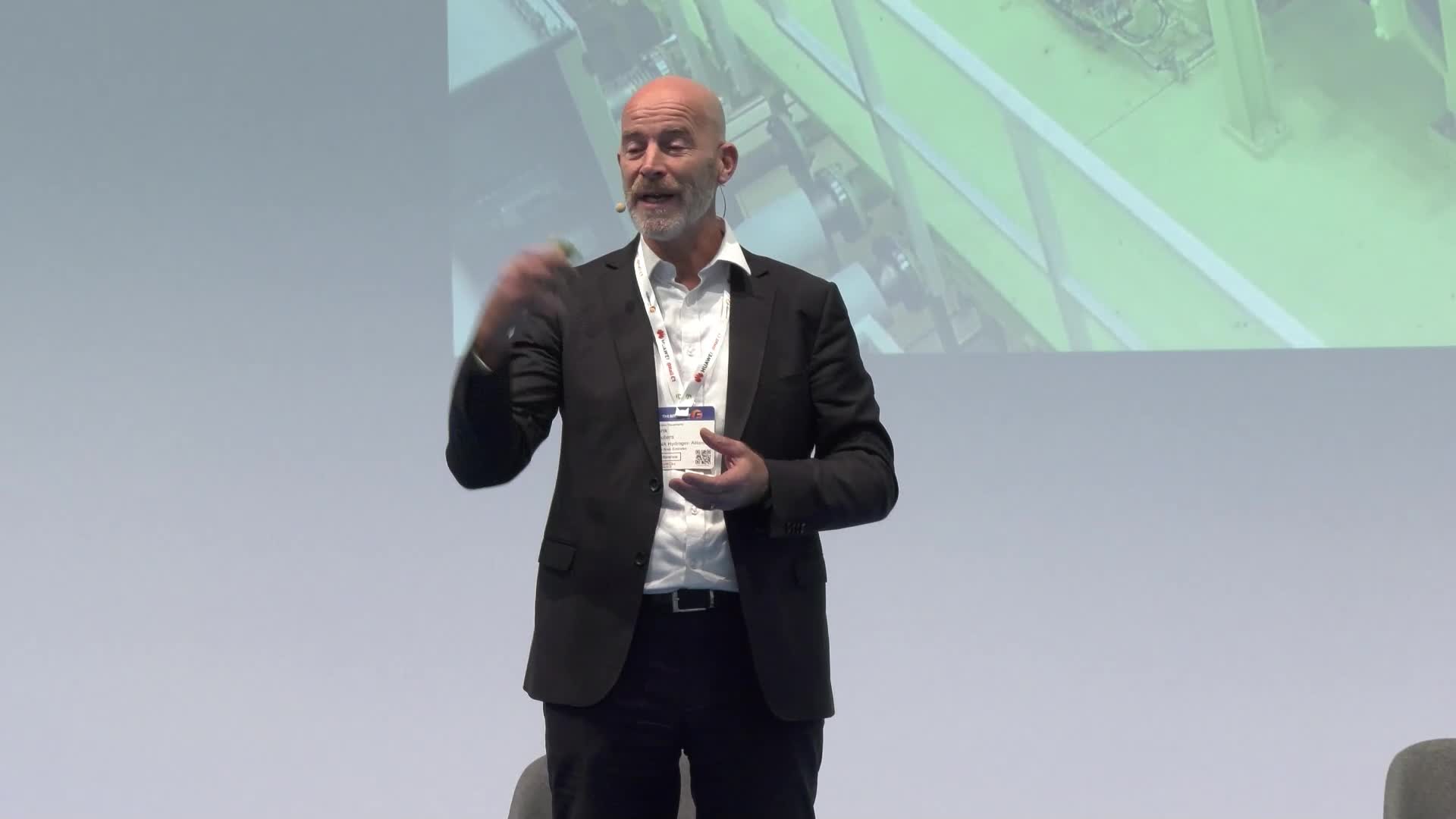
The Case for Green Ammonia and How to Build a Hydrogen Market

premium account

Recording of Thursday, June 20, 2024 | The smarter E Europe 2024 | Exhibition Program | Language: English | Duration: 23:23 .

Ammonia: The Future of Green Energy Across Marine, Aviation, and Power Sectors

This year marks a celebration of progress toward alternative energy sources, spurred initially by the 1974 oil price shock. Recent strides include the EU's hydrogen accelerator launched following Russia's invasion two years ago to enhance energy independence and supply. An advocate for solar energy and hydrogen over the past decades, I recently discovered ammonia as a promising green fuel. Ammonia can be produced using nitrogen from air and hydrogen from water with green electricity through the Haber-Bosch process. Ammonia serves as both a fertilizer and an explosive but is increasingly recognized for its potential in various applications due to its properties as a hydrogen carrier. For instance, Namibia could produce large quantities of hydrogen transported via ammonia. Innovative uses are emerging globally: AGC in Japan tested glass production using ammonia; Berke in the Netherlands developed steam boilers running on it; marine transport could switch from polluting bunker fuels to ammonia engines significantly reducing emissions, demanding tripling current global production; aviation potentially adopting jet engines running on ammonia would require similarly high increases in production. The power sector also sees potential, with Japan conducting tests co-firing pulverized coal plants with up to 20% ammonia aiming eventually at full conversion leading manufacturers like IHI, MHI, GE developing direct combustion gas turbines for efficient usage.

Automated summarization by AI Conver

Frank Wouters
Chairman
MENA Hydrogen Alliance
UAE

Hydrogen is both a domestic and international resource. Looking at the globe, where are the promised lands? What can they contribute to EU's energy economy? And what is Europe's role in this economy still to be built? After a keynote with global scope, the session presents selected countries with their ongoing projects or prospects.

Further Talks of this session:

Speaker

Julia Seitz
Research Associate to the Division Director Hydrogen Technologies
Fraunhofer-Institute for Solar Energy Systems ISE
Germany

To Talk

Speaker

Prof. Dr. Christopher Hebling
Director Division Hydrogen Technologies
Fraunhofer Institute for Solar Energy Systems ISE
Germany

To Talk

Speaker

Markus Vlasits
Managing Director
NewCharge
Germany

To Talk

Speaker

Eva Meschede
Advisor, H2Uppp - International Hydrogen Ramp-Up Program, implemented by
GIZ - Deutsche Gesellschaft für Internationale Zusammenarbeit
India

To Talk

Further Content
Webinar
Mixed Investment Solar Projects in Mexico: The 54% Model Explained

January 29, 2026

Mexico has introduced a new mixed investment scheme for renewable power generation, requiring a minimum 54% direct or indirect participation by CFE.

Anna Darmani, Principal Analyst from Wood Mackenzie
Big BESS Is Here to Save the Day

The smarter E Podcast Episode 246 | Language: English

January 8, 2026

Utility-scale batteries are booming in Europe. Discover key BESS trends, market impacts, and what to expect for large-scale storage in 2026.

Business Visibility
Sponsoring & Marketing Overview

All sponsorship and marketing opportunities at a glance: Find the ideal marketing mix for your company.

The smarter E Europe Conferences 2025
Factors That Influence the Success of a Minigrid Project

Wednesday, May 07, 2025, 11:00 am - 12:30 pm

The smarter E Europe Conferences 2025 | Conference Program

premium account

Off-grid solar systems are often the least expensive option for rural electrification. Solar home systems can power individual households, while mini-grids can supply entire villages. Each comes with its own advantages, disadvantages, and challenges. The aim of this session is to explore challenges as well as success stories. It takes well-functioning components such as battery systems, charge management and inverters to make projects successful. Proper system sizing, maintenance and repair management, as well as a robust financial concept are also necessary. If one of these elements is missing, the electrification will not be sustainable. This session will focus on the aspects mentioned above. The speakers will present successful and unsuccessful approaches and discuss what can be learned from them.

The smarter E Europe Conferences 2025
Setting the Scene "Off-Grid"

Wednesday, May 07, 2025, 04:00 pm - 05:30 pm

The smarter E Europe Conferences 2025 | Conference Program

premium account

Photovoltaic prices have fallen continuously in recent years - a trend that should translate into a growing market for off-grid solutions. Declining costs are crucial for rural electrification in particular, making sustainable energy supply economically viable in remote regions. However, so far many of these price advantages have not yet reached the people that need them most. Do existing framework conditions to foster rural electrification still work in this new market reality? Which measures are needed to ensure that cost reductions reach our target group? This session discusses strategies for improving the availability of low-cost off-grid solutions, financing and innovative business models. A look at successful practical examples shows which political, economic and technological levers need to be pulled to make off-grid PV accessible on a large scale.

You are using an outdated browser

The website cannot be viewed in this browser. Please open the website in an up-to-date browser such as Edge, Chrome, Firefox, or Safari.