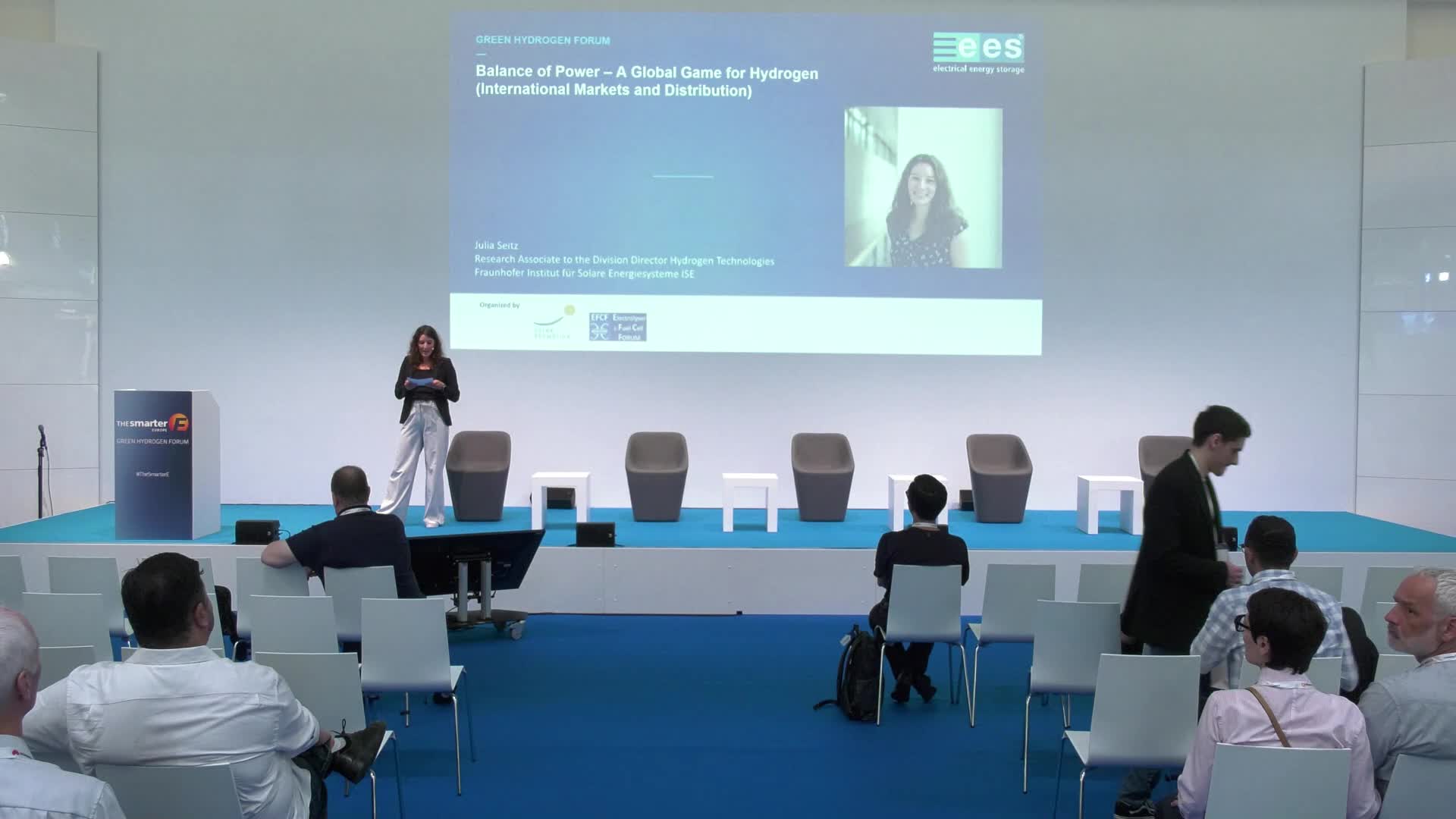
Welcome and Introduction into the Session

premium account

Recording of Thursday, June 20, 2024 | The smarter E Europe 2024 | Exhibition Program | Language: English | Duration: 3:05 .

Balance of Power: Exploring the Global Hydrogen Market and Europe's Role in a Sustainable Energy Future with Prof. Dr. Christopher Hebling

The session titled "Balance of Power, a global game for hydrogen" addresses the critical role of hydrogen in stabilizing power systems amid fluctuating renewable energy availability. The moderator underscores the significance of energy storages and how hydrogen can effectively balance power systems, marking it as pivotal in transitioning to sustainable energy futures. Hydrogen is highlighted as both a domestic and international resource requiring strategic supplier countries that could contribute significantly to Europe’s energy economy. The session aims to explore various dimensions of the global hydrogen markets including economic costs, transportable volumes, infrastructure needs, and policy frameworks essential for market development. Emphasis is placed on the rapid evolution and substantial potential within the billion-dollar global hydrogen market which includes diverse vectors such as liquid hydrogen, ammonia, and e-fuels influenced by regional dynamics. However, there remains a gap between strategy formation or agreements and actionable implementations necessitating effective government incentives. Prof. Dr. Christopher Hebling from Fraunhofer Institute for Solar Energy Systems ISE in Germany will provide an expert's perspective on these issues due to his extensive involvement in international hydrogen strategies.

Automated summarization by AI Conver

Julia Seitz
Research Associate to the Division Director Hydrogen Technologies
Fraunhofer-Institute for Solar Energy Systems ISE
Germany

Hydrogen is both a domestic and international resource. Looking at the globe, where are the promised lands? What can they contribute to EU's energy economy? And what is Europe's role in this economy still to be built? After a keynote with global scope, the session presents selected countries with their ongoing projects or prospects.

Further Talks of this session:

Speaker

Prof. Dr. Christopher Hebling
Director Division Hydrogen Technologies
Fraunhofer Institute for Solar Energy Systems ISE
Germany

To Talk

Speaker

Frank Wouters
Chairman
MENA Hydrogen Alliance
UAE

To Talk

Speaker

Markus Vlasits
Managing Director
NewCharge
Germany

To Talk

Speaker

Eva Meschede
Advisor, H2Uppp - International Hydrogen Ramp-Up Program, implemented by
GIZ - Deutsche Gesellschaft für Internationale Zusammenarbeit
India

To Talk

Further Content
Webinar
Mixed Investment Solar Projects in Mexico: The 54% Model Explained

January 29, 2026

Mexico has introduced a new mixed investment scheme for renewable power generation, requiring a minimum 54% direct or indirect participation by CFE.

Anna Darmani, Principal Analyst from Wood Mackenzie
Big BESS Is Here to Save the Day

The smarter E Podcast Episode 246 | Language: English

January 8, 2026

Utility-scale batteries are booming in Europe. Discover key BESS trends, market impacts, and what to expect for large-scale storage in 2026.

Business Visibility
Sponsoring & Marketing Overview

All sponsorship and marketing opportunities at a glance: Find the ideal marketing mix for your company.

Alex Barrows, Molly Morgan, Sonia Dunlop
Inside 2026’s PV Pricing Reset

The smarter E Podcast Episode 247 | Language: English

January 22, 2026

Solar PV prices shift after years of oversupply. This episode covers supply-chain pressures, tech competition, and 2026 market impacts.

The smarter E Europe Conferences 2025
Factors That Influence the Success of a Minigrid Project

Wednesday, May 07, 2025, 11:00 am - 12:30 pm

The smarter E Europe Conferences 2025 | Conference Program

premium account

Off-grid solar systems are often the least expensive option for rural electrification. Solar home systems can power individual households, while mini-grids can supply entire villages. Each comes with its own advantages, disadvantages, and challenges. The aim of this session is to explore challenges as well as success stories. It takes well-functioning components such as battery systems, charge management and inverters to make projects successful. Proper system sizing, maintenance and repair management, as well as a robust financial concept are also necessary. If one of these elements is missing, the electrification will not be sustainable. This session will focus on the aspects mentioned above. The speakers will present successful and unsuccessful approaches and discuss what can be learned from them.

You are using an outdated browser

The website cannot be viewed in this browser. Please open the website in an up-to-date browser such as Edge, Chrome, Firefox, or Safari.