The Future of Megawatt Charging: Overview of MCS's Role in the Commercial Vehicle Sector

Premium Account

Recording of Wednesday, May 07, 2025 | The smarter E Europe | Conference Program | Language: English | Duration: 13:42 .

Electrified Trucking's Future Hinges on MCS Charging and Collaborative Infrastructure Efforts

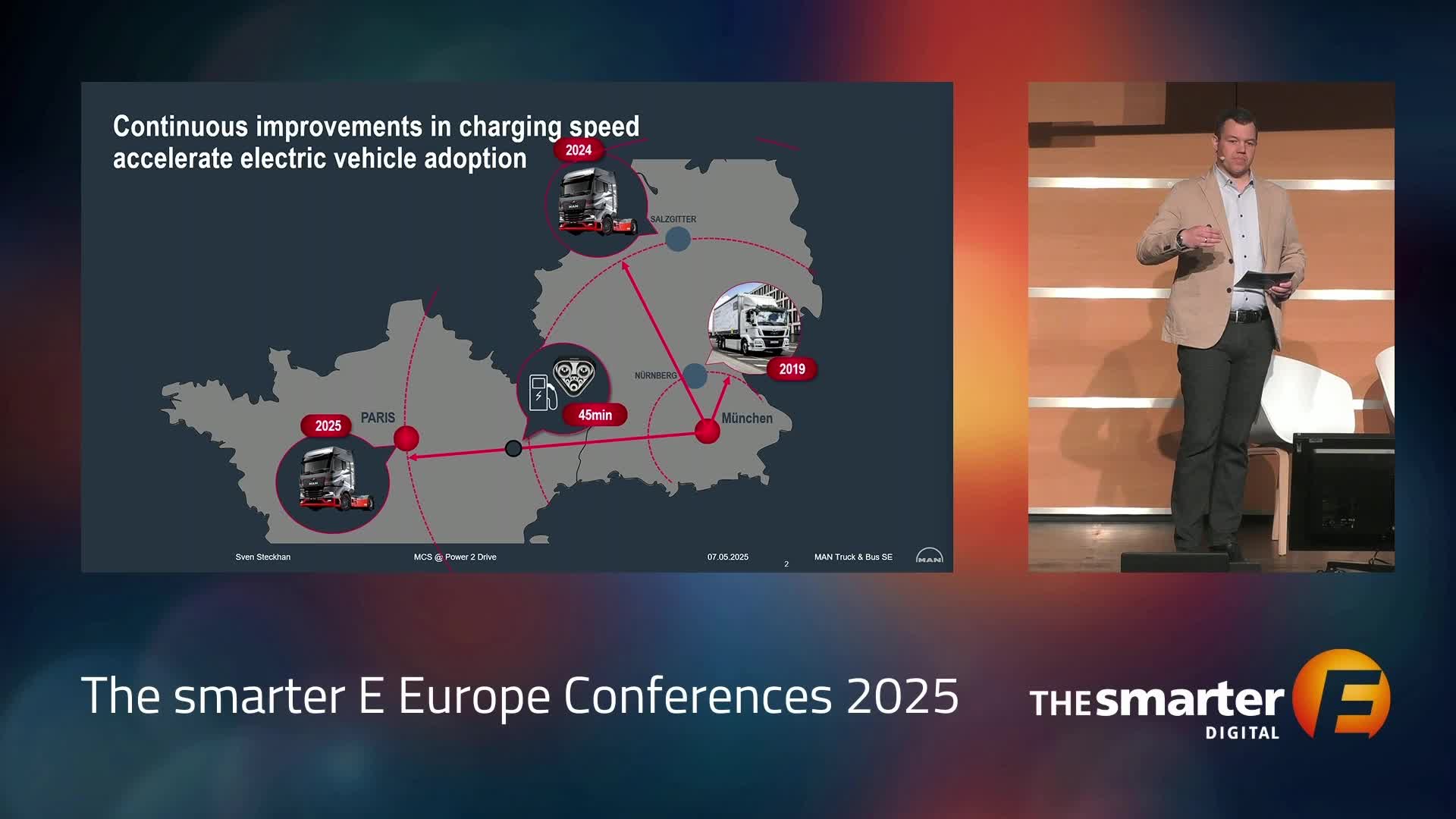
The transition to electrified trucking is a significant challenge requiring collaboration among grid suppliers, OEMs, customers, and charge point operators. Electrified trucks have been on the roads since 2019 with initial models offering 150 kilowatt charging power suitable for urban distribution. By 2024, advancements allowed for easy long haulage through depot charging despite limited public infrastructure. The demand for Megawatt Charging System (MCS) technology arises primarily in extreme long-haul scenarios where rapid recharging within legal driving limits is crucial. Current trucks achieve up to two million kilometers with minimal failures using CCS systems; however, future models aim at integrating MCS technology once standards are finalized—targeting up to 750 kilowatts of power by 2025 while balancing customer needs against practical energy demands around one megawatt capacity being optimal presently. Collaborative efforts across industry stakeholders continue fostering sustainable growth opportunities via strategic partnerships enhancing high-power station accessibility throughout Europe supporting burgeoning electric truck adoption rates effectively meeting diverse clientele requirements efficiently amidst evolving market conditions globally.

Automatisierte Zusammenfassung durch AI Conver

Sven Steckhan
Senior Manager - Program Lead Charging
MAN Truck & Bus SE
Germany

This session will explore the latest advancements in high-speed megawatt charging, questioning whether current capabilities have reached their peak or if further innovation is possible. The discussions will center on megawatt charging technologies, exploring their future potential in the heavy-duty vehicle market, alongside the challenges of integrating these systems with the electricity grid and ensuring adequate capacity at charging stations.

Further Talks of this session:

Speaker

Sebastian Lahmann
Head of Team Implementing
National Center for Charging Infrastructure / NOW GmbH
Germany

Recording was not authorized for publication.

Speaker

Christopher Thompson
Head of Product Marketing
ABB E-Mobility GmbH
Switzerland

To Talk

Tobias Wagner

To Talk

Speaker

Kathrin Walz
Smart Grid Engineer
Netze BW GmbH
Germany

Christopher Thompson
Head of Product Marketing
ABB E-Mobility GmbH
Switzerland

Sven Steckhan
Senior Manager - Program Lead Charging
MAN Truck & Bus SE
Germany

Sebastian Lahmann
Head of Team Implementing
National Center for Charging Infrastructure / NOW GmbH
Germany

Dr. Till Kreft
Manager Public Affairs
Milence
Germany

Recording was not authorized for publication.

Weiterführende Inhalte
Thomas Raffeiner and Petrouschka Werther
What EV Acceleration Means for the Grid

The smarter E Podcast Episode 260 | Language: English

July 9, 2026

Cars as batteries on wheels: Thomas Raffeiner and Petrouschka Werther discuss how V2G and smart charging turn EVs into critical grid assets.

The smarter E Europe Conferences 2026
Lessons From a Recycler in a First-Moving Market

Tuesday, June 23, 2026, 02:30 pm

The smarter E Europe Conferences 2026 | Conference Program

Premium Account

For more than two decades, Norway has been steadily building a marketplace for electric transport. Having started out with inexpensive short-range electric cars and household charging sockets, Norway has now moved to mass-market solutions where fast charging (DC) and grid balancing (AC) plays an ever more vital role. With more than 1,000,000 electric cars and over 10,000 fast chargers in a relatively small market, Norway offers a rare early view of large-scale electrification. Over the past decade, electric cars have seen substantial improvements, which is now making it easier for new markets to advance electrification. At the same time, Norway has to deal with challenges years before other markets do. Yet despite different starting points, we can see that most markets are facing the same core challenges. From grid-smart charging strategies to innovative business models, there are excellent examples of best practices emerging elsewhere in Europe. What will the next thing in electrification be, both in mature and in emerging markets? And what will be possible when the right people and companies come together, sharing knowledge, solving common problems and accelerating the shift to cleaner mobility?

The smarter E Europe Conferences 2026
Vehicle to Grid: From Idea to Reality

Tuesday, June 23, 2026, 02:30 pm

The smarter E Europe Conferences 2026 | Conference Program

Premium Account

For more than two decades, Norway has been steadily building a marketplace for electric transport. Having started out with inexpensive short-range electric cars and household charging sockets, Norway has now moved to mass-market solutions where fast charging (DC) and grid balancing (AC) plays an ever more vital role. With more than 1,000,000 electric cars and over 10,000 fast chargers in a relatively small market, Norway offers a rare early view of large-scale electrification. Over the past decade, electric cars have seen substantial improvements, which is now making it easier for new markets to advance electrification. At the same time, Norway has to deal with challenges years before other markets do. Yet despite different starting points, we can see that most markets are facing the same core challenges. From grid-smart charging strategies to innovative business models, there are excellent examples of best practices emerging elsewhere in Europe. What will the next thing in electrification be, both in mature and in emerging markets? And what will be possible when the right people and companies come together, sharing knowledge, solving common problems and accelerating the shift to cleaner mobility?

The smarter E Europe Conferences 2026
How Optimized Lifetime Site Economics and Architecture Guaranteeing Lowest Cost per KW/H and Highest Up-Time and Reliability

Tuesday, June 23, 2026, 02:30 pm

The smarter E Europe Conferences 2026 | Conference Program

Premium Account

For more than two decades, Norway has been steadily building a marketplace for electric transport. Having started out with inexpensive short-range electric cars and household charging sockets, Norway has now moved to mass-market solutions where fast charging (DC) and grid balancing (AC) plays an ever more vital role. With more than 1,000,000 electric cars and over 10,000 fast chargers in a relatively small market, Norway offers a rare early view of large-scale electrification. Over the past decade, electric cars have seen substantial improvements, which is now making it easier for new markets to advance electrification. At the same time, Norway has to deal with challenges years before other markets do. Yet despite different starting points, we can see that most markets are facing the same core challenges. From grid-smart charging strategies to innovative business models, there are excellent examples of best practices emerging elsewhere in Europe. What will the next thing in electrification be, both in mature and in emerging markets? And what will be possible when the right people and companies come together, sharing knowledge, solving common problems and accelerating the shift to cleaner mobility?

The smarter E Europe Conferences 2026
Policy Guidelines and the Experiences of Electric Vehicle Drivers

Tuesday, June 23, 2026, 02:30 pm

The smarter E Europe Conferences 2026 | Conference Program

Premium Account

For more than two decades, Norway has been steadily building a marketplace for electric transport. Having started out with inexpensive short-range electric cars and household charging sockets, Norway has now moved to mass-market solutions where fast charging (DC) and grid balancing (AC) plays an ever more vital role. With more than 1,000,000 electric cars and over 10,000 fast chargers in a relatively small market, Norway offers a rare early view of large-scale electrification. Over the past decade, electric cars have seen substantial improvements, which is now making it easier for new markets to advance electrification. At the same time, Norway has to deal with challenges years before other markets do. Yet despite different starting points, we can see that most markets are facing the same core challenges. From grid-smart charging strategies to innovative business models, there are excellent examples of best practices emerging elsewhere in Europe. What will the next thing in electrification be, both in mature and in emerging markets? And what will be possible when the right people and companies come together, sharing knowledge, solving common problems and accelerating the shift to cleaner mobility?

Sie verwenden einen veralteten Browser

Die Website kann in diesem Browser nicht angezeigt werden. Bitte öffnen Sie die Website in einem aktuellen Browser wie Edge, Chrome, Firefox oder Safari.