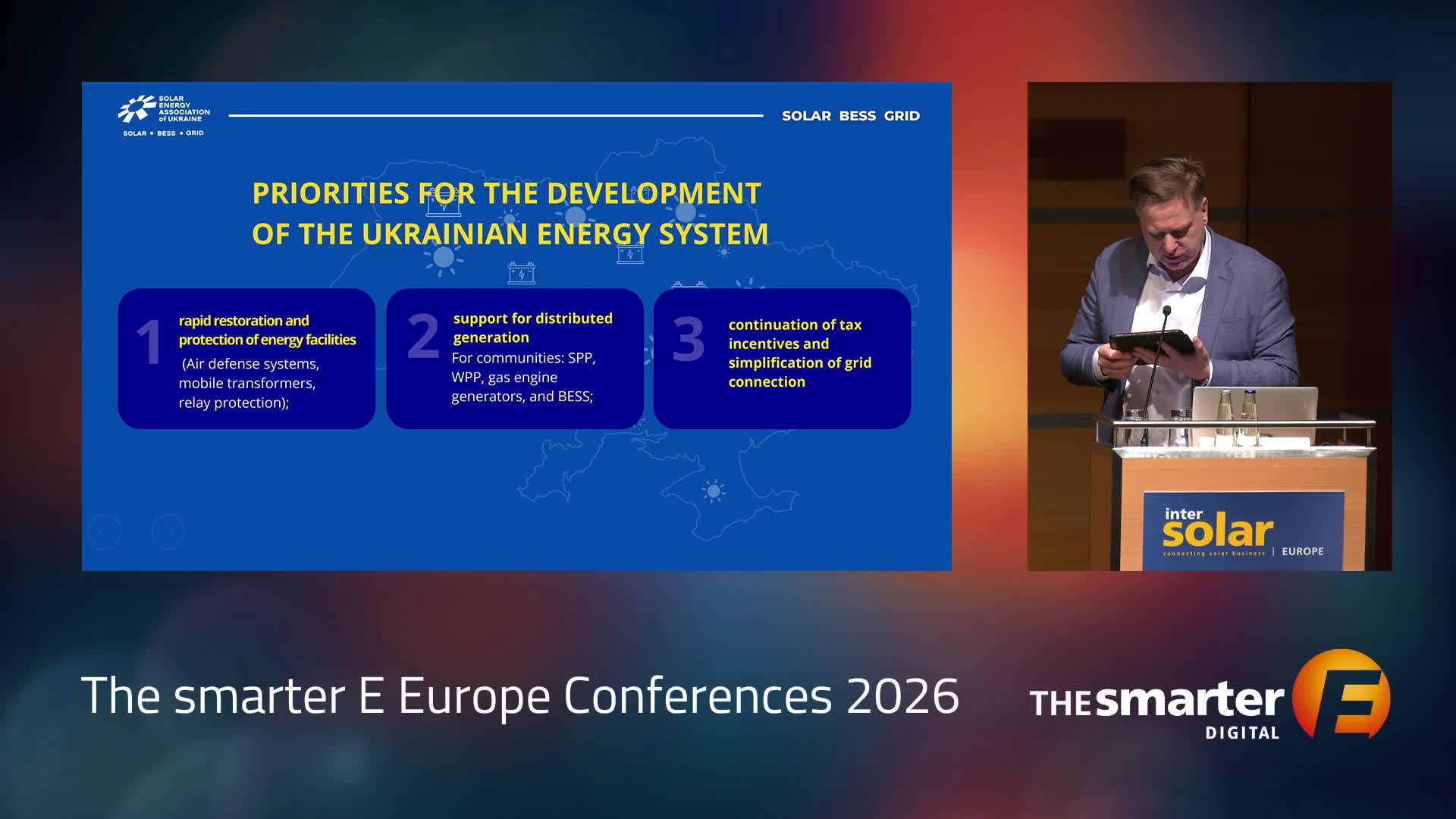
Recording of Tuesday, June 23, 2026 | The smarter E Europe Conferences 2026 | Language: English | Duration: 14:16 .
Ukraine’s energy sector is shifting from a centralized system toward a more distributed and resilient model, with solar power and battery storage becoming increasingly important. The war has destroyed or damaged up to 50% of Ukraine’s energy capacity, causing power shortages, outages, and greater reliance on electricity imports. Ukraine needs up to 10 GW of new or restored capacity, and while solar cannot replace everything, solar PV combined with batteries is one of the fastest solutions to deploy. Solar and storage are growing quickly. In 2024, Ukraine installed about 800 MW of new solar capacity. In 2025, this increased to more than 1.5 GW of solar PV and at least 1 GWh of battery storage. Total solar capacity is now estimated at around 8.5 GW, though the real figure may be higher because many private systems are not officially registered. The main driver is no longer only decarbonization, but energy security. Businesses, households, and municipalities are using batteries to maintain operations during blackouts, reduce electricity costs, and gain more control over supply. Batteries are increasingly replacing diesel generators because they provide faster backup, can store solar power, and support critical services. Examples include solar-plus-storage projects for water supply in Zhytomyr and district heating in Cherkasy. The presentation concludes that solar-plus-battery systems are becoming essential infrastructure for Ukraine’s communities, businesses, and critical services.
Automated summarization by AI Conver
Speaker
Vladyslav Sokolovskyi
Chairman of the Board of the Solar Energy Association of Ukraine
Solar Energy Association of Ukraine
Ukraine
In the wake of Russia's invasion of Ukraine, Europe's energy systems are facing increasing physicaland cyber threats. Strengthening resilience has become a strategic priority. This session explores how solar PV, battery storage and grid-forming technologies can protect critical infrastructure, enhance system stability and support rapid recovery after disruptions. Drawing on lessons from Ukraine and Europe's frontline states, experts will be discussing how decentralized renewables can contribute to energy security.
Key topics:
Further Talks of this session:
Speaker
David Wedepohl
Managing Director International Affairs
BSW - German Solar Association
Speaker
Olga Kovalchuk
Managing Director
Goldbeck Solar
Speaker
Jarand Rystad
CEO
Rystad Energy AS
Norway
Speaker
Walburga Hemetsberger
CEO
SolarPower Europe
Belgium
Speaker
David Wedepohl
Managing Director International Affairs
BSW - German Solar Association
Germany
Vladyslav Sokolovskyi
Chairman of the Board of the Solar Energy Association of Ukraine
Solar Energy Association of Ukraine
Ukraine
Walburga Hemetsberger
CEO
SolarPower Europe
Belgium