Welcome and Introduction

premium account

Recording of Tuesday, June 18, 2024 | The smarter E Europe 2024 | Conference Program | Language: English | Duration: 5:52 .

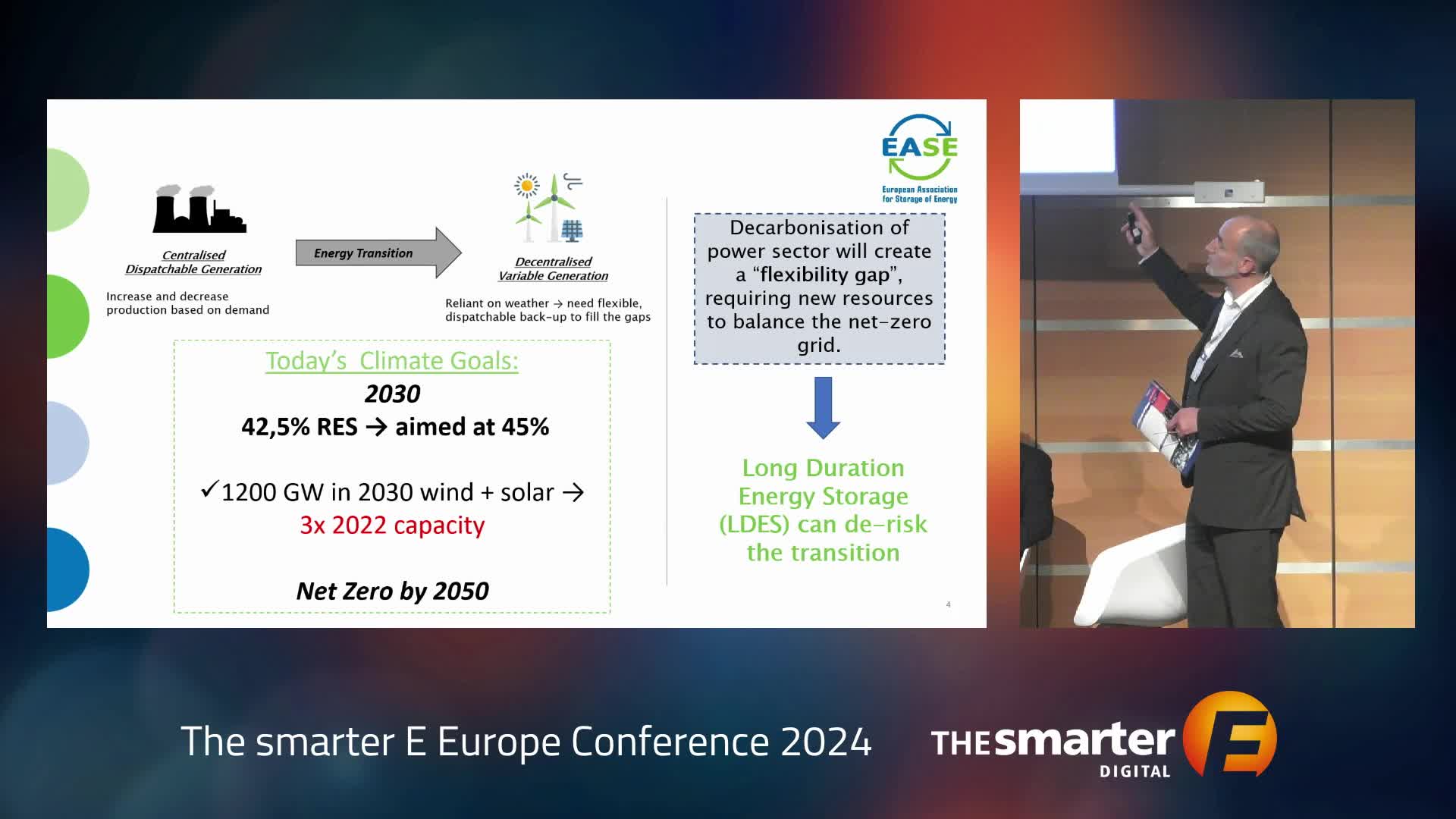
REPowerEU Initiative Targets Tripling Renewable Energy by 2030, Demands Major Storage Investments

In 1922, amidst geopolitical tensions with Russia and Ukraine, Europe faced the need to reduce dependency on imported Russian gas. The European Commission launched "Repower You," aiming to significantly amplify renewable energy capacity by tripling it by 2030—a monumental challenge given the timeline. Countries like Germany exemplified both progress and setbacks in this domain; despite being among leading builders of renewables such as PV and wind power, Germany curtailed a significant amount of energy due to grid inadequacies—10 gigawatt hours last year alone. The European Joint Research Center projected that if current practices persisted ("business as usual"), by 2040 Europe would curtail approximately 310 terawatt hours of electricity annually—equivalent to half the consumption of EU's smallest member states collectively. To counteract this inefficiency, substantial investment in storage is crucial: an estimated need for 200 gigawatts (rising potentially higher) of installed storage capacity by 2030, scaling up to around 600 gigawatts by mid-century. This shift towards enhanced storage could mitigate financial losses from curtailment costs already experienced—for instance, Germany spent €4 billion on curtailment recently. Effective utilization of funds for procuring advanced storage solutions is essential. With these strategic advancements in place, Europe aims not only at bolstering its renewable infrastructure but also ensuring efficient management through improved grid systems and robust storage capacities. Following this framework presentation are four detailed sessions covering specific aspects related to challenges and innovations within Europe's renewable transition landscape; questions will be fielded post-presentations during a dedicated Q&A panel discussion.

Automated summarization by AI Conver

Patrick Clerens
Secretary General
EASE - The European Association for Storage of Energy
Belgium

As the world embraces renewables, and particularly large-scale, variable solar and wind power, grid-scale storage, especially batteries, become key. This session will provide insights into improved network development plans and flexibility strategies, address grid congestion and effective capacity management. Delve into case studies of successful deployment strategies and business models for the seamless integration of storage, enhanced grid stability and optimized energy management. Join us for insightful discussions on the future of energy storage, system costs, integration timelines, and the dynamic landscape of large, grid-scale storage.

Speaker

Marcel Schepers
Product Manager Flexibility Marketing
EnBW Energie Baden-Württemberg AG
Germany

To Talk

Speaker

Klemens Kaar
Development Director
Corre Energy
Germany

To Talk

Speaker

Vitalijus Baranskas
Chief Technical Officer
Energy cells JSC
Lithuania

To Talk

Speaker

Sankara Subramanian
ESS- Utility Market Leader
Saft Batteries
France

To Talk

Speaker

Sankara Subramanian
ESS- Utility Market Leader
Saft Batteries
France

Rimvydas Stilinis
CEO
Energy cells JSC
Lithuania

Marcel Schepers
Product Manager Flexibility Marketing
EnBW Energie Baden-Württemberg AG
Germany

Patrick Clerens
Secretary General
EASE - The European Association for Storage of Energy
Belgium

Klemens Kaar
Development Director
Corre Energy
Germany

To Talk

Further Content
Webinar
Growth of the European Solar Market, Specifically, Romania

February 24, 2026

Webinar: EU Solar Market Overview with Focus on Romania

The smarter E Europe Exhibition Program 2025
DC Microgrids as the Next Frontier in Grid Modernization and DER Integration

Wednesday, May 07, 2025, 11:00 am - 12:25 pm

The smarter E Europe Exhibition Program 2025 | Exhibition Program

premium account

Discover how next-gen distribution grid technologies are addressing the challenges of renewable integration and dynamic energy demands. This session offers insights into the latest developments in AI-driven data analytics and the transformative role of IoT in grid management.

Irene Guerra Gil, Mark Bruno
Staying Home, with Smart Energy Management

The smarter E Podcast Episode 245 | Language: English

December 11, 2025

Irene Guerra Gil and Mark Bruno explain how smart home energy systems and building initiatives cut costs and emissions.

The smarter E Europe Conferences 2025
Factors That Influence the Success of a Minigrid Project

Wednesday, May 07, 2025, 11:00 am - 12:30 pm

The smarter E Europe Conferences 2025 | Conference Program

premium account

Off-grid solar systems are often the least expensive option for rural electrification. Solar home systems can power individual households, while mini-grids can supply entire villages. Each comes with its own advantages, disadvantages, and challenges. The aim of this session is to explore challenges as well as success stories. It takes well-functioning components such as battery systems, charge management and inverters to make projects successful. Proper system sizing, maintenance and repair management, as well as a robust financial concept are also necessary. If one of these elements is missing, the electrification will not be sustainable. This session will focus on the aspects mentioned above. The speakers will present successful and unsuccessful approaches and discuss what can be learned from them.

The smarter E Europe Conferences 2025
Q&A Session of of the Session Off-Grid: Rural Electrification Based on Solar Systems - Lessons Learned

Wednesday, May 07, 2025, 11:00 am - 12:30 pm

The smarter E Europe Conferences 2025 | Conference Program

premium account

Off-grid solar systems are often the least expensive option for rural electrification. Solar home systems can power individual households, while mini-grids can supply entire villages. Each comes with its own advantages, disadvantages, and challenges. The aim of this session is to explore challenges as well as success stories. It takes well-functioning components such as battery systems, charge management and inverters to make projects successful. Proper system sizing, maintenance and repair management, as well as a robust financial concept are also necessary. If one of these elements is missing, the electrification will not be sustainable. This session will focus on the aspects mentioned above. The speakers will present successful and unsuccessful approaches and discuss what can be learned from them.

You are using an outdated browser

The website cannot be viewed in this browser. Please open the website in an up-to-date browser such as Edge, Chrome, Firefox, or Safari.