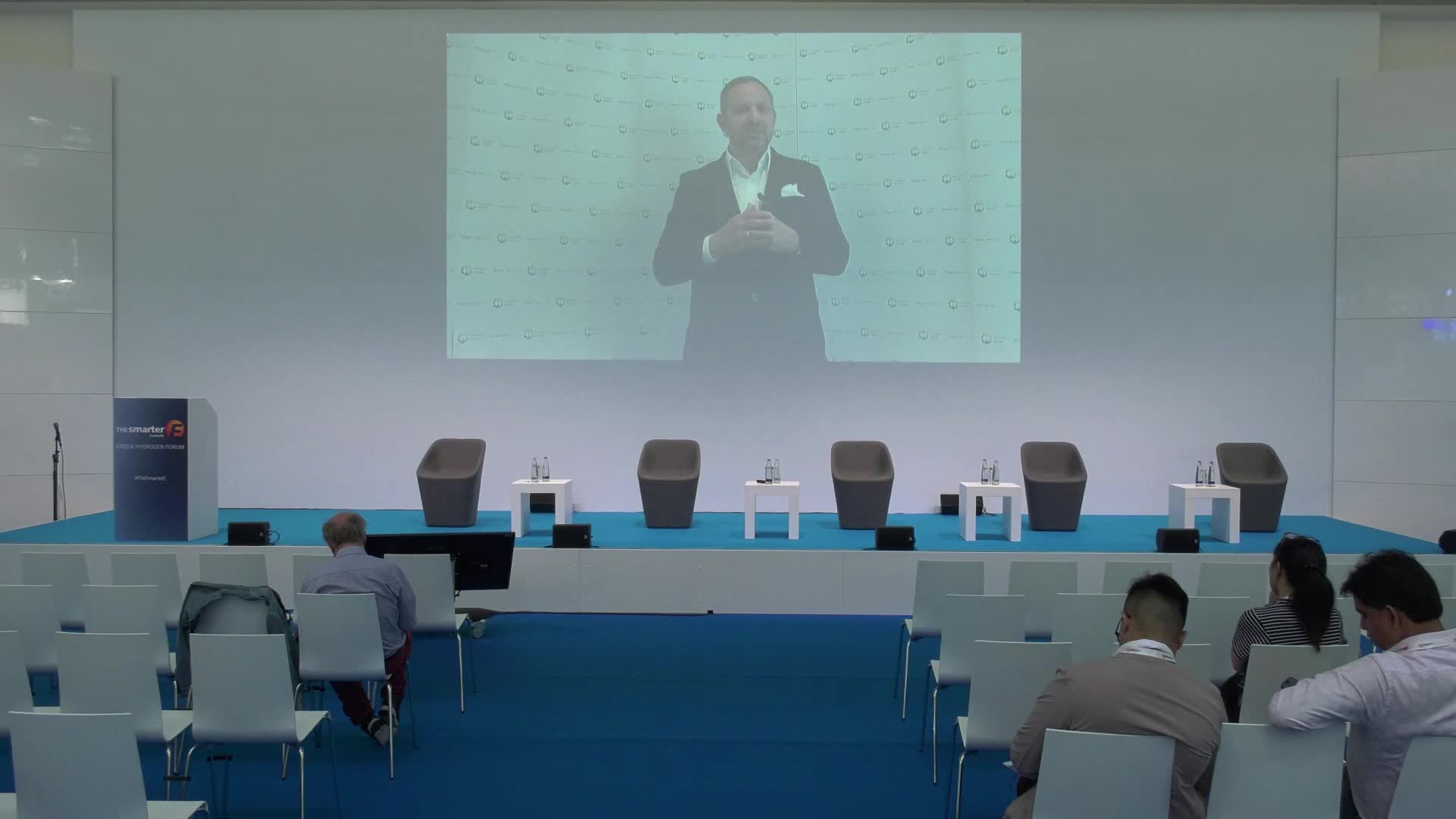
Boosting the Creation of a Liquid European Market for Clean Hydrogen

premium account

Recording of Wednesday, June 19, 2024 | The smarter E Europe 2024 | Exhibition Program | Language: English | Duration: 8:21 .

Challenges and Progress in Green Hydrogen Sector Highlighted at Munich Forum Amid Infrastructure, Investment, and Regulatory Hurdles

The Green Hydrogen Forum in Munich, a significant annual event, could not be attended in person by the speaker this year. The forum's focus is on the progress and challenges within the hydrogen sector. While there have been many positive developments making people happy, disappointments remain concerning final investment decisions. Understanding that market penetration for energy carriers such as oil, gas, and coal historically took decades is vital; hence patience with hydrogen’s integration is necessary as we are merely four years into the European Hydrogen Strategy. An important milestone was witnessing the first auction of the European Hydrogen Bank which received 132 bids with seven projects likely to receive funding at competitive prices. Seven key points were highlighted: 1. De-risking: Essential to support off-takers with long-term contracts and clear infrastructure signals. 2. Internalizing External Costs: CO2 pricing must reflect true environmental costs. 3. Simplification: Eliminate unnecessary regulatory complexities like hourly correlation requirements. 4. Setting Targets: Implement targets from directives like renewable energy usage mandates effectively. 5. Credit Market Union: Attract private investment through policy certainty and an internal credit market union. 6. Grid Expansion: Balance investments between power grids and cost-effective pipeline infrastructures for molecules. 7. International Partnerships: Collaborate particularly with regions like MENA for affordable renewable hydrogen supply. Concluding remarks emphasized collaboration to advance these initiatives successfully before expressing hopes for future participation in next year's forum events.

Automated summarization by AI Conver

Christian Weinberger
Strategy Adviser
hydrogen-advisers.eu
Austria

Jorgo Chatzimarkakis
CEO
Hydrogen Europe
Belgium

The hydrogen economy starts to take form. Prompted by the industry, policymakers have responded by establishing the hydrogen bank, securing initial contracts for differences, a start to be continued, highlighting at the same time the urgent need for a new European infrastructure. The European Hydrogen Backbone is an initiative to think European and allow regions to act locally, bringing together the full play. However, change is implmented by people, and this new sector of the economy demands skilled workforce. The hydrogen academy aims at offering transition paths to this new promising sector.

Speaker

Olivier Bucheli
President
European Electrolyser & Fuel Cell Forum
Switzerland

To Talk

Speaker

Klaus Sehling
Commercial Management Business Development
VERBUND Green Hydrogen GmbH
Germany

To Talk

Speaker

Johanna Schiele
Policy Officer
European Commission
Belgium

To Talk

Speaker

Christian Wolff
Senior Consultant
Ramboll
Germany

Laurence Green
Senior Consultant
Ramboll
Germany

To Talk

Further Content
Webinar
Growth of the European Solar Market, Specifically, Romania

February 24, 2026

Webinar: EU Solar Market Overview with Focus on Romania

Business Visibility
Sponsoring & Marketing Overview

All sponsorship and marketing opportunities at a glance: Find the ideal marketing mix for your company.

Webinar Collection
Mixed Investment Solar Projects in Mexico: The 54% Model Explained

January 29, 2026

Mexico has introduced a new mixed investment scheme for renewable power generation, requiring a minimum 54% direct or indirect participation by CFE.

The smarter E Europe Conferences 2025
Factors That Influence the Success of a Minigrid Project

Wednesday, May 07, 2025, 11:00 am - 12:30 pm

The smarter E Europe Conferences 2025 | Conference Program

premium account

Off-grid solar systems are often the least expensive option for rural electrification. Solar home systems can power individual households, while mini-grids can supply entire villages. Each comes with its own advantages, disadvantages, and challenges. The aim of this session is to explore challenges as well as success stories. It takes well-functioning components such as battery systems, charge management and inverters to make projects successful. Proper system sizing, maintenance and repair management, as well as a robust financial concept are also necessary. If one of these elements is missing, the electrification will not be sustainable. This session will focus on the aspects mentioned above. The speakers will present successful and unsuccessful approaches and discuss what can be learned from them.

The smarter E Europe Conferences 2025
Q&A Session of of the Session Off-Grid: Rural Electrification Based on Solar Systems - Lessons Learned

Wednesday, May 07, 2025, 11:00 am - 12:30 pm

The smarter E Europe Conferences 2025 | Conference Program

premium account

Off-grid solar systems are often the least expensive option for rural electrification. Solar home systems can power individual households, while mini-grids can supply entire villages. Each comes with its own advantages, disadvantages, and challenges. The aim of this session is to explore challenges as well as success stories. It takes well-functioning components such as battery systems, charge management and inverters to make projects successful. Proper system sizing, maintenance and repair management, as well as a robust financial concept are also necessary. If one of these elements is missing, the electrification will not be sustainable. This session will focus on the aspects mentioned above. The speakers will present successful and unsuccessful approaches and discuss what can be learned from them.

You are using an outdated browser

The website cannot be viewed in this browser. Please open the website in an up-to-date browser such as Edge, Chrome, Firefox, or Safari.