Charging: Pain Points and Expectations from the Users' Perspective

premium account

Recording of Wednesday, May 07, 2025 | The smarter E Europe Exhibition Program 2025 | Exhibition Program | Language: English | Duration: 12:23 .

USCALE Highlights Consumer Pain Points in EV Charging and Calls for Improved Infrastructure Solutions

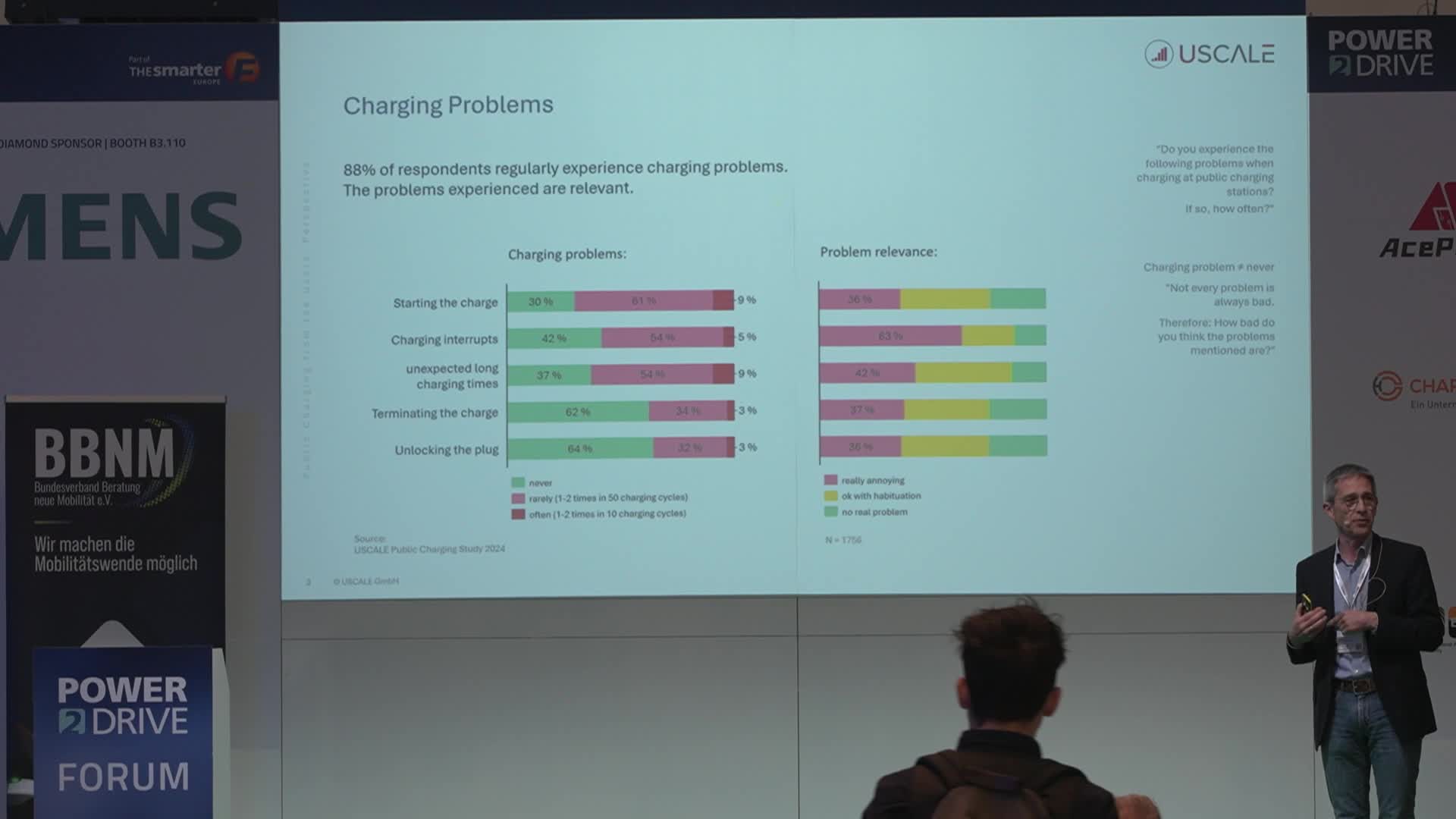
The content discusses the concept of USCALE, which focuses on user scaling to measure and address consumer pain points in electric vehicle (EV) charging. The speaker highlights that while technology is often discussed at fairs, the consumer's experience remains overlooked. They emphasize understanding who the customer is—essentially current combustion engine drivers—and note a gap between early adopters and mainstream consumers due to existing barriers like low EV consumption and revenue issues. Charging reliability emerges as a significant concern; 88-90% of users report occasional problems with charging, impacting their driving ability significantly for about half of them. Tesla manages these issues better than others due to its infrastructure system, but new market participants introduce more challenges as they bring diverse technologies into play. Payment options also pose concerns among consumers both before purchase and after experiencing EVs firsthand, particularly regarding price transparency during public charging sessions. Overall satisfaction varies across different aspects such as authorization processes or pricing structures.

Automated summarization by AI Conver

Dr. Axel Sprenger
CEO & Founder
USCALE GmbH

Charging Infrastructure at Its Limit - Think Ahead or Fall Behind!A functioning charging infrastructure is the key to making electromobility a success in the mass market. Reliable and secure charging solutions determine wh+D32ether charging networks remain stable, profitable, and future-proof.Does security start at the payment terminal at the charging station, the electric vehicle, or the power grid? What happens if operators can future-proof their charging networks with a simple software update - or get left behind? How can manufacturers cut costs with open-source solutions without compromising security and performance? And what does Section 14a of the German Energy Industry Act (§14a EnWG) mean in practice - a curse or an opportunity for grid operators?

Further Talks of this session:

Speaker

Dr. Marco Möller
CEO
PIONIX GmbH

To Talk

Speaker

Mattias Nilsson
Global Sales Engineer
Zaptec Deutschland Gmbh

To Talk

Speaker

Alexander Bourgett
Vice President Strategic Development and Research
eSystems MTG GmbH

To Talk

Speaker

Stefan Richter
CEO
KEBA Energy Automation GmbH

To Talk

Speaker

Can-Luca Senghas
Consultant Business Solutions
eMobilio

To Talk

Further Content
Webinar
Mixed Investment Solar Projects in Mexico: The 54% Model Explained

January 29, 2026

Mexico has introduced a new mixed investment scheme for renewable power generation, requiring a minimum 54% direct or indirect participation by CFE.

Anna Darmani, Principal Analyst from Wood Mackenzie
Big BESS Is Here to Save the Day

The smarter E Podcast Episode 246 | Language: English

January 8, 2026

Utility-scale batteries are booming in Europe. Discover key BESS trends, market impacts, and what to expect for large-scale storage in 2026.

Business Visibility
Sponsoring & Marketing Overview

All sponsorship and marketing opportunities at a glance: Find the ideal marketing mix for your company.

The smarter E Europe Conferences 2025
Factors That Influence the Success of a Minigrid Project

Wednesday, May 07, 2025, 11:00 am - 12:30 pm

The smarter E Europe Conferences 2025 | Conference Program

premium account

Off-grid solar systems are often the least expensive option for rural electrification. Solar home systems can power individual households, while mini-grids can supply entire villages. Each comes with its own advantages, disadvantages, and challenges. The aim of this session is to explore challenges as well as success stories. It takes well-functioning components such as battery systems, charge management and inverters to make projects successful. Proper system sizing, maintenance and repair management, as well as a robust financial concept are also necessary. If one of these elements is missing, the electrification will not be sustainable. This session will focus on the aspects mentioned above. The speakers will present successful and unsuccessful approaches and discuss what can be learned from them.

The smarter E Europe Conferences 2025
Q&A Session of of the Session Off-Grid: Rural Electrification Based on Solar Systems - Lessons Learned

Wednesday, May 07, 2025, 11:00 am - 12:30 pm

The smarter E Europe Conferences 2025 | Conference Program

premium account

Off-grid solar systems are often the least expensive option for rural electrification. Solar home systems can power individual households, while mini-grids can supply entire villages. Each comes with its own advantages, disadvantages, and challenges. The aim of this session is to explore challenges as well as success stories. It takes well-functioning components such as battery systems, charge management and inverters to make projects successful. Proper system sizing, maintenance and repair management, as well as a robust financial concept are also necessary. If one of these elements is missing, the electrification will not be sustainable. This session will focus on the aspects mentioned above. The speakers will present successful and unsuccessful approaches and discuss what can be learned from them.

You are using an outdated browser

The website cannot be viewed in this browser. Please open the website in an up-to-date browser such as Edge, Chrome, Firefox, or Safari.