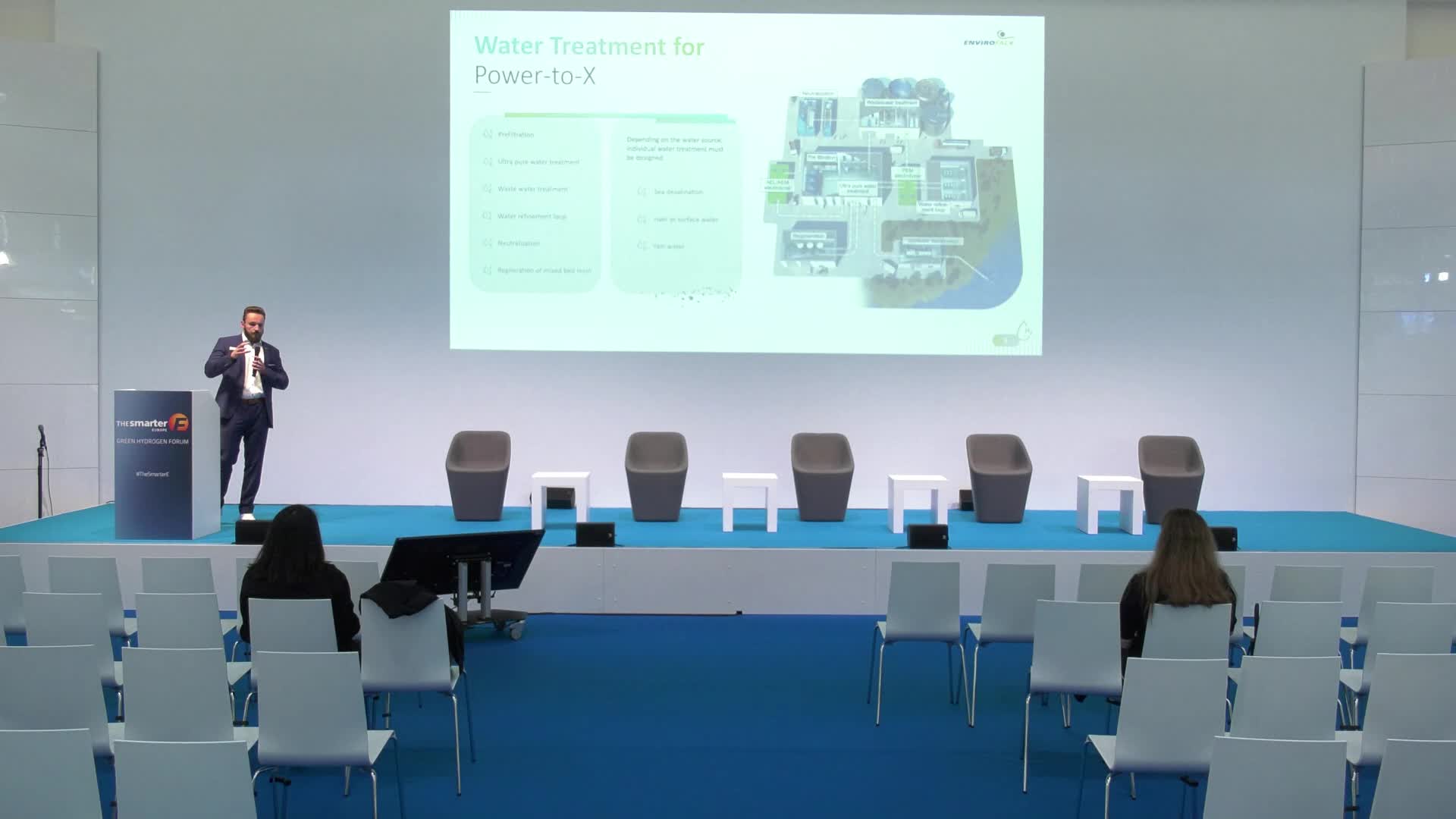
High Purity Water for Power to X - Water Treatment Along the Entire Value Chain

premium account

Recording of Thursday, June 20, 2024 | The smarter E Europe | Exhibition Program | Language: English | Duration: 8:28 .

Importance of Water Treatment in Hydrogen Production Highlighted by EnviroFALK's Christopher Lenz

Christopher Lenz, the Business Development Manager for Hydrogen Projects at EnviroFALK, introduces his company as part of the EnviroWater Group, a network specializing in comprehensive water treatment solutions globally. The presentation emphasizes the crucial role of water treatment in hydrogen production, often overshadowed by a focus on electricity procurement and cost-effectiveness within the hydrogen economy. He explains that effective water treatment is essential for creating a sustainable energy economy. Lenz discusses hydrogen's natural occurrence predominantly bound in minerals and notably in water. Despite Earth's vast 1.4 billion cubic kilometers of water, only 2.5% is fresh, with just 0.3% accessible for human use—highlighting the necessity of efficient water management. He details that producing one kilogram of hydrogen theoretically requires nine kilograms of water but practically needs about ten to twelve kilograms due to inefficiencies. Moreover, electrolyzing power consumption necessitates significant volumes—200-300 liters per hour per megawatt. The core issue tackled is why supplying polluted water to electrolysis systems diminishes efficiency due to contaminants like salts causing surface buildup or CO2 reducing resin lifespan and accelerating corrosion through fluoride presence. To address these challenges, he outlines multiple purification steps transforming drinking-quality into high-purity standards: softening systems exchange hardness ions (calcium/magnesium) with sodium; reverse osmosis removes up to 98% salts/particles; membrane degassing eliminates gases like CO2; electrodeionization drops conductivity below 0.5 microsiemens/cm via further desalting; final ion exchange ensures this low conductivity level remains stable. By drastically lowering salt content from typical concentrations comparable—to dissolved teaspoons per bucket down—to near-reservoir purity levels (~one teaspoon/5 million liters), EnviroFALK’s processes safeguard efficient hydrogen production infrastructure.

Automated summarization by AI Conver

Christopher Lenz
Business Development Manager
EnviroFALK PharmaWaterSystems GmbH
Germany

Industrial/Product Live Pitches

Further Talks of this session:

Speaker

Hasret Varan
Sales & Business Development Manager -Power 2 Gas
SMA Altenso GmbH
Germany

To Talk

Speaker

Hyacinthe Flandrin
EMEA Sales Engineer Manager
LONGi Hydrogen
Germany

To Talk

Speaker

Dr. Rudolf Konwitschny
Market Segment Industry / Leak Detection Application Team
Pfeiffer Vacuum GmbH
Germany

To Talk

To Talk

Further Content
Webinar Collection
Mixed Investment Solar Projects in Mexico: The 54% Model Explained

January 29, 2026

Mexico has introduced a new mixed investment scheme for renewable power generation, requiring a minimum 54% direct or indirect participation by CFE.

Adriana Fricke, Robin Berg
Has Vehicle-to-Grid Reached the Tipping Point?

The smarter E Podcast Episode 248 | Language: English

February 5, 2026

Why 2026 could be a turning point for bidirectional EV charging – from regulation to large V2G fleets in Europe.

Business Visibility
Sponsoring & Marketing Overview

All sponsorship and marketing opportunities at a glance: Find the ideal marketing mix for your company.

The smarter E Europe Conferences 2025
Factors That Influence the Success of a Minigrid Project

Wednesday, May 07, 2025, 11:00 am - 12:30 pm

The smarter E Europe Conferences 2025 | Conference Program

premium account

Off-grid solar systems are often the least expensive option for rural electrification. Solar home systems can power individual households, while mini-grids can supply entire villages. Each comes with its own advantages, disadvantages, and challenges. The aim of this session is to explore challenges as well as success stories. It takes well-functioning components such as battery systems, charge management and inverters to make projects successful. Proper system sizing, maintenance and repair management, as well as a robust financial concept are also necessary. If one of these elements is missing, the electrification will not be sustainable. This session will focus on the aspects mentioned above. The speakers will present successful and unsuccessful approaches and discuss what can be learned from them.

The smarter E Europe Conferences 2025
Q&A Session of of the Session Off-Grid: Rural Electrification Based on Solar Systems - Lessons Learned

Wednesday, May 07, 2025, 11:00 am - 12:30 pm

The smarter E Europe Conferences 2025 | Conference Program

premium account

Off-grid solar systems are often the least expensive option for rural electrification. Solar home systems can power individual households, while mini-grids can supply entire villages. Each comes with its own advantages, disadvantages, and challenges. The aim of this session is to explore challenges as well as success stories. It takes well-functioning components such as battery systems, charge management and inverters to make projects successful. Proper system sizing, maintenance and repair management, as well as a robust financial concept are also necessary. If one of these elements is missing, the electrification will not be sustainable. This session will focus on the aspects mentioned above. The speakers will present successful and unsuccessful approaches and discuss what can be learned from them.

You are using an outdated browser

The website cannot be viewed in this browser. Please open the website in an up-to-date browser such as Edge, Chrome, Firefox, or Safari.