How Optimized Schedules & Revenue Stacking Make Hybrid Plants Profitable

premium account

Recording of Wednesday, June 19, 2024 | The smarter E Europe 2024 | Conference Program | Language: English | Duration: 13:46 .

Isabella Caschetto, Product Manager at Camopo Energy, Discusses Optimized Schedules and Revenue Stacking for Hybrid Power Plants Using Advanced Software Solutions

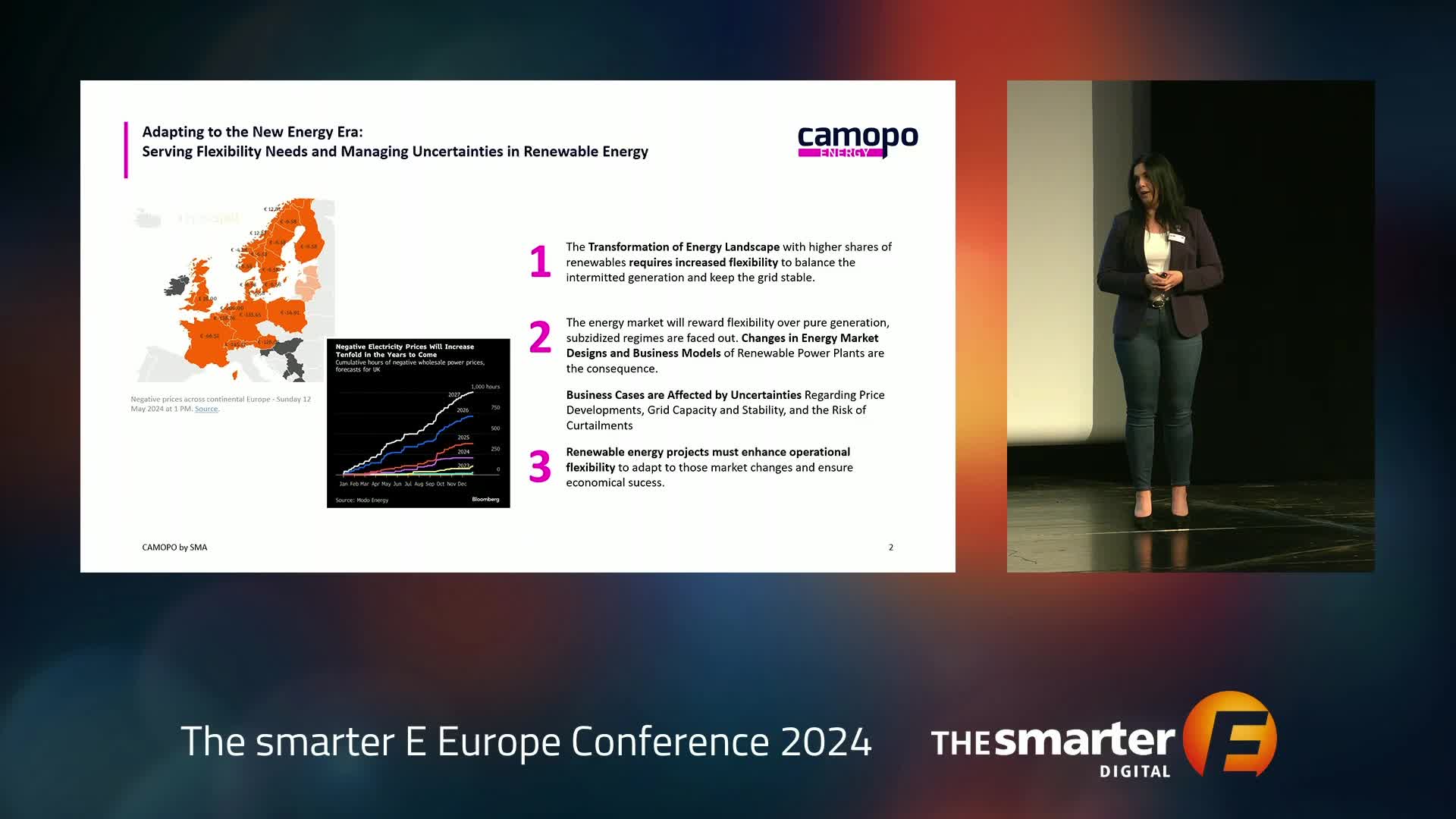
Isabella Caschetto, Product Manager of Camopo Energy—a division within the SMA Solar Technology Group—addressed a session focusing on optimizing hybrid power plants' commercial operations using software solutions. She discussed how the evolving energy market impacts business models and revenue opportunities, highlighting increased instances of negative pricing and renewable energy curtailments due to grid capacity limitations. With traditional feed-in tariffs phasing out, new merchant models that reward flexibility over pure generation are emerging. Caschetto emphasized that hybrid power plants combining PV (photovoltaic) systems with batteries offer complex but rewarding opportunities by enhancing grid connection utilization. Two primary approaches were outlined: co-located hybrids that share grid connections for distinct business strategies and full hybrids requiring integrated asset management for joint dispatching strategies and various use cases like peak load shaping or avoiding curtailment. Given battery capital expenditure challenges, multiple revenue streams are essential for economic viability. Sophisticated software is necessary to manage these dynamic decisions effectively across different markets in real-time. She concluded by illustrating this complexity through an example from a German PV-battery plant managed by their solution.

Automated summarization by AI Conver

Isabella Caschetto
Product Manager Digital Services
SMA Solar Technology AG
Deutschland

Hybrid power plants play a crucial role in addressing the flexibility limitations of variable renewables. Solar and wind and/or battery storage systems improve grid-stability, allow to integrate more renewable energy and offer potential additional revenue for power plant operators.

This session will include:

  • Hybrid solar power plant case studies
  • Status and developments of hybrid solar power plant systems
  • Policy frameworks for a solar-based hybrid power supply

Speaker

Jenny Chase
Lead Solar Analyst
BloombergNEF
United Kingdom

To Talk

Speaker

Kyle David Ryan
Senior Project Engineer, Solar Engineering
RWE Renewables Europe & Australia GmbH
Germany

To Talk

Speaker

Johannes Linder
Director System Design & Innovation
BELECTRIC GmbH
Germany

To Talk

Speaker

Laurent Talbot
Head of Energy Storage
Statkraft Erneuerbare GmbH
Germany

To Talk

Speaker

Howard Wenger
President
Nextracker
Spain

To Talk

Further Content
Webinar
Mixed Investment Solar Projects in Mexico: The 54% Model Explained

January 29, 2026

Mexico has introduced a new mixed investment scheme for renewable power generation, requiring a minimum 54% direct or indirect participation by CFE.

Webinar Collection
A New Renewable Energy Knowledge Exchange Partnership: Exploring Collaboration and Investment Opportunities in Rwanda, Zambia, Malawi and Scotland

January 23, 2026

free account

Learn about Malawi, Zambia & Rwanda.

Anna Darmani, Principal Analyst from Wood Mackenzie
Big BESS Is Here to Save the Day

The smarter E Podcast Episode 246 | Language: English

January 8, 2026

Utility-scale batteries are booming in Europe. Discover key BESS trends, market impacts, and what to expect for large-scale storage in 2026.

Alex Barrows, Molly Morgan, Sonia Dunlop
Inside 2026’s PV Pricing Reset

The smarter E Podcast Episode 247 | Language: English

January 22, 2026

Solar PV prices shift after years of oversupply. This episode covers supply-chain pressures, tech competition, and 2026 market impacts.

The smarter E Europe Conferences 2025
Factors That Influence the Success of a Minigrid Project

Wednesday, May 07, 2025, 11:00 am - 12:30 pm

The smarter E Europe Conferences 2025 | Conference Program

premium account

Off-grid solar systems are often the least expensive option for rural electrification. Solar home systems can power individual households, while mini-grids can supply entire villages. Each comes with its own advantages, disadvantages, and challenges. The aim of this session is to explore challenges as well as success stories. It takes well-functioning components such as battery systems, charge management and inverters to make projects successful. Proper system sizing, maintenance and repair management, as well as a robust financial concept are also necessary. If one of these elements is missing, the electrification will not be sustainable. This session will focus on the aspects mentioned above. The speakers will present successful and unsuccessful approaches and discuss what can be learned from them.

You are using an outdated browser

The website cannot be viewed in this browser. Please open the website in an up-to-date browser such as Edge, Chrome, Firefox, or Safari.