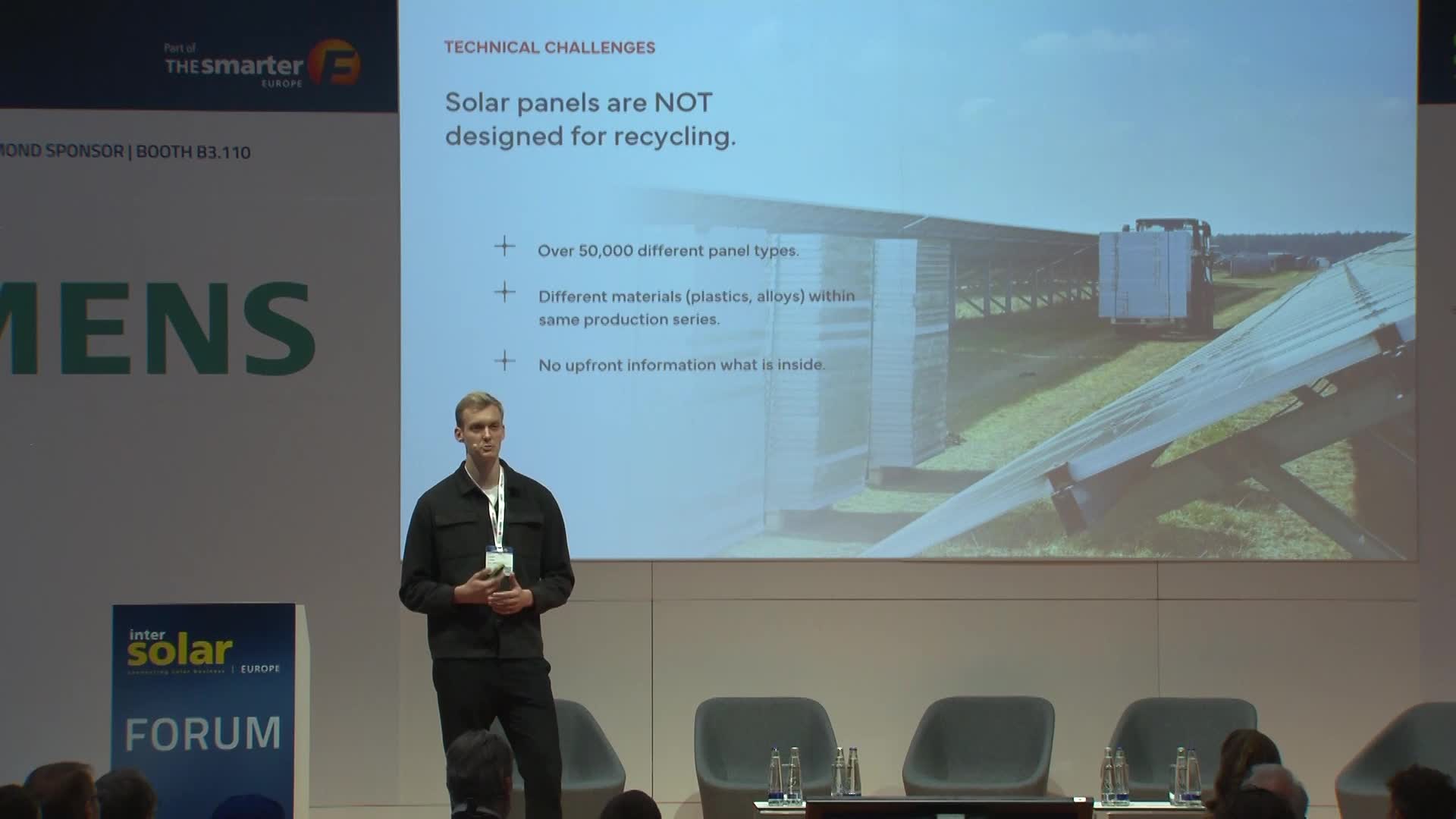
How we Bring Solar Panel Recycling from Germany to Europe and Beyond

premium account

Recording of Thursday, May 08, 2025 | The smarter E Europe | Exhibition Program | Language: English | Duration: 11:59 .

Solar Materials Co-Founder Highlights Challenges and Innovations in Solar Panel Recycling for a Circular Economy

Fridolin Franke, co-founder and negotiation director of Solar Materials, discusses the company's mission to establish a circular economy for solar panels. Founded four years ago in Magdeburg, Germany, with 45 employees and €17 million in venture capital funding, Solar Materials focuses on recycling solar panels economically. Europe has about 50 million tons of installed solar panels containing valuable materials like silver—approximately 12,000 tons worth more than Poland's annual production. However, challenges arise because over 50 thousand types of non-recyclable-designed panels exist; they vary greatly due to weathering and improper dismantling processes. Solar Materials employs mechanical processing steps alongside low-temperature thermal methods for delamination without shredding first—a unique approach compared to other research projects involving costly chemical or thermal techniques. The company plans further expansion by increasing capacity at its German site while establishing Italy’s first recycling facility next year despite regulatory hurdles related mainly around storage permits when decommissioned large-scale parks generate massive amounts quickly exceeding current capacities leading some shipments outside EU borders losing raw resources needed within Europe's geopolitical context emphasizing self-sufficiency through enforcing laws ensuring material recovery locally instead globally dispersedly lost forevermore!

Automated summarization by AI Conver

Fridolin Franke
Business Development, Operations & Finance
Solar Materials

20 years or so after the first solar boom in Germany and Europe, the industry is looking how to deal with the growing number of used modules. Despite the ramp-up of PV recycling, there are still some unknowns: What are the obligations and responsibilities when it comes to PV recycling? What will happen to PV modules at the end of their service life? What practicable and sustainable solutions are there, and how can raw materials be recovered?This sessions will be providing an overview of the legal and regulatory framework conditions governing PV recycling in Europe. It will show the role that module manufacturers, wholesalers and project developers play in the end-of-life management of PV modules. This will be followed by two recycling companies presenting the state of the art of their respective recycling method and its business case.

Further Talks of this session:

To Talk

Speaker

Jan Clyncke
Managing Director
PV CYCLE

To Talk

Speaker

Karsten Wambach
R&D consultant
on behalf of Reiling

To Talk

Video is not available.

Further Content
Webinar
Growth of the European Solar Market, Specifically, Romania

February 24, 2026

Webinar: EU Solar Market Overview with Focus on Romania

Webinar Collection
Mixed Investment Solar Projects in Mexico: The 54% Model Explained

January 29, 2026

Mexico has introduced a new mixed investment scheme for renewable power generation, requiring a minimum 54% direct or indirect participation by CFE.

Adriana Fricke, Robin Berg
Has Vehicle-to-Grid Reached the Tipping Point?

The smarter E Podcast Episode 248 | Language: English

February 5, 2026

Why 2026 could be a turning point for bidirectional EV charging – from regulation to large V2G fleets in Europe.

The smarter E Europe Conferences 2025
Q&A Session of of the Session Off-Grid: Rural Electrification Based on Solar Systems - Lessons Learned

Wednesday, May 07, 2025, 11:00 am - 12:30 pm

The smarter E Europe Conferences 2025 | Conference Program

premium account

Off-grid solar systems are often the least expensive option for rural electrification. Solar home systems can power individual households, while mini-grids can supply entire villages. Each comes with its own advantages, disadvantages, and challenges. The aim of this session is to explore challenges as well as success stories. It takes well-functioning components such as battery systems, charge management and inverters to make projects successful. Proper system sizing, maintenance and repair management, as well as a robust financial concept are also necessary. If one of these elements is missing, the electrification will not be sustainable. This session will focus on the aspects mentioned above. The speakers will present successful and unsuccessful approaches and discuss what can be learned from them.

The smarter E Europe Conferences 2025
Digital Tools for Planning and Monitoring: Insights from Mozambique

Wednesday, May 07, 2025, 02:00 pm - 03:30 pm

The smarter E Europe Conferences 2025 | Conference Program

premium account

This session explores how digitalization is revolutionizing off-grid energy projects, enabling scalability and efficiency in underserved areas. Experts will discuss cutting-edge solutions based on the use and application of digital tools to support planning, development, and operations ultimately enhancing affordability. Attendees will gain insights into leveraging digital tools for optimized planning and project management, customer engagement, monitoring, and sustainable growth. Real-world case studies will highlight successful implementations, showcasing how technology bridges the gap between innovation and impact in energy access.

You are using an outdated browser

The website cannot be viewed in this browser. Please open the website in an up-to-date browser such as Edge, Chrome, Firefox, or Safari.