Hybrid Horizons: Co-Location in Europe - Trends, Policy, and Business Models

premium account

Recording of Tuesday, June 23, 2026 | The smarter E Europe Conferences 2026 | Language: English | Duration: 15:55 .

Trends and Strategies for Co-location in Europe

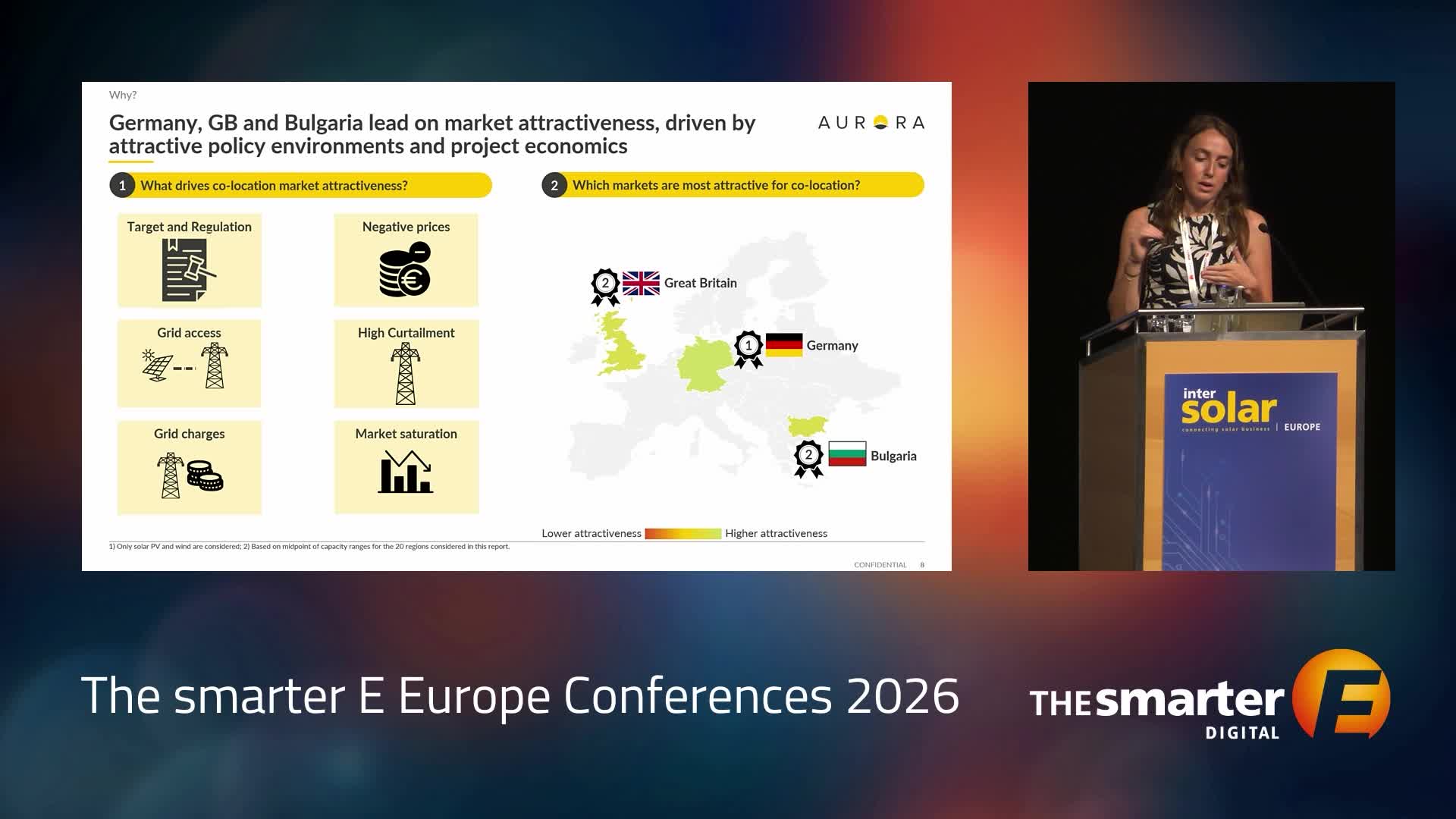
Co-location in Europe is gaining momentum, with significant growth in co-located renewable energy and battery storage systems, projected to leap from 2 gigawatts in 2023 to 6 gigawatts by 2025, potentially exceeding 35 gigawatts by 2030. Key players in this market include the UK and Germany, with Spain, Bulgaria, Hungary, and Finland also advancing through successful auctions. Co-location offers advantages such as cost savings in inverters and reduced balance of system expenses while mitigating grid congestion and improving access, addressing issues like lengthy grid queues. Various business cases for co-location are identified, including virtual hybrid projects and different configurations for DC and AC setups. Important market drivers include regulatory policies that boost investor confidence and facilitate growth in new markets like the Baltic regions and Southern Europe. However, challenges such as inverter losses, asset over-sizing, and the evolving nature of market dynamics—including negative pricing and curtailment rates—require careful management. Overall, a strategic approach to co-location can optimize energy production and enhance the sustainability of energy projects across Europe.

Automated summarization by AI Conver

Speaker

Rebecca McManus
European Renewables Lead Expert
Aurora Energy Research
Germany

Hybrid PV projects are transforming Europe's utility-scale solar sector. As battery sizes grow and grid constraints intensify, co-location and hybrid operation are becoming the key to accessing the grid and unlocking new value streams - from merchant optimization to industrial energy supply. This session examines real-world revenue models, policy trends and grid-forming requirements,providing background on how hybrid projects truly pay off.

This session will address:

  • Business cases for co-location, overplanting and shared grid connections of hybrid solar plants
  • Grid-forming and related services with regulatory drivers shaping hybrid economics
  • Revenue-stacking strategies in merchant and contracted markets
  • Industrial optimization and storage-led value creation in practice

Further Talks of this session:

Speaker

Cecilie Kristiansen
Research Analyst
Wood Mackenzie
United Kingdom

To Talk

Speaker

Andreas Nitsch
Senior Solution Engineer
Opoura GmbH
Germany

To Talk

Speaker

Laura Hoffmann-Ostenhof
Central Europe Industry Lead
Gridcog
United Kingdom

To Talk

Speaker

Barbara Flesche
Executive Vice President, Europe
Statkraft AS
Norway

Stefan Müller
COO
Enerparc AG
Germany

To Talk

Further Content
Publication
The German PV and Battery Storage Market

The first of its kind, this study offers an overview of the photovoltaics and battery storage market in Germany.

Rutger Schlatmann and Angelika Harter
Perovskites: The Race for the Future of PV?

The smarter E Podcast Episode 258 | Language: English

June 25, 2026

HZB researchers explore perovskite tandem solar cells, efficiency gains, and the challenges of bringing the technology to market.

Publications
Global Market Outlook for Solar Power 2025–2029

SolarPower Europe’s annual Global Market Outlook for Solar Power is the most authoritative market analysis for the solar sector.

The smarter E Europe Conferences 2026
Panel Discussion of the Session: Solar Made in the EU

Tuesday, June 23, 2026, 02:30 pm

The smarter E Europe Conferences 2026 | Conference Program

premium account

Despite strong research capabilities and the presence of leading production equipment suppliers, Europe has been struggling to rebuild competitive wafer-to-module manufacturing, while the USA and India have enabled a local renaissance in solar manufacturing. In Europe, even long-established inverter manufacturers have been losing considerable ground. With the EU's Net Zero Industry Act yet to deliver momentum, attention is turning to the upcoming Industry Accelerator Act. This session examines how policy, investment and value-chain strategies can strengthen domestic manufacturing and increase internal value creation.Key topics:Overview of EU and national policy frameworks to support local manufacturingStatus of Europe's solar manufacturing value chainInvestment gaps and competitiveness challenges Strategies for triggering a sustainable solar manufacturing revival 

The smarter E Europe Conferences 2026
Panel Discussion of the Session: Off-Grid: PV-Based Hydrogen Microgrid Projects Around the World

Tuesday, June 23, 2026, 02:30 pm

The smarter E Europe Conferences 2026 | Conference Program

premium account

Discover how green hydrogen and fuel cell technologies are transforming decentralized energy systems worldwide. This session will be presenting hands-on experience from pioneering projects in Thailand, Ghana, Namibia and South Africa. Find out how solar-powered hydrogen microgrids can replace diesel generators, strengthen energy resilience and enable short- to long-term storage, while supporting environmental and climate goals. Project partners including German SMEs and research institutes, share insights on lessons learned, local benefits and the replication potential of these systems. Selected projects were implemented with the support from the Export Initiative Environmental Protection, a funding programme of the German Federal Ministry for the Environment, Climate Action, Nature Conservation and Nuclear Safety. 

You are using an outdated browser

The website cannot be viewed in this browser. Please open the website in an up-to-date browser such as Edge, Chrome, Firefox, or Safari.