Hydrogen Horizons: Exploring EU Funding Pathways

premium account

Recording of Wednesday, May 07, 2025 | The smarter E Europe Exhibition Program 2025 | Exhibition Program | Language: English | Duration: 18:48 .

Comprehensive Guide to EU Hydrogen Funding and Infrastructure Development by EY's Berta Paniagua Bernabé

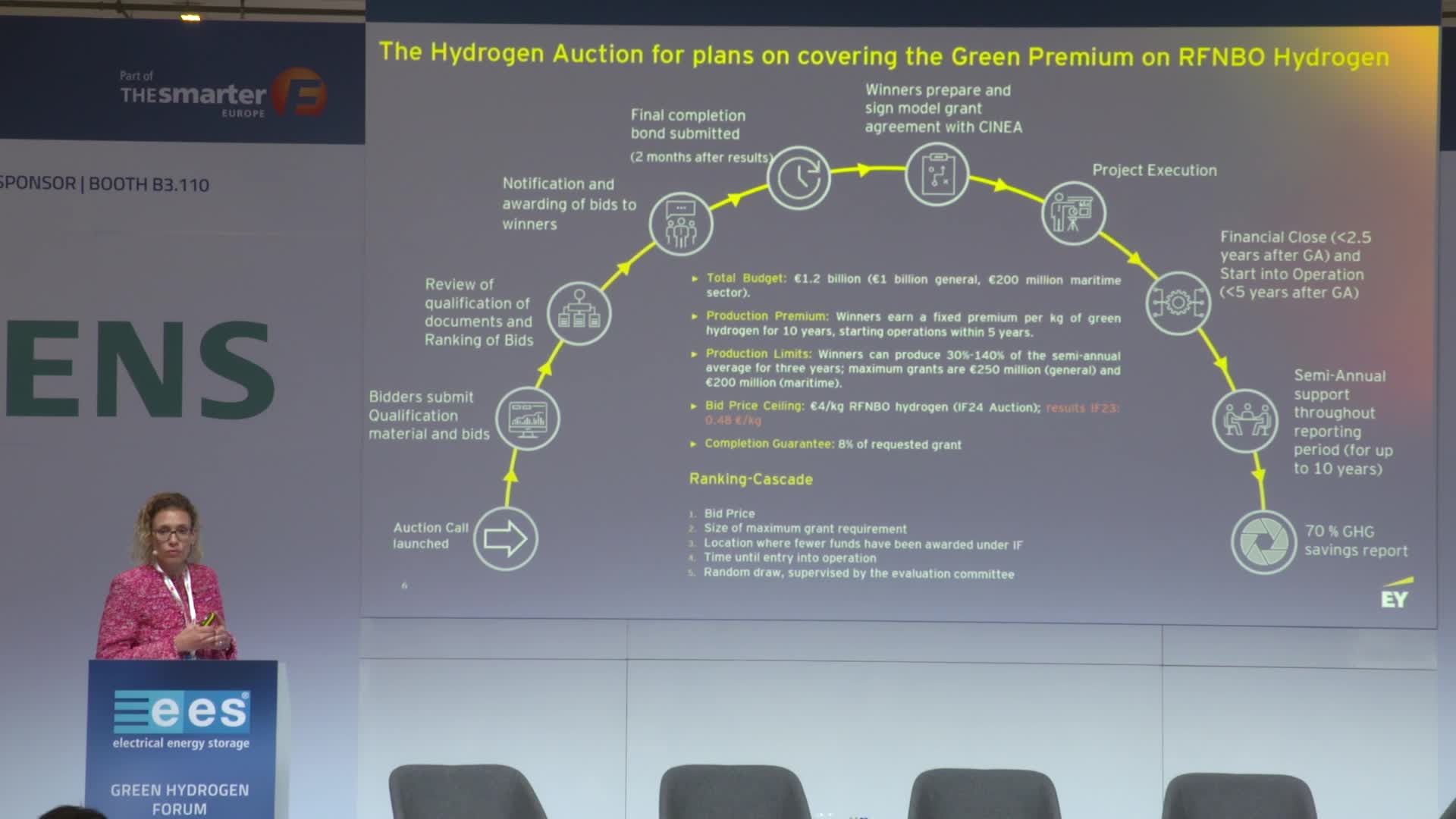
Berta Paniagua Bernabé from Ernst & Young Spain discusses EU funding opportunities for hydrogen projects, emphasizing the need to consider various programs collectively due to their distinct objectives and requirements. Her team specializes in securing hydrogen-related funding and collaborates with the European Commission as evaluators, offering insights into preferred project types by funders. The Innovation Fund is a key program aimed at decarbonizing hard-to-abate industries through innovative solutions such as new value chains or electrolysis methods for hydrogen production, boasting an average grant size of 127 million euros but maintaining a competitive environment with only about a 25% success rate. Other initiatives like CEF Energy focus on infrastructure improvements across Europe related to renewable energy sources including hydrogen refueling stations; however, applicants must be included on specific lists before applying. Additionally, IPSEI (Important Projects of Common European Interest) funded by member states faces challenges due to varying rules despite potential coverage up to 100%. Overall emphasis is placed on staying informed about evolving programs and emerging options facilitated by active efforts from the European Commission towards enhancing access to funding for efficient strategies around hydrogen development projects.

Automated summarization by AI Conver

Berta Paniagua Bernabé
Senior Manager - Global Incentives
Ernst & Young Spain
Germany

After the hype the deception, at least with respect to exaggerated expectations. Against this, we start to see various instruments deploying effects and projects getting built. What effects do the Hydrogen Bank auctions, IPCEI, the Innovation Fund and Valley projects deploy? What questions do research and innovation still need to address? This session provides an overview of the EU level progress and challenges on the path to energy security and decarbonisation.

Further Talks of this session:

Speaker

Olivier Bucheli
President
European Electrolyser & Fuel Cell Forum
Switzerland

To Talk

Speaker

Dr. Christian Weinberger

To Talk

Speaker

Francois Paquet
Managing Director
Renewable Hydrogen Coalition
Germany

To Talk

Speaker

Dr. Eric Rüland
Vice President Sales & Products
RCT GH GmbH
Germany

To Talk

To Talk

Further Content
Webinar
Growth of the European Solar Market, Specifically, Romania

February 24, 2026

Webinar: EU Solar Market Overview with Focus on Romania

Irene Guerra Gil, Mark Bruno
Staying Home, with Smart Energy Management

The smarter E Podcast Episode 245 | Language: English

December 11, 2025

Irene Guerra Gil and Mark Bruno explain how smart home energy systems and building initiatives cut costs and emissions.

Publications
European Market Outlook for Battery Storage 2025–2029

Comprehensive analysis of Europe’s battery storage market – now available for download

The smarter E Europe Exhibition Program 2025
DC Microgrids as the Next Frontier in Grid Modernization and DER Integration

Wednesday, May 07, 2025, 11:00 am - 12:25 pm

The smarter E Europe Exhibition Program 2025 | Exhibition Program

premium account

Discover how next-gen distribution grid technologies are addressing the challenges of renewable integration and dynamic energy demands. This session offers insights into the latest developments in AI-driven data analytics and the transformative role of IoT in grid management.

The smarter E Europe Conferences 2025
Factors That Influence the Success of a Minigrid Project

Wednesday, May 07, 2025, 11:00 am - 12:30 pm

The smarter E Europe Conferences 2025 | Conference Program

premium account

Off-grid solar systems are often the least expensive option for rural electrification. Solar home systems can power individual households, while mini-grids can supply entire villages. Each comes with its own advantages, disadvantages, and challenges. The aim of this session is to explore challenges as well as success stories. It takes well-functioning components such as battery systems, charge management and inverters to make projects successful. Proper system sizing, maintenance and repair management, as well as a robust financial concept are also necessary. If one of these elements is missing, the electrification will not be sustainable. This session will focus on the aspects mentioned above. The speakers will present successful and unsuccessful approaches and discuss what can be learned from them.

You are using an outdated browser

The website cannot be viewed in this browser. Please open the website in an up-to-date browser such as Edge, Chrome, Firefox, or Safari.