Inverters Fast Track to the Flex Era

premium account

Recording of Wednesday, May 07, 2025 | The smarter E Europe Conferences 2025 | Conference Program | Language: English | Duration: 11:12 .

Liam Cowman Discusses Innovations and Challenges in Grid-Forming Technology Amidst Evolving Energy Market Demands

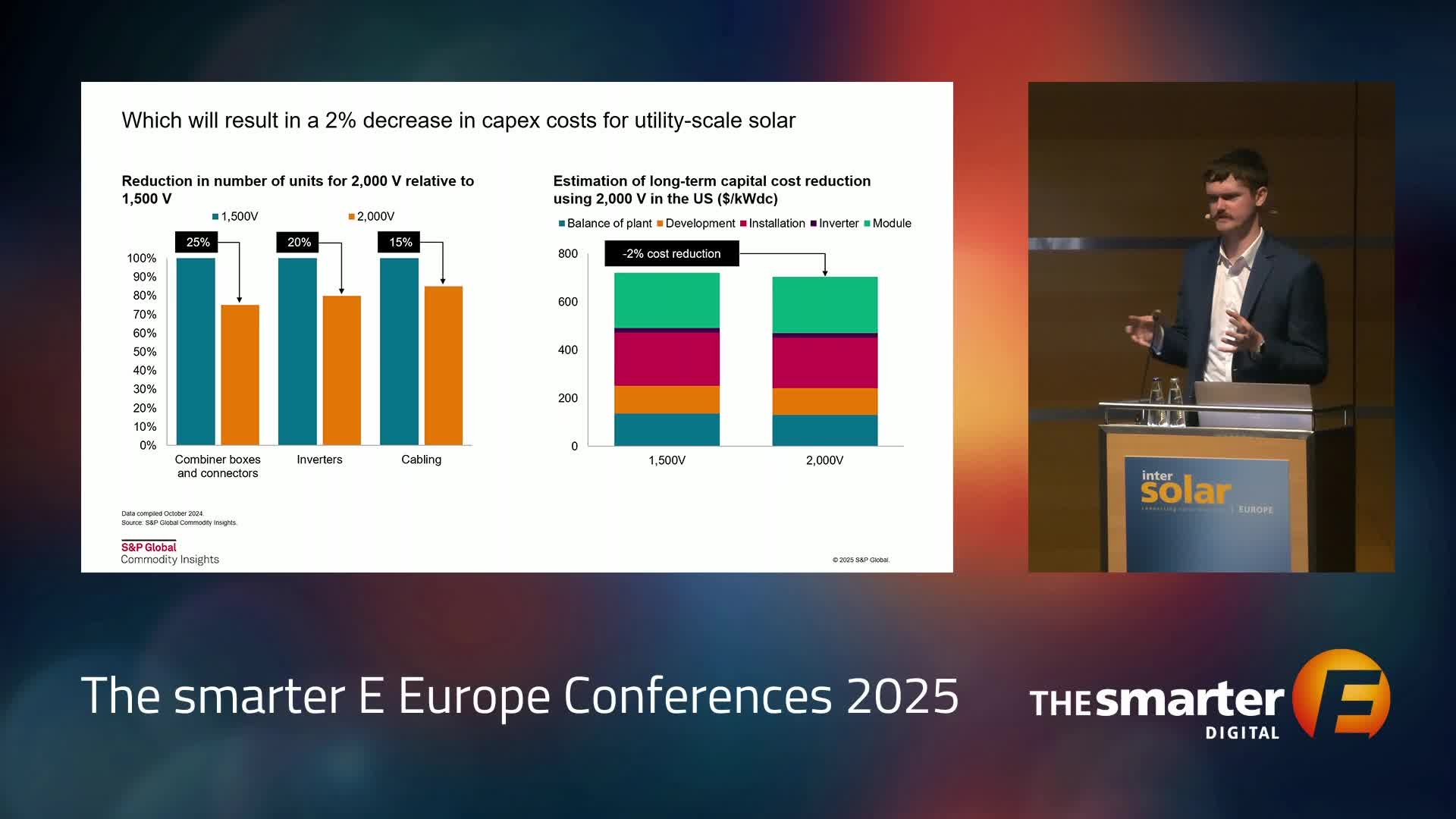
Liam Cowman, a clinical analyst at S&P Global, delves into the recent challenges and innovations within the energy sector. Key areas of innovation include enhanced software for managing residential energy flows, transitioning utility-scale installations to 2000 volts for improved efficiency and cost reduction, grid-forming inverters that bolster renewable integration by mimicking traditional generation systems' responsibilities, and heightened cybersecurity focus due to increased digitalization. The residential market faces cooling demand with complex consumer needs necessitating advanced software solutions for effective management of home energy assets like solar panels and EVs. Utility-scale operations are shifting from 1500V to 2000V but face delays due to undeveloped standards and component shortages until around 2027-2028. Grid-forming inverter technology is advancing rapidly yet remains costly without adequate incentives or regulatory support across Europe despite its importance alongside rising renewables penetration requiring robust security measures against cyber threats globally amidst exponential data growth trends observed recently worldwide. Despite these hurdles, significant progress continues as demonstrated by projects like Black Hillock in the UK showcasing advancements over the past year.

Automated summarization by AI Conver

Liam Coman
Solar Research Analyst
S&P Global

The pace of solar system technology advancements has been remarkable in recent years, with major improvements in efficiency, usability, and energy yield across all components - including modules, mounting systems, and inverters. However, with persistent overcapacities and intense price pressure, the race for cost reduction through innovation has never been more crucial. Solar companies must continually push the boundaries of technology to remain competitive. This session will provide: Overview of major technological advancements in solar system components Updates on the latest innovations in modules, inverters, balance-of-system equipment, racking, and tracker solutions Discussion on different technology roadmaps shaping the future of solar deployment.

Further Talks of this session:

Speaker

Jenny Chase
Lead Solar Analyst
BloombergNEF
United Kingdom

To Talk

Speaker

Dr. Gianluca Coletti
Adjunct Professor
UNSW Sydney
Australia

Recording of presentation not authorized for publication.

Speaker

Manuel Jimenez Castro
Global Application Engineer, PV + BESS + H2
Siemens AG
Germany

To Talk

Speaker

Nadine Wade
Productmanager
K2 Systems GmbH
Germany

To Talk

Speaker

Alejandro Cardona Velez
Corporate Engineering Director
Soltec
Spain

To Talk

To Talk

Further Content
Webinar
Mixed Investment Solar Projects in Mexico: The 54% Model Explained

January 29, 2026

Mexico has introduced a new mixed investment scheme for renewable power generation, requiring a minimum 54% direct or indirect participation by CFE.

Anna Darmani, Principal Analyst from Wood Mackenzie
Big BESS Is Here to Save the Day

The smarter E Podcast Episode 246 | Language: English

January 8, 2026

Utility-scale batteries are booming in Europe. Discover key BESS trends, market impacts, and what to expect for large-scale storage in 2026.

The smarter E Europe Conferences 2025
Setting the Scene "Off-Grid"

Wednesday, May 07, 2025, 04:00 pm - 05:30 pm

The smarter E Europe Conferences 2025 | Conference Program

premium account

Photovoltaic prices have fallen continuously in recent years - a trend that should translate into a growing market for off-grid solutions. Declining costs are crucial for rural electrification in particular, making sustainable energy supply economically viable in remote regions. However, so far many of these price advantages have not yet reached the people that need them most. Do existing framework conditions to foster rural electrification still work in this new market reality? Which measures are needed to ensure that cost reductions reach our target group? This session discusses strategies for improving the availability of low-cost off-grid solutions, financing and innovative business models. A look at successful practical examples shows which political, economic and technological levers need to be pulled to make off-grid PV accessible on a large scale.

The smarter E Europe Conferences 2025
Factors That Influence the Success of a Minigrid Project

Wednesday, May 07, 2025, 11:00 am - 12:30 pm

The smarter E Europe Conferences 2025 | Conference Program

premium account

Off-grid solar systems are often the least expensive option for rural electrification. Solar home systems can power individual households, while mini-grids can supply entire villages. Each comes with its own advantages, disadvantages, and challenges. The aim of this session is to explore challenges as well as success stories. It takes well-functioning components such as battery systems, charge management and inverters to make projects successful. Proper system sizing, maintenance and repair management, as well as a robust financial concept are also necessary. If one of these elements is missing, the electrification will not be sustainable. This session will focus on the aspects mentioned above. The speakers will present successful and unsuccessful approaches and discuss what can be learned from them.

Renate Egan, Executive Director of ACAP
What’s Next in PV Cell and Module Tech

The smarter E Podcast Episode 244 | Language: English

November 27, 2025

UNSW and ACAP drive advances in solar tech. Prof. Renate Egan shares new PV research and how innovation will shape the industry in 2026.

You are using an outdated browser

The website cannot be viewed in this browser. Please open the website in an up-to-date browser such as Edge, Chrome, Firefox, or Safari.