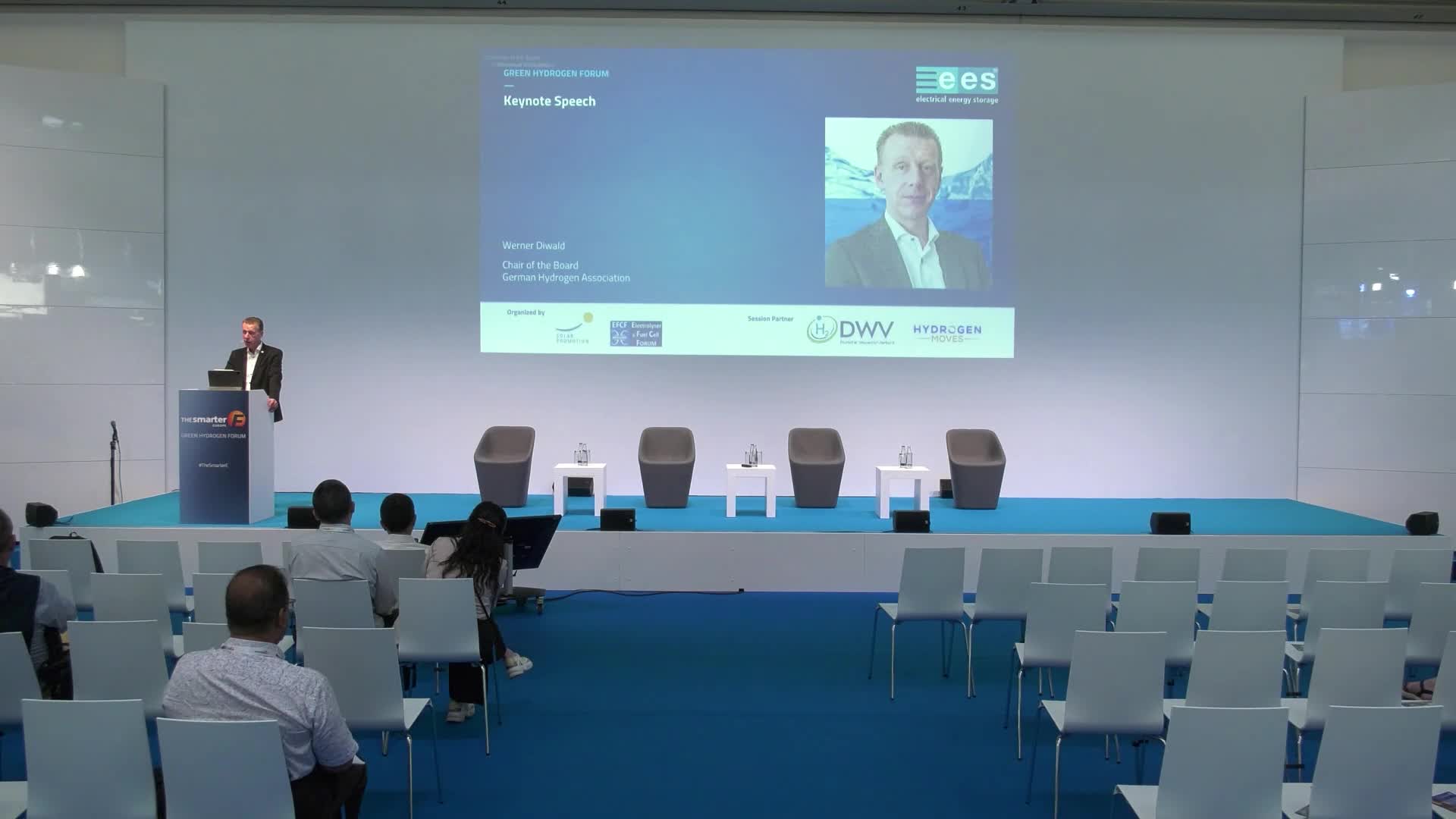
Keynote

premium account

Recording of Friday, June 21, 2024 | The smarter E Europe | Exhibition Program | Language: English | Duration: 43:54 .

Urgent Call for German Government Action to Boost Green Hydrogen Market at EES Fair Keynote

In a keynote speech at the EES Fair's hydrogen session on financing the energy revolution, the speaker emphasized the urgent need for Germany to expedite its efforts in developing a green hydrogen market economy. Despite public perception that progress is being made, actual advancements in Germany are lagging due to excessive discussions rather than decisive actions. The German government must seize this opportunity to build a resilient and efficient energy system that can compete globally. The speaker called for substantial political and financial support from the federal government, stressing that mere promises of limited funding will not suffice. A proposed 100 billion euro Hydrogen Future Fund over seven years aims to secure Germany’s position as a leader in hydrogen technology with an anticipated annual turnover of 2,500 billion euros. Key action areas include accelerating renewable energy expansion, establishing robust infrastructure across Europe, promoting green industrial processes, ensuring competitive conventional production during transitions, and encouraging investments through reliable policies. The High Guide 2030 outlines 85 strategic measures developed by industry experts aiming for climate neutrality by 2045 while securing economic growth and job creation. Six main guidelines were suggested: 1. Government investment and promotion of renewable energies. 2. Sector-wide adoption of hydrogen. 3. Investment in infrastructure and storage systems. 4. Streamlining planning processes. 5. Developing future-oriented engineering industries. 6. European cooperation strategies. Ultimately, immediate action is necessary to transform announcements into concrete frameworks conducive to large-scale production capacities essential for maintaining Germany's industrial leadership amidst global competition challenges.

Automated summarization by AI Conver

Werner Diwald
Chairman of the Board
German Hydrogen Association
Germany

In this panel session, the challenges to finance hydrogen projects are discussed. What are the obstacles and risks for private investors? Do we need more safeguarding for private investors? How can investors make an impact with their investments? How will private investors support the energy transition?

Further Talks of this session:

Speaker

Silke Frank
Managing Director (Moderatorin)
Hydrogen Moves GmbH
Germany

To Talk

Speaker

Rainer Gehrung
CFO/CSO
Home Power Solutions
Germany

To Talk

Speaker

Werner Diwald
Chairman of the Board
German Hydrogen Association
Germany

Marcel D. Werner
Partner
SENCO Capital
Germany

Rainer Gehrung
CFO/CSO
Home Power Solutions
Germany

Silke Frank
Managing Director (Moderatorin)
Hydrogen Moves GmbH
Germany

Dr. Alexander Budzinski
Partner Advisory
Grant Thornton AG Wirtschaftsprüfungsgesellschaft

To Talk

Further Content
Webinar Collection
Mixed Investment Solar Projects in Mexico: The 54% Model Explained

January 29, 2026

Mexico has introduced a new mixed investment scheme for renewable power generation, requiring a minimum 54% direct or indirect participation by CFE.

Adriana Fricke, Robin Berg
Has Vehicle-to-Grid Reached the Tipping Point?

The smarter E Podcast Episode 248 | Language: English

February 5, 2026

Why 2026 could be a turning point for bidirectional EV charging – from regulation to large V2G fleets in Europe.

Business Visibility
Sponsoring & Marketing Overview

All sponsorship and marketing opportunities at a glance: Find the ideal marketing mix for your company.

The smarter E Europe Conferences 2025
Factors That Influence the Success of a Minigrid Project

Wednesday, May 07, 2025, 11:00 am - 12:30 pm

The smarter E Europe Conferences 2025 | Conference Program

premium account

Off-grid solar systems are often the least expensive option for rural electrification. Solar home systems can power individual households, while mini-grids can supply entire villages. Each comes with its own advantages, disadvantages, and challenges. The aim of this session is to explore challenges as well as success stories. It takes well-functioning components such as battery systems, charge management and inverters to make projects successful. Proper system sizing, maintenance and repair management, as well as a robust financial concept are also necessary. If one of these elements is missing, the electrification will not be sustainable. This session will focus on the aspects mentioned above. The speakers will present successful and unsuccessful approaches and discuss what can be learned from them.

The smarter E Europe Conferences 2025
Q&A Session of of the Session Off-Grid: Rural Electrification Based on Solar Systems - Lessons Learned

Wednesday, May 07, 2025, 11:00 am - 12:30 pm

The smarter E Europe Conferences 2025 | Conference Program

premium account

Off-grid solar systems are often the least expensive option for rural electrification. Solar home systems can power individual households, while mini-grids can supply entire villages. Each comes with its own advantages, disadvantages, and challenges. The aim of this session is to explore challenges as well as success stories. It takes well-functioning components such as battery systems, charge management and inverters to make projects successful. Proper system sizing, maintenance and repair management, as well as a robust financial concept are also necessary. If one of these elements is missing, the electrification will not be sustainable. This session will focus on the aspects mentioned above. The speakers will present successful and unsuccessful approaches and discuss what can be learned from them.

You are using an outdated browser

The website cannot be viewed in this browser. Please open the website in an up-to-date browser such as Edge, Chrome, Firefox, or Safari.