LDES and the Iron Salt Battery: Clean, Affordable, and Capable Energy Storage for the Path to Net Zero

premium account

Recording of Thursday, June 20, 2024 | The smarter E Europe | Exhibition Program | Language: English | Duration: 11:56 .

"Thibaut Duby from World Storage Presents Innovative Iron-Soled Battery Solution to Achieve 24-7 Renewable Energy and Support Net-Zero Electricity Systems at EES Event."

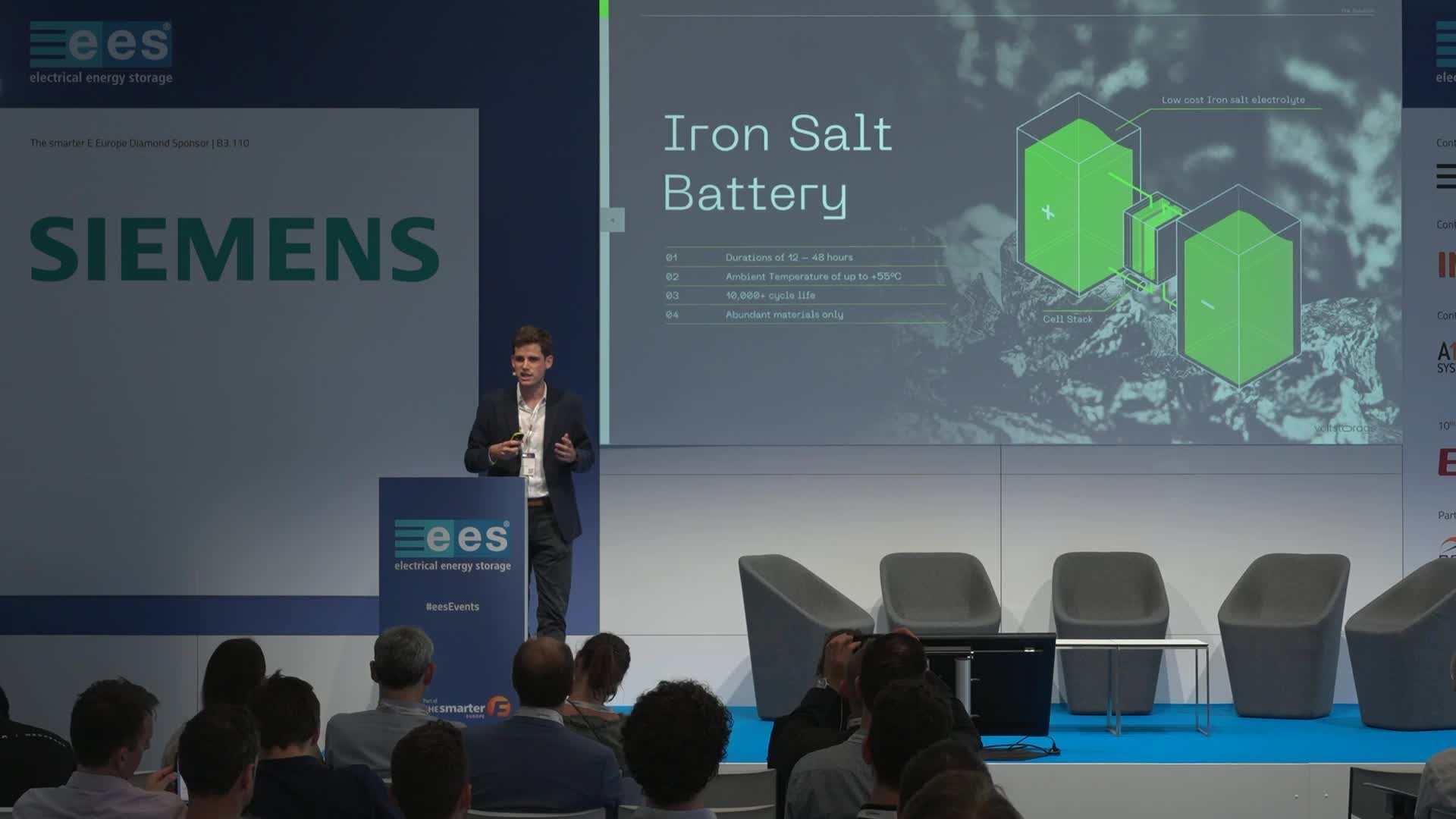
Thibaut Duby, responsible for business development at World Storage, introduces the company's innovative solution to achieving net zero in electricity systems: the iron-soled battery. Founded in 2016 in Munich, World Storage aims to make renewable energy available 24-7 through this breakthrough technology. The iron-soled battery leverages Redox flow concepts with separate cell stacks and electrolyte tanks that offer scalability and cost efficiency. This system can withstand high temperatures up to 55 degrees Celsius, lasts up to 10,000 cycles (translating into roughly 25-30 years), and relies on abundant local materials rather than rare earth metals. Duby emphasizes long-duration storage's importance for consistent green energy availability by citing a case where renewables alone only provide base load power about 55% of the time annually. Adding long-duration storage increases this figure significantly. He also discusses Germany’s future renewable targets and anticipates their technology meeting various durations of "dunkelflutter" events—periods with minimal solar or wind energy production. World Storage has a roadmap leading to large-scale deployments by late 2028 after demonstrating their first unit by end of 2025. They have substantial experience from deploying over 250 Redox floor systems globally. A significant case study involves AquaPower in the Middle East, where they aim to replace oil and gas turbines powering desalination plants with solely renewable energy using their iron-soled batteries designed for harsh environments.

Automated summarization by AI Conver

Storing energy for longer can safely provide additional flexibility for a power system relying on renewable energy sources, and thus plays an important role in a successful energy transition. Co-hosted by LDES and IBESA, this session will dive headfirst into the topic of long duration energy storage systems - learn about current market dynamics, technologies and more!

Further Talks of this session:

To Talk

To Talk

To Talk

To Talk

To Talk

Further Content
Webinar Collection
Demand-side flexibility in action: Real-world strategies for energy-intensive industries

May 5, 2026

free account

Webinar showing how flexibility can reduce energy costs and strengthen competitiveness.

Battery Business & Development Forum
Capital Flows into BESS: Where Investors Put Money and What They Expect Now

Tuesday, March 31, 2026 10:00am–11:15am

premium account

Capital for battery storage is available — but it is becoming more selective.

Battery Business & Development Forum
BESS Routes-to-Market in Europe: Merchant, Capacity, and Tolling — What Works Where

Tuesday, March 31, 2026 11:45am–1:00pm

premium account

This session breaks down the three dominant routes-to-market in Europe and examines where they work in practice, how they are structured, and what risks they carry.

Battery Business & Development Forum
Deep Dive: Resilient Grids with Grid-Forming Batteries: Market Opportunities and Technical Pathways

Tuesday, March 31, 2026 11:45am–1:00pm

premium account

This session highlights their growing role in grid stability, including grid-forming, voltage control, congestion management and system support across transmission and distribution networks.

Battery Business & Development Forum
Deep Dive Europe 1: What’s Brussels’ Plan for Battery Storage in European Markets

Tuesday, March 31, 2026 2:00pm–3:15pm

premium account

The session explores how EU strategies - under all relevant policy frameworks, including a dedicated Energy Storage Strategy under preparation — aim to scale storage deployment, strengthen flexibility markets, and accelerate integration into a resilient, renewables-based power system across EU member states.

You are using an outdated browser

The website cannot be viewed in this browser. Please open the website in an up-to-date browser such as Edge, Chrome, Firefox, or Safari.