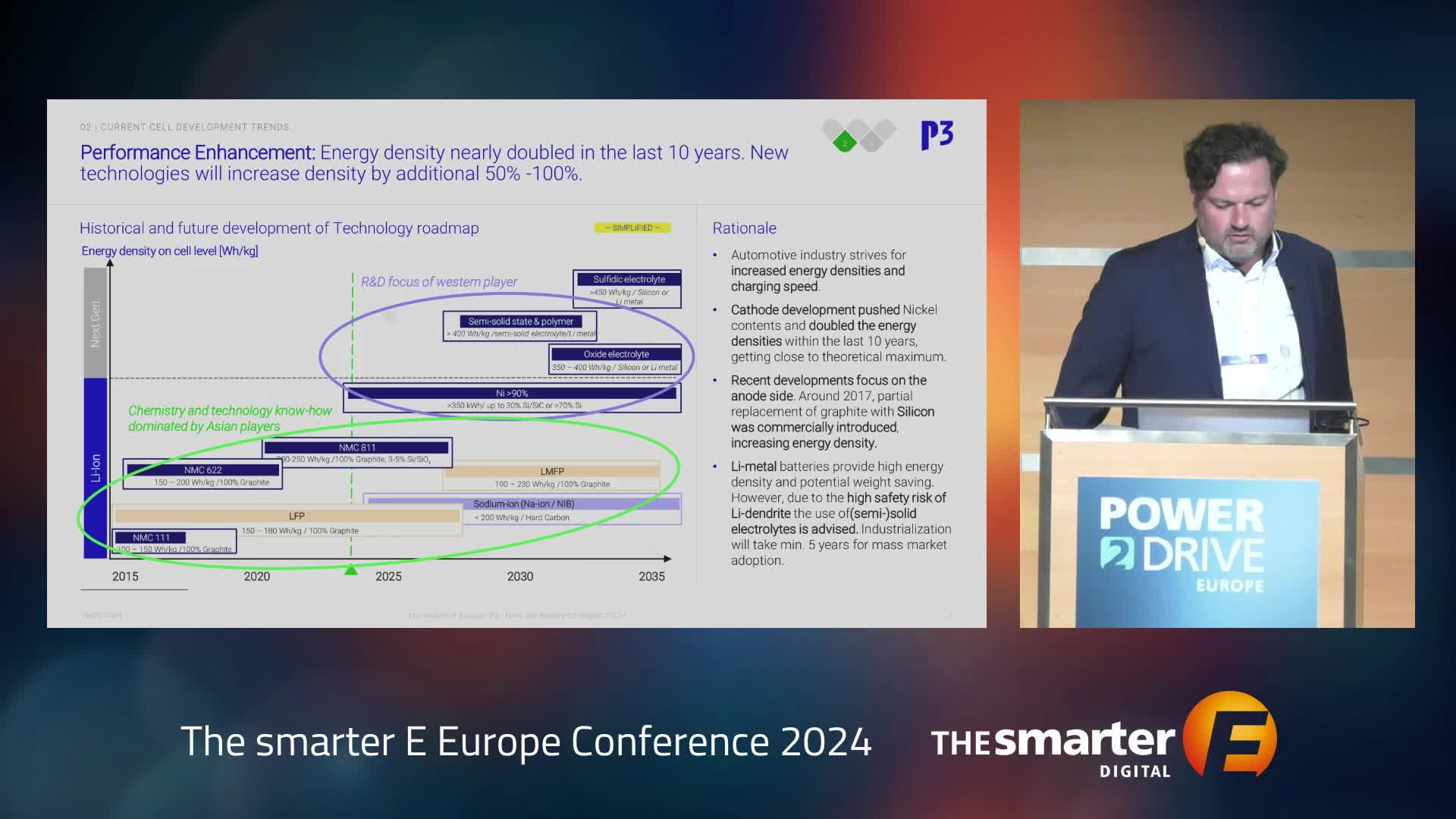
Next-Gen Battery Strategies 2027+: Potentials and Challenges for Future Battery Designs and Diversification in Product Portfolios to Serve a Large Bandwidth of Market Applications.

premium account

Recording of Wednesday, June 19, 2024 | The smarter E Europe | Conference Program | Language: English | Duration: 14:12 .

Future of Battery Technology: Industry Veteran Discusses Next-Gen Designs, Market Trends, and Cost Innovations Towards 2027 and Beyond

The presentation discusses the future of battery technology, focusing on developments up to 2027 and beyond. The speaker outlines key aspects such as development strategies, sales projections, next-generation battery designs, application trends, and cost implications. Starting with a historical perspective from their experience in hybridizing the Mercedes S-Class in 2006 to recent advancements like those in the Nissan Leaf by 2015, they highlight significant progress in energy density and capacity over time. Key industry players are discussed, particularly CATL's rise to dominance due to rapid innovation cycles when compared with traditional Western manufacturers. Tesla is noted as a benchmark for industrialization efficiency and cost-performance metrics within six months; its Model S, Y, and 3 showcase different batteries optimized for performance while keeping costs low. Emerging trends include blending NMC (Nickel Manganese Cobalt) with LFP (Lithium Iron Phosphate) compositions for better price-performance ratios suitable for diverse applications like automotive tracks. The supply chain remains Asia-centric despite efforts at localization by companies such as Northwell in Europe. Overall improvements are seen across energy densities rising while prices drop due to these technological innovations.

Automated summarization by AI Conver

Markus Hackmann
Managing Director
P3 Group GmbH
Germany

Batteries are at the heart of any electric vehicle. Their design determines the vehicle's range, charging speed, performance in cold weather, fire safety and many other properties. The speed of development has been immense, as new cell chemistries such as LFP, sodium-ion and solid state batteries are pushing into the market. Significant progress has been made with monitoring battery usage with a view to design optimization so that the battery performance is maximized without accelerating the ageing process. In this session, we share insights on the performance of today's vehicle batteries and future technological developments.

Further Talks of this session:

Speaker

Dr. Christopher Hecht
Data Scientist
ISEA Institute, RWTH Aachen University
Germany

To Talk

Speaker

Andreas Richter
R&D Manager
DEKRA SE

To Talk

Speaker

Dr. Jonas Böhm
TWAICE
Germany

To Talk

Speaker

Luke Hu
General Manager, Global Business
Electroder
Germany

To Talk

To Talk

Further Content
James Allston, Marko Topič
Keep Calm and Deploy Solar (and Batteries)

The smarter E Podcast Episode 254 | Language: English

April 30, 2026

How European businesses use solar, batteries and EV fleets to manage volatile power prices and explore the future of perovskite solar.

Gautham Ram Chandra Mouli, Ruben Valiente
Beating the Blockade with EVs and Batteries

The smarter E Podcast Episode 253 | Language: English

April 16, 2026

Flexibility as a hedge: How V2G and battery storage reduce fossil fuel reliance and turn electric transport into a strategic asset for grid stability.

Marcel Rümenapf
Will Soaring Fuel Costs Make eMobility Mass Market? – With Marcel Rümenapf

The smarter E Podcast Episode 256 | Language: English

May 28, 2026

Siemens’ Marcel Rümenapf explains why eMobility is becoming a strategic advantage for European logistics fleets.

Thomas Raffeiner and Petrouschka Werther
What EV Acceleration Means for the Grid

The smarter E Podcast Episode 260 | Language: English

July 9, 2026

Cars as batteries on wheels: Thomas Raffeiner and Petrouschka Werther discuss how V2G and smart charging turn EVs into critical grid assets.

The smarter E Europe Conferences 2026
Panel Discussion of the Session: User Success Stories and Best Cases

Tuesday, June 23, 2026, 02:30 pm

The smarter E Europe Conferences 2026 | Conference Program

premium account

For more than two decades, Norway has been steadily building a marketplace for electric transport. Having started out with inexpensive short-range electric cars and household charging sockets, Norway has now moved to mass-market solutions where fast charging (DC) and grid balancing (AC) plays an ever more vital role. With more than 1,000,000 electric cars and over 10,000 fast chargers in a relatively small market, Norway offers a rare early view of large-scale electrification. Over the past decade, electric cars have seen substantial improvements, which is now making it easier for new markets to advance electrification. At the same time, Norway has to deal with challenges years before other markets do. Yet despite different starting points, we can see that most markets are facing the same core challenges. From grid-smart charging strategies to innovative business models, there are excellent examples of best practices emerging elsewhere in Europe. What will the next thing in electrification be, both in mature and in emerging markets? And what will be possible when the right people and companies come together, sharing knowledge, solving common problems and accelerating the shift to cleaner mobility?

You are using an outdated browser

The website cannot be viewed in this browser. Please open the website in an up-to-date browser such as Edge, Chrome, Firefox, or Safari.