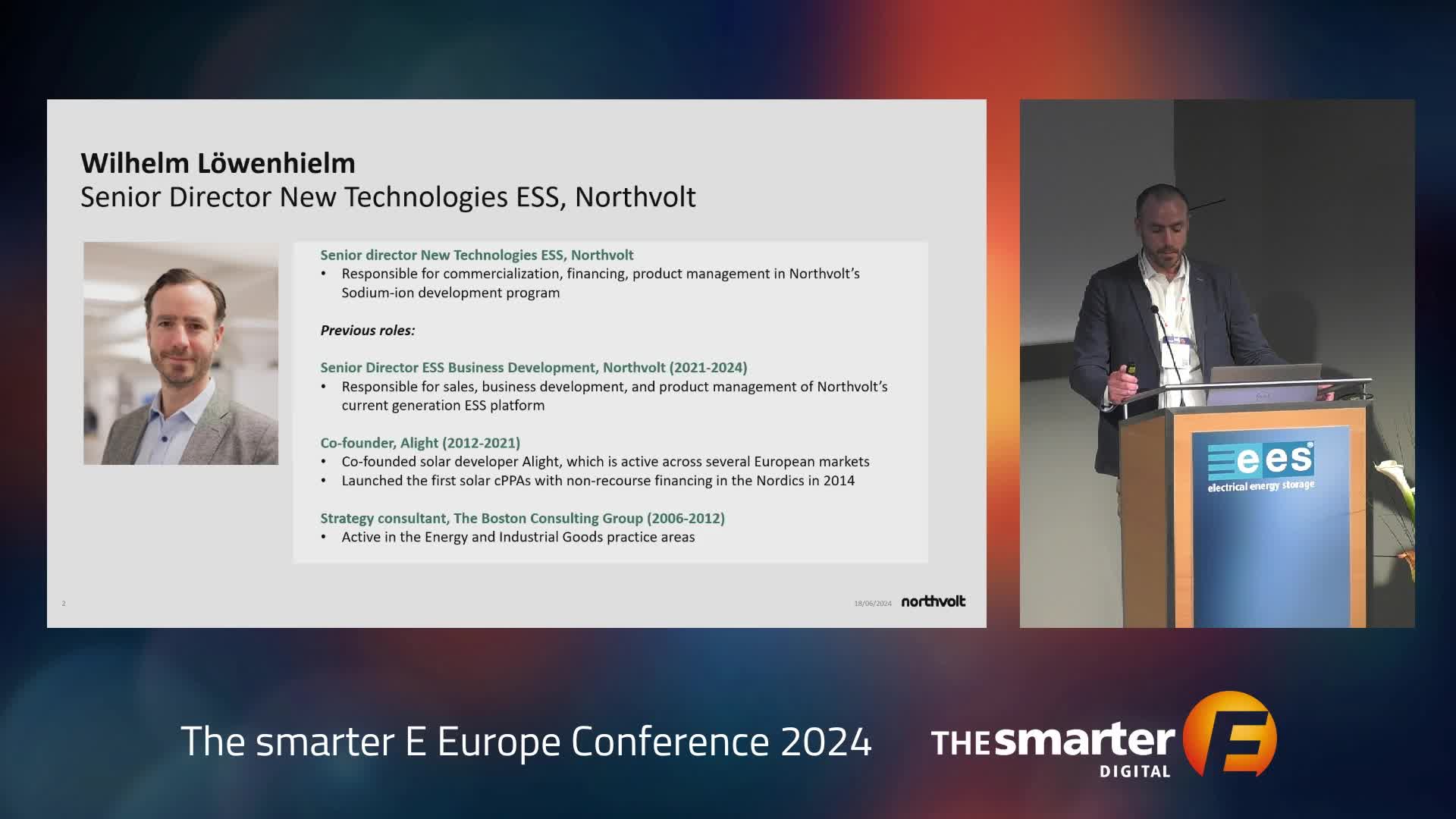
Perspectives on LDES Wilhelm Löwenhielm

premium account

Recording of Tuesday, June 18, 2024 | The smarter E Europe | Conference Program | Language: English | Duration: 8:50 .

Northvolt Expands Gigafactory While Embracing Lithium and Sodium Ion Technologies for Future Energy Storage Needs

Wilhelm Löwenhielm, an employee at Northvolt, a Sweden-based battery manufacturer, discusses his work with energy storage systems. Northvolt caters primarily to the automotive sector but also supports industrial vehicles and energy storage applications. The company’s first gigafactory in Skellefteå is set to expand its annual capacity from 16 gigawatt hours to 60 gigawatt hours within a few years. Löwenhielm recently transitioned into working on sodium-ion technologies but emphasizes the continued relevance of lithium-ion technology for long-duration energy storage. He notes that despite recent remarkable cost reductions for lithium-ion cells and an oversaturated market driving prices down further, lithium-ion remains highly bankable due to its decade-long operational data. He highlights challenges such as competitive pricing pressures from Chinese manufacturers and stresses the importance of anticipating future market needs rather than focusing solely on current profitability. While acknowledging the limitations of batteries for extremely long durations, he believes that both lithium-ion and emerging sodium-ion technologies will continue dominating the market over the next decade due to their efficiency and scalability advantages. Sodium-ion batteries are poised as a promising alternative by mitigating issues related to critical raw materials and price volatility seen in lithium variants. This new technology could establish a lower-cost benchmark without relying on scarce resources like cobalt or experiencing drastic price fluctuations tied to lithium carbonate costs. In summary, while fostering innovation in various battery technologies is crucial for enabling grid transitions away from fossil fuels, Löwenhielm sees significant potential in enhancing existing solutions like lithium-ions alongside developing scalable alternatives like sodium-ions.

Automated summarization by AI Conver

Wilhelm Löwenhielm
Senior Director ESS
Northvolt
Sweden

Long-duration energy storage (LDES) is undoubtedly a key enabler for achieving net-zero. However, despite a wide range of technology providers claiming cost competitiveness and other advantages over lithium-ion batteries, the latter continue to dominate new deployments in Europe and elsewhere. So what's holding LDES back? What is needed to enable more widespread adoption? And when will the age of LDES finally arrive?In this panel, experts will provide an assessment of the suitability of LDES for today's market, the barriers that exist and the requirements and likely timeline for LDES to finally become mainstream.

Further Talks of this session:

Speaker

Dr. Oliver Schmidt
CEO
dvlp.energy
Germany

To Talk

Speaker

Susan Taylor
Senior Analyst
S&P Global

To Talk

Speaker

Julia Souder
CEO
LDES Council
Belgium

To Talk

Speaker

Laurent Segalen
CEO
Megawatt-X
United Kingdom

To Talk

Speaker

Jan Andersson
Director, Global Market Development
Sumitomo SHi FW
Finland

To Talk

To Talk

Further Content
Thaddäus Kreisig
Stack ’Em Up: Germany’s Big Battery Inflection Point – with Thaddäus Kreisig

The smarter E Podcast Episode 265 | Language: English

September 16, 2026

Discover how Germany's solar surge is driving a gigawatt-scale battery boom, the revenue models making projects viable, and the hurdles ahead.

The smarter E Europe Conference 2023
Zinc-Ion Batteries: The Key to Sustainable Energy Storage in Europe

Tuesday, June 13, 2023, 04:30 pm - 06:00 pm

The smarter E Europe Conference 2023 | Conference Program

free account

Technology is the key to battery storage markets developing at a rapid pace. Just look at the way system costs have dropped drastically in recent years as a result of progress in the development of battery materials and battery cells and advancement in storage system technology.In the diverse stationary markets in particular, opportunities for technological alternatives to the lithium-ion battery are being opened up. In this session, you can hear from experts directly about current progress in the development of specific battery technologies and learn about the impact those battery technologies are set to have on the market for electrical energy storage systems in the near future.

Publications
European Market Outlook for Battery Storage 2025–2029

Comprehensive analysis of Europe’s battery storage market – now available for download

The smarter E Europe Conference 2023
NAS Batteries for Long-Duration Stationary Energy Storage

Tuesday, June 13, 2023, 04:30 pm - 06:00 pm

The smarter E Europe Conference 2023 | Conference Program

free account

Technology is the key to battery storage markets developing at a rapid pace. Just look at the way system costs have dropped drastically in recent years as a result of progress in the development of battery materials and battery cells and advancement in storage system technology.In the diverse stationary markets in particular, opportunities for technological alternatives to the lithium-ion battery are being opened up. In this session, you can hear from experts directly about current progress in the development of specific battery technologies and learn about the impact those battery technologies are set to have on the market for electrical energy storage systems in the near future.

The smarter E Europe Conference 2023
Technology Innovation vs. Market Design Innovation - What Will Come First To Help Long-Duration Energy Storage in the EU? - The Vanadium Redox Flow Battery Case

Tuesday, June 13, 2023, 02:30 pm - 04:00 pm

The smarter E Europe Conference 2023 | Conference Program

free account

The pressing need to mitigate the impact of climate change and to deal with the ongoing energy crisis requires a new regulatory framework in Europe. This is why the European Commission has presented a legislative proposal for the adaptation of the EU Electricity Market Design in Q1 2023. But how would this new framework impact the energy storage market? How would the provision of flexibility be encouraged? How would existing entry barriers for energy storage be further reduced? In this panel, representatives from the EU, utilities, IPPs and storage providers will be discussing whether the new market design is suitable for incentivizing both the necessary energy storage installations and ideas for future improvements.

You are using an outdated browser

The website cannot be viewed in this browser. Please open the website in an up-to-date browser such as Edge, Chrome, Firefox, or Safari.