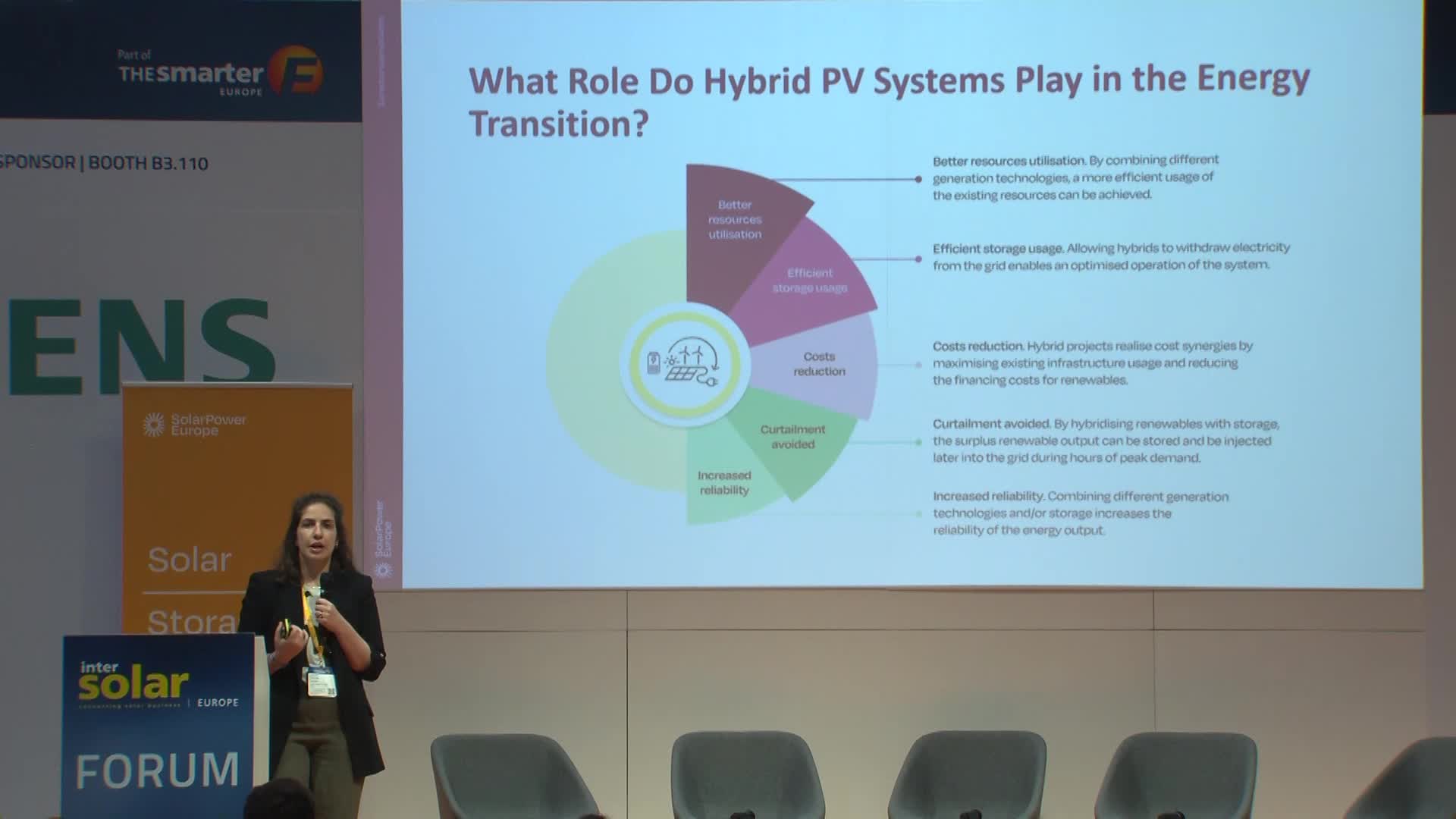
Presentation of SolarPower Europe Hybrid PV Systems Report

premium account

Recording of Thursday, May 08, 2025 | The smarter E Europe Exhibition Program 2025 | Exhibition Program | Language: English | Duration: 17:58 .

Solar Power Europe Report Emphasizes Digitalization and Storage in Advancing PV Hybrid Systems for Energy Transition

The presentation centered on a report by Solar Power Europe about photovoltaic (PV) hybrid systems and their integration with other technologies. The focus was to clarify misconceptions, highlight challenges and benefits, and address regulatory hurdles for broader adoption of these systems. As a trade association with over 320 members across the solar industry spectrum, Solar Power Europe emphasizes viewing energy transition as an integrated process promoting decarbonization through solar PV. Hybrid systems combine complementary technologies at shared connection points; they can be co-located or fully hybridized setups like wind power plants combined with solar installations to enhance grid stability and reduce curtailment. These systems are gaining market presence in combinations such as PV plus wind/batteries due to better resource utilization, cost reductions from shared connections, enhanced grid stability via efficient storage use, along with policy recommendations aimed at improving renewable integration into grids. Digitalization's role is crucial for interoperability between different technologies ensuring system operators' flexibility and stability. Clear guidance is needed for collocated systems regarding communication responsibilities among various technology components—Poland’s approach serves as an example within European discussions. Integrating advanced storage solutions alongside renewables remains challenging but essential for achieving full base load capacity prompting ongoing policy dialogues throughout Europe. Further engagement opportunities were offered during scheduled events emphasizing how combining regional geographic conditions of solar and wind reduces curtailment issues while enhancing grid reliability without significant production cuts.

Automated summarization by AI Conver

Catarina Augusto
Senior Advisor on Grids & Flexibility
SolarPower Europe

As the energy landscape evolves, grids must adapt to support the growing integration of renewables, particularly solar. Meeting the EU's targets requires significant investment and time, making it essential to optimize existing infrastructure and align grid expansion with flexible solutions. This session will showcase projects and provide insights into hybrid utility-scale systems, exploring how solar, combined with technologies like storage and wind, can address grid challenges and drive regulatory reforms for faster renewable integration.

Further Talks of this session:

Dries Acke
Deputy CEO
SolarPower Europe

To Talk

Speaker

Humberto Loureiro
Head of Project Management
EDP Renewables

To Talk

Speaker

Johannes Ott
Project Manager
ABO Energy

To Talk

Speaker

Jan Kloczko
Deputy Commercial Director
GreenVolt

To Talk

To Talk

Further Content
Webinar
Mixed Investment Solar Projects in Mexico: The 54% Model Explained

January 29, 2026

Mexico has introduced a new mixed investment scheme for renewable power generation, requiring a minimum 54% direct or indirect participation by CFE.

Anna Darmani, Principal Analyst from Wood Mackenzie
Big BESS Is Here to Save the Day

The smarter E Podcast Episode 246 | Language: English

January 8, 2026

Utility-scale batteries are booming in Europe. Discover key BESS trends, market impacts, and what to expect for large-scale storage in 2026.

The smarter E Europe Conferences 2025
Setting the Scene "Off-Grid"

Wednesday, May 07, 2025, 04:00 pm - 05:30 pm

The smarter E Europe Conferences 2025 | Conference Program

premium account

Photovoltaic prices have fallen continuously in recent years - a trend that should translate into a growing market for off-grid solutions. Declining costs are crucial for rural electrification in particular, making sustainable energy supply economically viable in remote regions. However, so far many of these price advantages have not yet reached the people that need them most. Do existing framework conditions to foster rural electrification still work in this new market reality? Which measures are needed to ensure that cost reductions reach our target group? This session discusses strategies for improving the availability of low-cost off-grid solutions, financing and innovative business models. A look at successful practical examples shows which political, economic and technological levers need to be pulled to make off-grid PV accessible on a large scale.

The smarter E Europe Conferences 2025
Factors That Influence the Success of a Minigrid Project

Wednesday, May 07, 2025, 11:00 am - 12:30 pm

The smarter E Europe Conferences 2025 | Conference Program

premium account

Off-grid solar systems are often the least expensive option for rural electrification. Solar home systems can power individual households, while mini-grids can supply entire villages. Each comes with its own advantages, disadvantages, and challenges. The aim of this session is to explore challenges as well as success stories. It takes well-functioning components such as battery systems, charge management and inverters to make projects successful. Proper system sizing, maintenance and repair management, as well as a robust financial concept are also necessary. If one of these elements is missing, the electrification will not be sustainable. This session will focus on the aspects mentioned above. The speakers will present successful and unsuccessful approaches and discuss what can be learned from them.

The smarter E Europe Conferences 2025
Q&A Session of of the Session Off-Grid: Rural Electrification Based on Solar Systems - Lessons Learned

Wednesday, May 07, 2025, 11:00 am - 12:30 pm

The smarter E Europe Conferences 2025 | Conference Program

premium account

Off-grid solar systems are often the least expensive option for rural electrification. Solar home systems can power individual households, while mini-grids can supply entire villages. Each comes with its own advantages, disadvantages, and challenges. The aim of this session is to explore challenges as well as success stories. It takes well-functioning components such as battery systems, charge management and inverters to make projects successful. Proper system sizing, maintenance and repair management, as well as a robust financial concept are also necessary. If one of these elements is missing, the electrification will not be sustainable. This session will focus on the aspects mentioned above. The speakers will present successful and unsuccessful approaches and discuss what can be learned from them.

You are using an outdated browser

The website cannot be viewed in this browser. Please open the website in an up-to-date browser such as Edge, Chrome, Firefox, or Safari.