Quantifying the Impact of Dust and Snow on PV Power Plants

premium account

Recording of Wednesday, May 07, 2025 | The smarter E Europe 2025 | Conference Program | Language: English | Duration: 14:03 .

Exploring Advanced PV Soiling Models: Dust, Snow, and Pollen Impact on Solar Yield Predictions

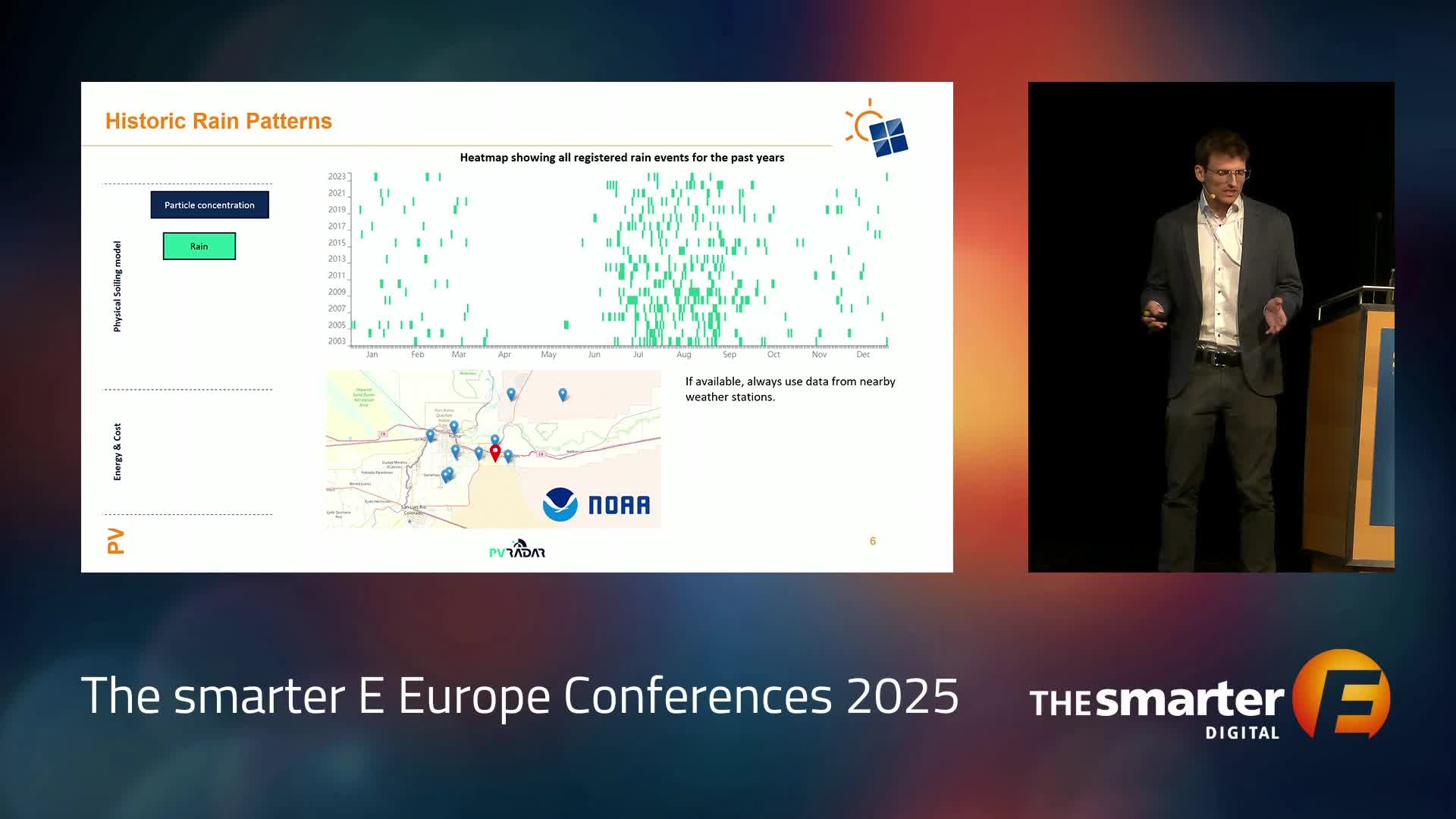
Thore Müller, representing a Munich-based software and consultancy company specializing in complex modeling for the photovoltaic (PV) sector, discusses soiling—a key factor affecting solar panel efficiency. The focus is on dust, snow, and pollen soiling types while excluding more localized sources like agriculture or wildlife. Dust soiling involves dry particles that rain can wash away; it’s modeled using fixed rate models or particle deposition models such as Kimber's model and HSU's model. PVRADAR Labs GmbH has developed its own similar particle deposition model used to assess potential losses at locations like Yuma, Arizona by analyzing particulate matter concentrations from datasets like MERA2 alongside rainfall data. This approach helps determine average monthly losses due to dust accumulation and evaluate cleaning strategies' cost-effectiveness based on energy sales prices versus costs involved. Snow-related issues are addressed with popular models simulating accumulations impacting irradiance levels during winter months in northern regions—highlighting significant seasonal variations in production loss percentages compared across multiple years of historical data analysis for optimal strategy development tailored towards specific environmental conditions encountered within arid environments particularly emphasized herein!

Automated summarization by AI Conver

Thore Müller
CEO
PVRADAR Labs GmbH
Germany

The increase in frequency and intensity of severe weather events associated with global climate change poses a growing risk to PV systems worldwide. These local and global risks range from outright destruction of power plants to long-term performance losses due to accelerated component and system degradation. Without concerted and event-specific resilience strategies, severe weather increasingly threatens the robustness and availability of PV generation worldwide. This session will: Raise awareness of climate change and its implications for a solar-intensive energy economy Present a range of extreme-weather events that can impact PV power plants and identify/quantify the risks Share strategies for designing and siting storm-resilient PV systems Provide information on failure mechanisms and their root causes.

Further Talks of this session:

Speaker

Ulrike Jahn
Senior Scientist
Fraunhofer Center for Silicon-Photovoltaics CSP
Germany

To Talk

Speaker

Dr. Laurie Burnham
Principal Member of the Technical Staff
Sandia National Laboratories
United States

To Talk

Speaker

Giosue Maugeri
Researcher
Ricerca sul sistema Energetico - RSE SpA
Italy

To Talk

Speaker

Prof. Leonardo Micheli
Associate Professor
Sapienza University of Rome
Italy

To Talk

Speaker

Jonathan Leloux
Managing Director
LuciSun
Belgium

To Talk

Further Content
Webinar
Mixed Investment Solar Projects in Mexico: The 54% Model Explained

January 29, 2026

Mexico has introduced a new mixed investment scheme for renewable power generation, requiring a minimum 54% direct or indirect participation by CFE.

Anna Darmani, Principal Analyst from Wood Mackenzie
Big BESS Is Here to Save the Day

The smarter E Podcast Episode 246 | Language: English

January 8, 2026

Utility-scale batteries are booming in Europe. Discover key BESS trends, market impacts, and what to expect for large-scale storage in 2026.

The smarter E Europe Conferences 2025
Factors That Influence the Success of a Minigrid Project

Wednesday, May 07, 2025, 11:00 am - 12:30 pm

The smarter E Europe Conferences 2025 | Conference Program

premium account

Off-grid solar systems are often the least expensive option for rural electrification. Solar home systems can power individual households, while mini-grids can supply entire villages. Each comes with its own advantages, disadvantages, and challenges. The aim of this session is to explore challenges as well as success stories. It takes well-functioning components such as battery systems, charge management and inverters to make projects successful. Proper system sizing, maintenance and repair management, as well as a robust financial concept are also necessary. If one of these elements is missing, the electrification will not be sustainable. This session will focus on the aspects mentioned above. The speakers will present successful and unsuccessful approaches and discuss what can be learned from them.

The smarter E Europe Conferences 2025
Q&A Session of of the Session Off-Grid: Rural Electrification Based on Solar Systems - Lessons Learned

Wednesday, May 07, 2025, 11:00 am - 12:30 pm

The smarter E Europe Conferences 2025 | Conference Program

premium account

Off-grid solar systems are often the least expensive option for rural electrification. Solar home systems can power individual households, while mini-grids can supply entire villages. Each comes with its own advantages, disadvantages, and challenges. The aim of this session is to explore challenges as well as success stories. It takes well-functioning components such as battery systems, charge management and inverters to make projects successful. Proper system sizing, maintenance and repair management, as well as a robust financial concept are also necessary. If one of these elements is missing, the electrification will not be sustainable. This session will focus on the aspects mentioned above. The speakers will present successful and unsuccessful approaches and discuss what can be learned from them.

The smarter E Europe Conferences 2025
Setting the Scene "Affodability"

Wednesday, May 07, 2025, 04:00 pm - 05:30 pm

The smarter E Europe Conferences 2025 | Conference Program

premium account

Photovoltaic prices have fallen continuously in recent years - a trend that should translate into a growing market for off-grid solutions. Declining costs are crucial for rural electrification in particular, making sustainable energy supply economically viable in remote regions. However, so far many of these price advantages have not yet reached the people that need them most. Do existing framework conditions to foster rural electrification still work in this new market reality? Which measures are needed to ensure that cost reductions reach our target group? This session discusses strategies for improving the availability of low-cost off-grid solutions, financing and innovative business models. A look at successful practical examples shows which political, economic and technological levers need to be pulled to make off-grid PV accessible on a large scale.

You are using an outdated browser

The website cannot be viewed in this browser. Please open the website in an up-to-date browser such as Edge, Chrome, Firefox, or Safari.