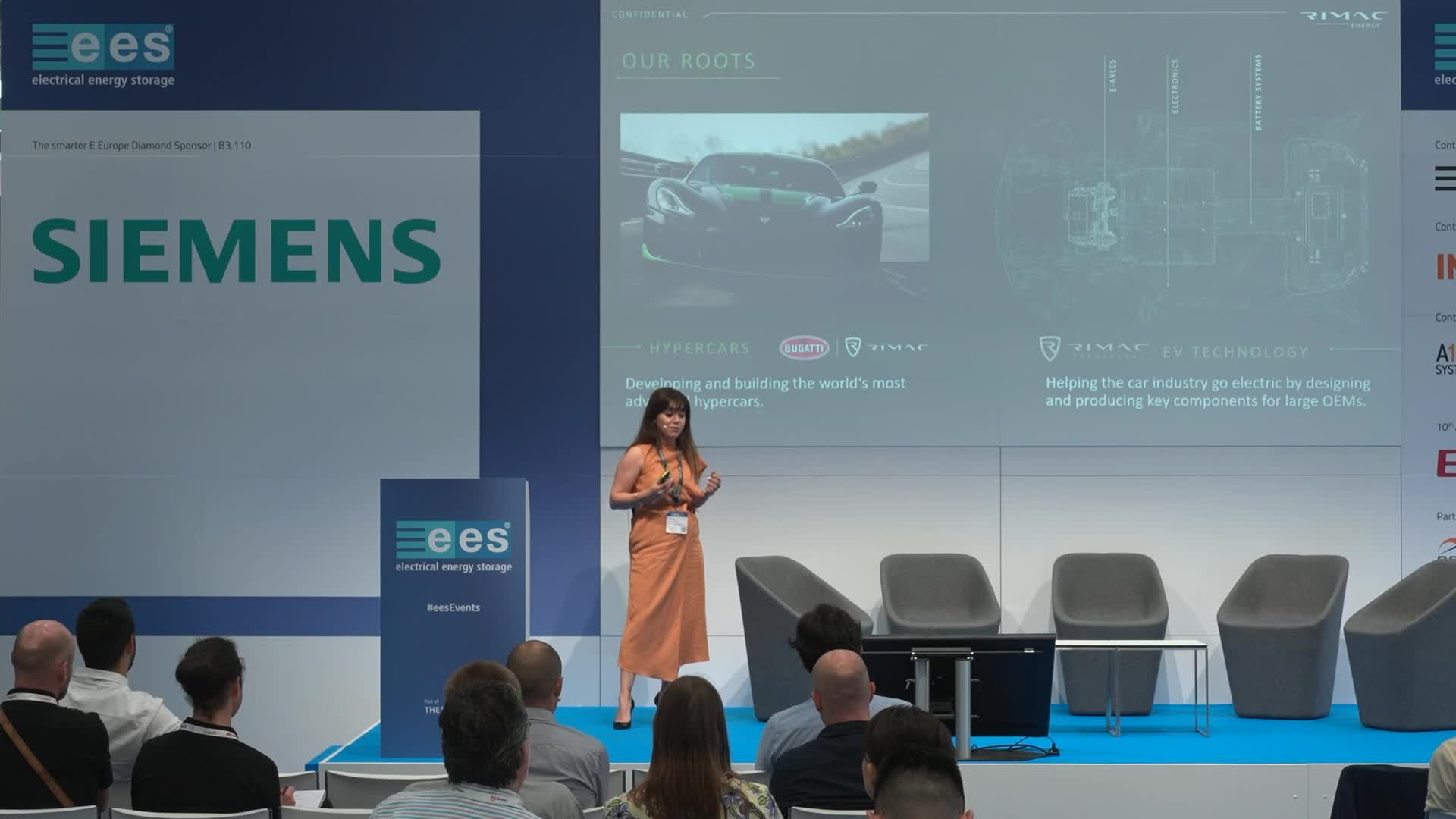
Safety Optimization: Early Detection and Redundancy in Stationary Storage Systems

premium account

Recording of Thursday, June 20, 2024 | The smarter E Europe | Exhibition Program | Language: English | Duration: 9:37 .

Rimac Energy Unveils Advanced Safety Optimization for Stationary Storage Solutions, Highlighting Modular Multi-Level Converter Technology and Robust Mitigation Measures"

Nasrin Shahed Khah from Rimac Energy presents an overview of the company's journey and focus on safety optimization in stationary storage solutions. She starts by discussing Rimac's history, highlighting its origins 15 years ago when their CEO converted a BMW to an electric race car. Since then, they have grown into a tier-one battery supplier for major OEMs like BMW and collaborated with Porsche to develop next-generation hypercars. Rimac has expanded into the ESS (Energy Storage System) market, designing integrated and scalable storage solutions that eliminate centralized inverters using modular multi-level control technology. Emphasizing safety is paramount; hence extensive measures are implemented at various levels—cell, module, rack, stack—to ensure robustness against failures and risks such as fires or explosions. Key strategies include advanced algorithms for real-time monitoring and detection of anomalies, maintaining uniform temperature across modules, hardware protections at multiple levels, fire-resistant housing with comprehensive detection systems, and system redundancy that enhances resilience against single-point failures. The presentation concludes by summarizing these vital approaches: early anomaly detection via algorithms, robust mitigation measures throughout design stages, and ensuring system redundancy through modular converters.

Automated summarization by AI Conver

Under the leadership of VDMA and PEM of RWTH Aachen, this session will focus on battery safety. It is primarily aimed at installers and manufacturers who want to be brought up to date with the latest safety standards and trends in the battery storage market.

Further Talks of this session:

To Talk

To Talk

To Talk

To Talk

Further Content
Gaëtan Masson and Delfina Muñoz
The Challenge in Turning Europe’s PV Research into an Industrial Reality

The smarter E Podcast Episode 266 | Language: English

October 1, 2026

Europe leads in solar research but lags in manufacturing. Jonathan Gifford explores industrial policy and tandem tech with experts.

Thaddäus Kreisig
Stack ’Em Up: Germany’s Big Battery Inflection Point – with Thaddäus Kreisig

The smarter E Podcast Episode 265 | Language: English

September 16, 2026

Discover how Germany's solar surge is driving a gigawatt-scale battery boom, the revenue models making projects viable, and the hurdles ahead.

Publications
European Market Outlook for Battery Storage 2025–2029

Comprehensive analysis of Europe’s battery storage market – now available for download

The smarter E Europe Conference 2023
The Future Role of Flexibility Support Schemes and Their Impact on the Storage Industry in Europe

Tuesday, June 13, 2023, 02:30 pm - 04:00 pm

The smarter E Europe Conference 2023 | Conference Program

The pressing need to mitigate the impact of climate change and to deal with the ongoing energy crisis requires a new regulatory framework in Europe. This is why the European Commission has presented a legislative proposal for the adaptation of the EU Electricity Market Design in Q1 2023. But how would this new framework impact the energy storage market? How would the provision of flexibility be encouraged? How would existing entry barriers for energy storage be further reduced? In this panel, representatives from the EU, utilities, IPPs and storage providers will be discussing whether the new market design is suitable for incentivizing both the necessary energy storage installations and ideas for future improvements.

Webinar
Managing dark doldrums: System solutions for a secure energy transition

December 15, 2026

How can energy supply security be achieved in a climate-neutral energy system? Experts present the results of the Fraunhofer ISE study ‘Renewables 24/7’ and discuss the role of flexible biogas plants in managing periods of dark doldrums and reducing system costs.

You are using an outdated browser

The website cannot be viewed in this browser. Please open the website in an up-to-date browser such as Edge, Chrome, Firefox, or Safari.