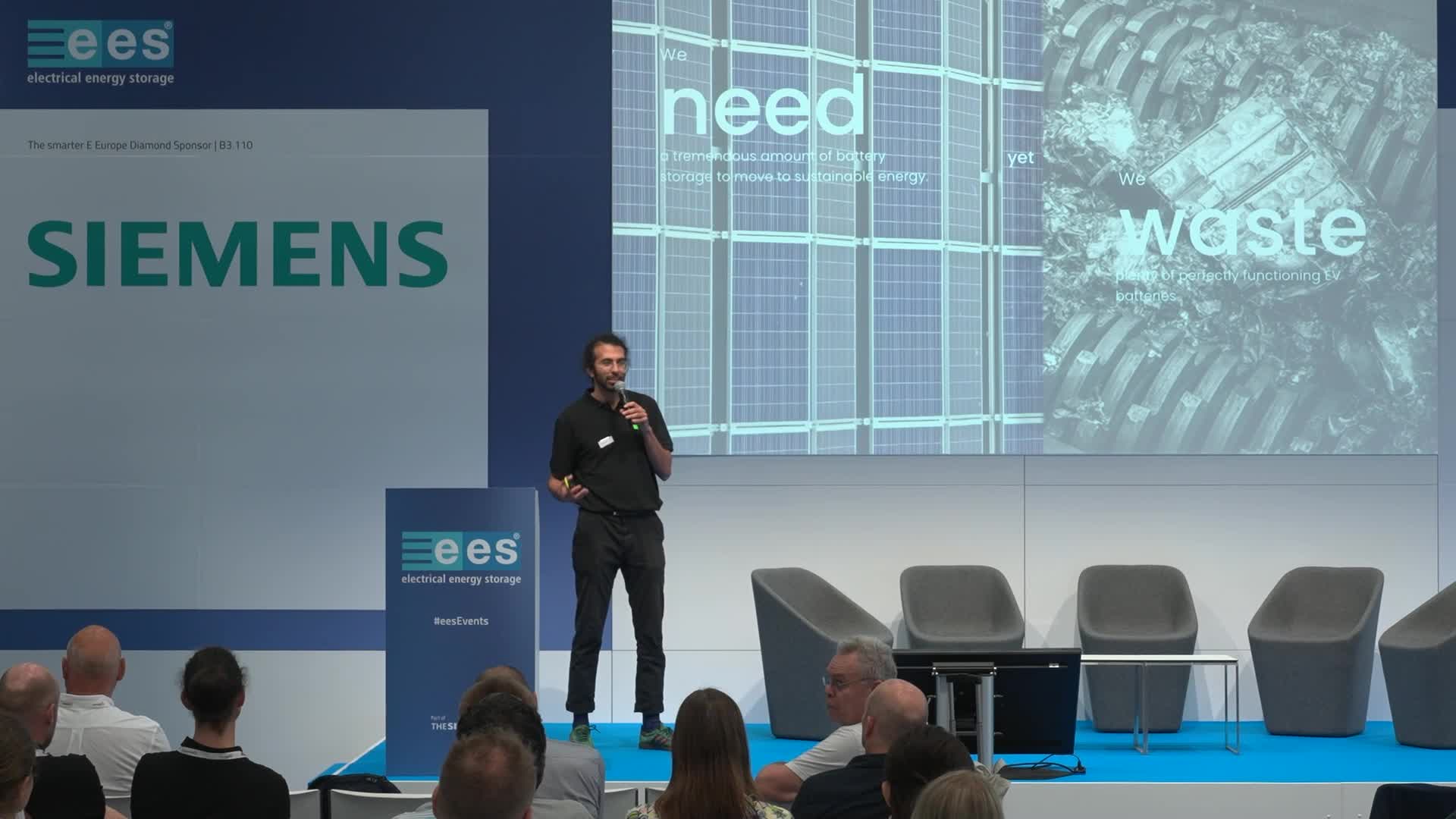
Why Repurposing EV Batteries is Safe and Powerful

premium account

Recording of Thursday, June 20, 2024 | The smarter E Europe | Exhibition Program | Language: English | Duration: 14:07 .

Voltfang's Afshin Doostdar discusses the safety, power, and necessity of repurposing EV batteries for energy storage systems amidst growing automotive battery surplus and recycling challenges

Afshin Doostdar, co-founder and CTO at Voltfang, discusses the importance of repurposing EV batteries for energy storage systems. With an increasing need for gigawatt hours of storage to enable renewable energy transitions, using automotive batteries post their first life in vehicles can be a viable solution given current recycling capacities are insufficient. EV batteries still hold considerable functionality after initial use, making them suitable for stationary applications. Doostdar delineates between "second use" and "second life" batteries; second use refers to unused surplus from production lines while second life denotes those already cycled through vehicle usage. Each type comes with its own characteristics but generally maintains low failure rates due to having passed their early high-failure phase (the 'bathtub curve'). The primary challenges in repurposing include unknown histories of battery modules and heterogeneous conditions among them. Addressing these involves stringent requalification processes—assessing remaining capacity and performance—to ensure safe integration into new systems. Proper system design tailored for stationary applications is also crucial alongside effective operation strategies ensuring longevity and safety monitoring during the second-life period ensures optimal utilization of these resources. Given Europe's predominance in NMC cell chemistries (contrasting Asia's LFP cells), understanding specific chemistry integrations further bolsters successful repurposing endeavors within regional markets.

Automated summarization by AI Conver

Under the leadership of VDMA and PEM of RWTH Aachen, this session will focus on battery safety. It is primarily aimed at installers and manufacturers who want to be brought up to date with the latest safety standards and trends in the battery storage market.

Further Talks of this session:

To Talk

To Talk

To Talk

To Talk

Further Content
Battery Business & Development Forum
BESS Routes-to-Market in Europe: Merchant, Capacity, and Tolling — What Works Where

Tuesday, March 31, 2026 11:45am–1:00pm

premium account

This session breaks down the three dominant routes-to-market in Europe and examines where they work in practice, how they are structured, and what risks they carry.

Battery Business & Development Forum
Capital Flows into BESS: Where Investors Put Money and What They Expect Now

Tuesday, March 31, 2026 10:00am–11:15am

premium account

Capital for battery storage is available — but it is becoming more selective.

Battery Business & Development Forum
Financing BESS: What Banks Accept — and Where Deals Break

Tuesday, March 31, 2026 2:00pm–3:15pm

premium account

This session brings together banks, developers, offtakers and investors to discuss what is currently financeable, how contracts are structured in practice, and where expectations diverge.

Battery Business & Development Forum
Deep Dive: Resilient Grids with Grid-Forming Batteries: Market Opportunities and Technical Pathways

Tuesday, March 31, 2026 11:45am–1:00pm

premium account

This session highlights their growing role in grid stability, including grid-forming, voltage control, congestion management and system support across transmission and distribution networks.

Battery Business & Development Forum
Deep Dive Germany 1 | Grid Access in Germany: FCA, Grid Fees and Market Perspectives

Tuesday, March 31, 2026 3:45pm–5:00pm

premium account

This session brings together regulators, grid operators and developers to discuss how the system currently works and where it is heading.

You are using an outdated browser

The website cannot be viewed in this browser. Please open the website in an up-to-date browser such as Edge, Chrome, Firefox, or Safari.