Successful Rethinking Hydrogen Storage - With an Ironoxide Based Storage System

premium account

Recording of Friday, June 21, 2024 | The smarter E Europe 2024 | Exhibition Program | Language: English | Duration: 14:49 .

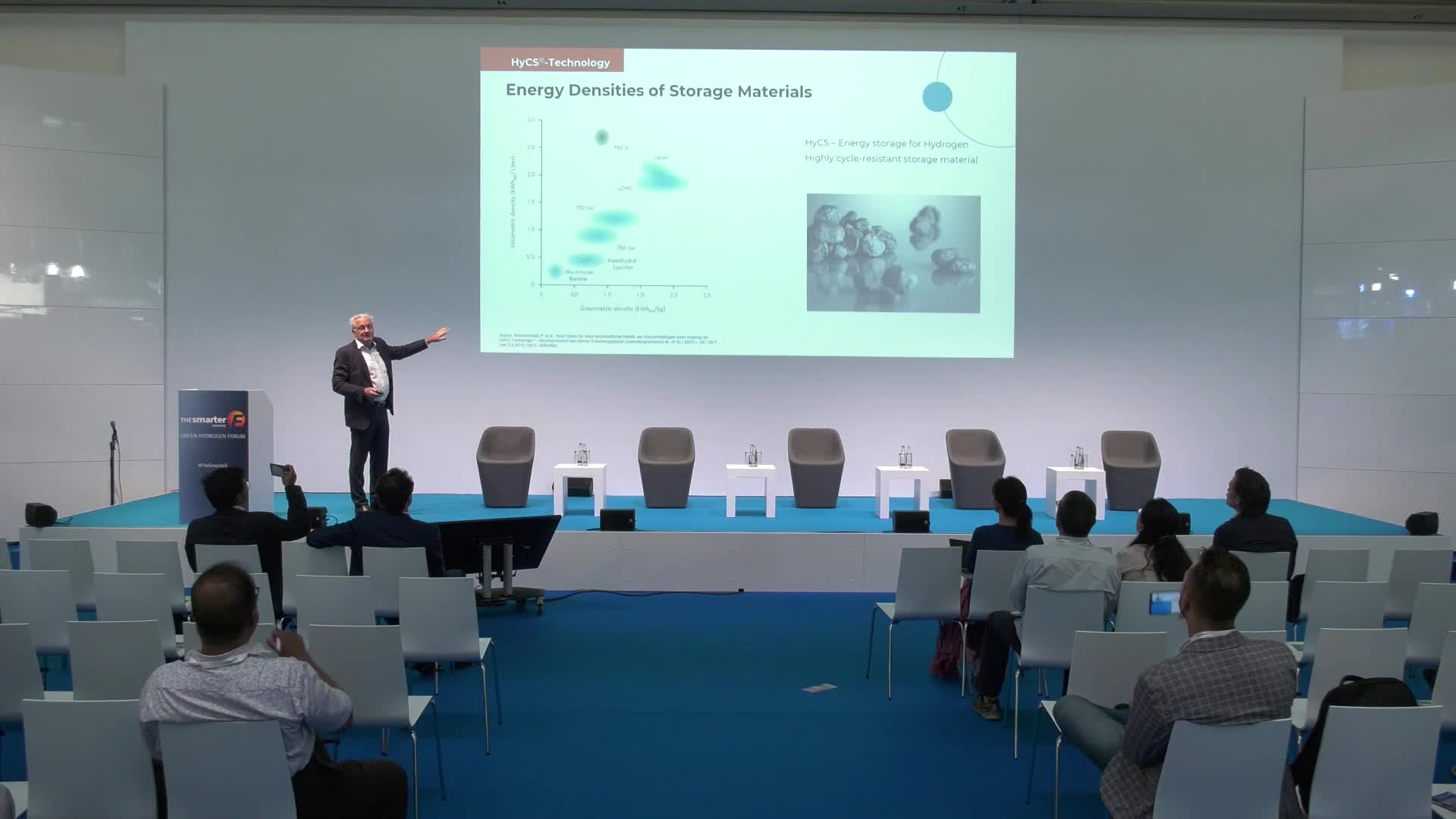
Frank Claasen Discusses Innovative Iron Oxide-Based Hydrogen Storage System by AMBARtec for Enhanced Energy Efficiency and Transportability

Frank Claasen from AMBARtec discusses an innovative iron oxide-based hydrogen storage system known as HyCS. Unlike conventional methods like steel bottles or liquefied hydrogen, this method uses the redox reduction of iron to store energy more efficiently. The process involves reducing iron oxide with hydrogen in a tank, releasing steam that can be condensed and reused in electrolysis, thus conserving water and avoiding wastewater production. Once reduced to pure iron, the material is safe for transport—non-hazardous and unpressurized—via standard 20-foot containers. When needed, inserting steam oxidizes the stored iron back into its original form while releasing hydrogen instantly. This approach prioritizes storing energy rather than just hydrogen itself. Claasen elaborates on efficiency gains when combining high-temperature electrolysis (efficiency up to 0.8) with high-temperature fuel cells versus traditional systems (around 0.6), achieving overall efficiencies around 64%. Additionally, their standard container holds about 600 kilograms of hydrogen equivalent to 20 megawatt hours but expects larger capacities by focusing on scalable manufacturing processes set for serial production by 2026.

Automated summarization by AI Conver

Frank Claasen
Business Development Manager
AMBARtec AG
Germany

Industrial/Product Live Pitches: Hydrogen Produktion Planning, Management, Risk & Safety

Speaker

Gesche Maass
Conference Manager
Solar Promotion GmbH
Germany

To Talk

Speaker

Prateek Banerjee
Senior Consultant
ILF Beratende Ingenieure
Germany

To Talk

Speaker

Maximilian Kuhnert
Sales Manager
H-Tec Systems GmbH
Germany

To Talk

Further Content
Webinar
Growth of the European Solar Market, Specifically, Romania

February 24, 2026

Webinar: EU Solar Market Overview with Focus on Romania

Business Visibility
Sponsoring & Marketing Overview

All sponsorship and marketing opportunities at a glance: Find the ideal marketing mix for your company.

Webinar Collection
Mixed Investment Solar Projects in Mexico: The 54% Model Explained

January 29, 2026

Mexico has introduced a new mixed investment scheme for renewable power generation, requiring a minimum 54% direct or indirect participation by CFE.

The smarter E Europe Exhibition Program 2025
DC Microgrids as the Next Frontier in Grid Modernization and DER Integration

Wednesday, May 07, 2025, 11:00 am - 12:25 pm

The smarter E Europe Exhibition Program 2025 | Exhibition Program

premium account

Discover how next-gen distribution grid technologies are addressing the challenges of renewable integration and dynamic energy demands. This session offers insights into the latest developments in AI-driven data analytics and the transformative role of IoT in grid management.

The smarter E Europe Conferences 2025
Factors That Influence the Success of a Minigrid Project

Wednesday, May 07, 2025, 11:00 am - 12:30 pm

The smarter E Europe Conferences 2025 | Conference Program

premium account

Off-grid solar systems are often the least expensive option for rural electrification. Solar home systems can power individual households, while mini-grids can supply entire villages. Each comes with its own advantages, disadvantages, and challenges. The aim of this session is to explore challenges as well as success stories. It takes well-functioning components such as battery systems, charge management and inverters to make projects successful. Proper system sizing, maintenance and repair management, as well as a robust financial concept are also necessary. If one of these elements is missing, the electrification will not be sustainable. This session will focus on the aspects mentioned above. The speakers will present successful and unsuccessful approaches and discuss what can be learned from them.

You are using an outdated browser

The website cannot be viewed in this browser. Please open the website in an up-to-date browser such as Edge, Chrome, Firefox, or Safari.