Transparency for a Sustainable Supply Chain

premium account

Recording of Wednesday, June 19, 2024 | The smarter E Europe | Conference Program | Language: English | Duration: 15:35 .

ENGIE's Deputy Head of Quality and Procurement outlines the company's commitment to sustainability, transparency in the supply chain, and decarbonization efforts through innovative energy solutions and detailed risk monitoring systems.

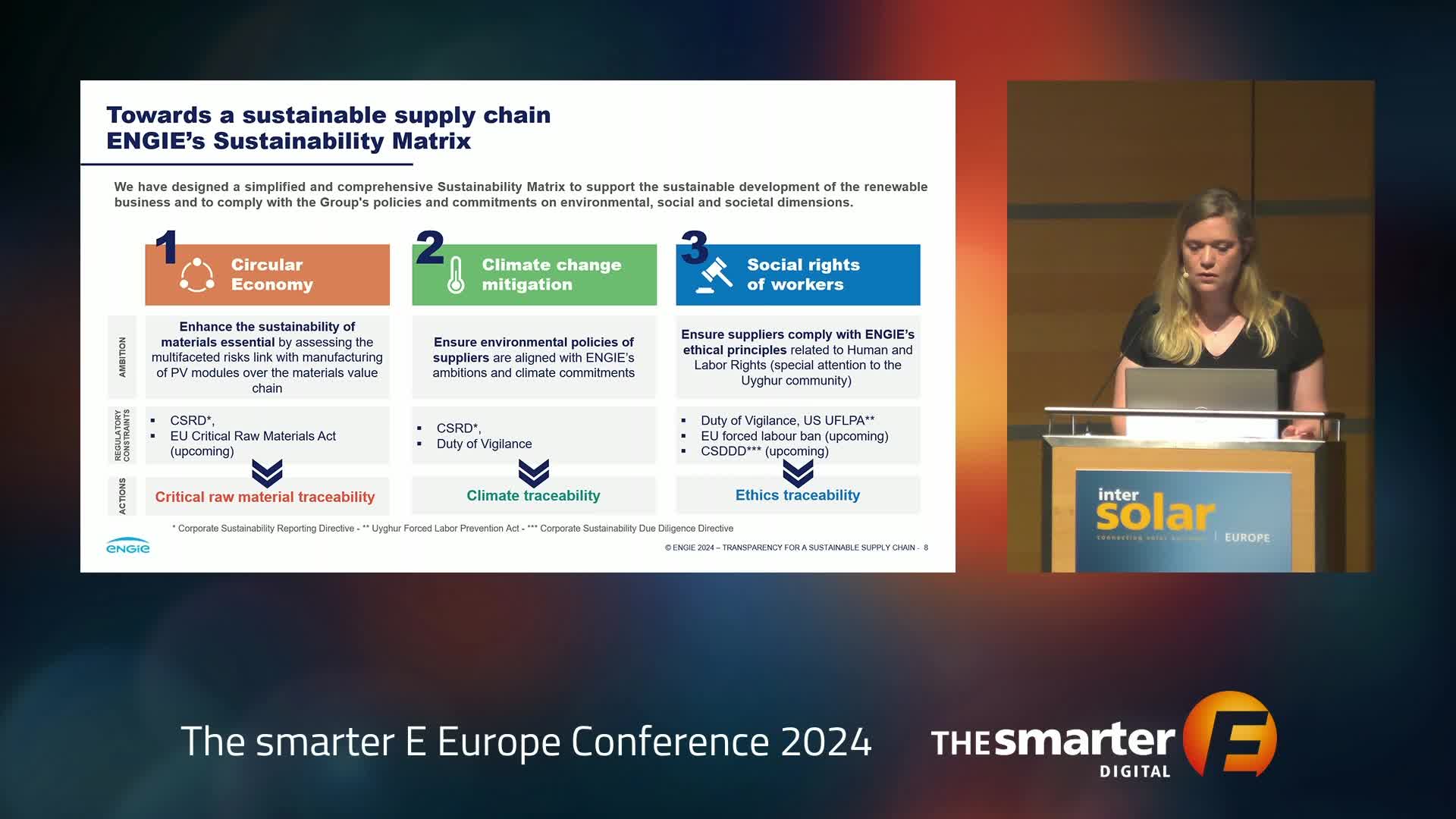
The deputy head of quality and procurement at ENGIE Renewables shared insights into the company's efforts in sustainability and transparency, particularly within its supply chain. ENGIE's overarching mission is to lead the global transition to a carbon-neutral economy by offering innovative energy solutions that support economic growth and social progress. Operating across 31 countries with over 97,000 employees, ENGIE focuses on four main regions: Noham, Latin America, EMEA (Europe, Middle East & Africa), Asia-Pacific including Australia. ENGIE emphasizes renewable energies through technologies like wind (onshore/offshore), hydroelectric power, and solar PV—where they are France's leading electricity producer. Transparency is critical for stakeholders such as investors, customers, regulators who demand clear communication regarding sourcing and production processes. To meet these expectations sustainably while mitigating risks associated with sourcing from unethical suppliers or unsustainable means; ENGIE developed a 'Material Risk Passport' tool encompassing 60 risk indicators across 12 categories ranging from market projections to environmental impacts. To further decarbonization efforts aligned towards net-zero emissions by 2045 certified under SBTI’s guidelines below two degrees trajectory; ENGIE initiated Sustain-2025 program aiding their suppliers reduce carbon footprints collaboratively over the next three years thereby reinforcing commitment toward sustainable procurement practices ensuring traceability throughout value chains maintaining accountability via comprehensive data scrutiny methods fulfilling stringent ethical standards required globally today fostering trustworthiness among diverse stakeholder groups involved therein thus bolstering overall corporate responsibility engagements.

Automated summarization by AI Conver

Laurene Gusse
Deputy Head of Quality & Procurement
ENGIE Renewables

As investors focus more on ESG criteria in the solar supply chain, the industry aims to enhance transparency, traceability, and reduce carbon footprint. This comes at a time of significant legislative change in Europe, with market access rules and the promotion of improved sustainability practices on the horizon.

This session will discuss:

  • How ESG considerations are impacting developers' procurement decisions
  • How solar manufacturers along the solar supply chain are addressing ESG concerns
  • Legislative requirements and industry efforts to increase transparency and sustainability performance
  • Processes for certifying solar products with low embodied carbon

Further Talks of this session:

Speaker

Dr. Guido Agostinelli
Solar Sector Head
IFC - International Finance Corporation
USA

To Talk

Speaker

Lin Sun
Head of Sustainability Development
JinkoSolar
China

To Talk

Speaker

Alexia Ruvoletto
Head of Secretariat
The Solar Stewardship Initiative
Belgium

To Talk

Speaker

Dr. Giorgio Bardizza
Global Manager Solar PV
TÜV Rheinland
Germany

To Talk

Speaker

Özer Ergül
Group Head of Procurement CPO
Aquila Capital
The Netherlands

Stacy Ettinger
Senior Vice President of Supply Chain & Trade
Solar Energy Industries Association
United States

To Talk

Further Content
The smarter E Europe Conferences 2026
Panel Discussion of the Session: Solar Made in the EU

Tuesday, June 23, 2026, 02:30 pm

The smarter E Europe Conferences 2026 | Conference Program

premium account

Despite strong research capabilities and the presence of leading production equipment suppliers, Europe has been struggling to rebuild competitive wafer-to-module manufacturing, while the USA and India have enabled a local renaissance in solar manufacturing. In Europe, even long-established inverter manufacturers have been losing considerable ground. With the EU's Net Zero Industry Act yet to deliver momentum, attention is turning to the upcoming Industry Accelerator Act. This session examines how policy, investment and value-chain strategies can strengthen domestic manufacturing and increase internal value creation.Key topics:Overview of EU and national policy frameworks to support local manufacturingStatus of Europe's solar manufacturing value chainInvestment gaps and competitiveness challenges Strategies for triggering a sustainable solar manufacturing revival 

Rutger Schlatmann and Angelika Harter
Perovskites: The Race for the Future of PV?

The smarter E Podcast Episode 258 | Language: English

June 25, 2026

HZB researchers explore perovskite tandem solar cells, efficiency gains, and the challenges of bringing the technology to market.

The smarter E Europe Conferences 2026
Panel Discussion of the Session: Off-Grid: PV-Based Hydrogen Microgrid Projects Around the World

Tuesday, June 23, 2026, 02:30 pm

The smarter E Europe Conferences 2026 | Conference Program

premium account

Discover how green hydrogen and fuel cell technologies are transforming decentralized energy systems worldwide. This session will be presenting hands-on experience from pioneering projects in Thailand, Ghana, Namibia and South Africa. Find out how solar-powered hydrogen microgrids can replace diesel generators, strengthen energy resilience and enable short- to long-term storage, while supporting environmental and climate goals. Project partners including German SMEs and research institutes, share insights on lessons learned, local benefits and the replication potential of these systems. Selected projects were implemented with the support from the Export Initiative Environmental Protection, a funding programme of the German Federal Ministry for the Environment, Climate Action, Nature Conservation and Nuclear Safety. 

The smarter E Europe Conferences 2026
Is Solar Cooling a Viable Solution for Agricultural Value Chains? - Challenges and Findings From a Field Study in Kenya

Tuesday, June 23, 2026, 11:30 am

The smarter E Europe Conferences 2026 | Conference Program

premium account

For many years, the photovoltaic (PV) market was dominated by grid feed-in systems. Increasingly affordable solar modules and storage systems have been changing this picture. The resulting competitive situation is leading to new results when evaluating whether a grid connection makes sense for a particular use or not. However, off-grid applications for thermal energy are also gaining importance, such as solar-electric heating and cooking. Innovative system design as well as innovative storage and applications are shifting into focus.

The smarter E Europe Conferences 2026
From Sheep to Cows: Experience From a Cow-Pv Project in Germany and Its Potential in Europe

Tuesday, June 23, 2026, 02:30 pm

The smarter E Europe Conferences 2026 | Conference Program

premium account

Agricultural PV has been moving from pilot to scale, combining food and power production while addressing land scarcity and climate pressure. Yet large-scale deployment is still constrained as it depends on clear policy frameworks, viable business cases, and proven system concepts. Taking inspiration from global developments, this session explores Europe's market potential, diverse applications from livestock to greenhouses, and the economic drivers shaping profitable agriculturalPV projects.This session will address:  Agricultural PV outlook and key business enablers for scale-upReal-world case studiesProgressive policy frameworks in major agricultural PV markets System design options and corresponding business model approachesEconomic, technical and agricultural requirements for utility-scale projects 

You are using an outdated browser

The website cannot be viewed in this browser. Please open the website in an up-to-date browser such as Edge, Chrome, Firefox, or Safari.