V2G and EMS: Transforming EVs into Grid-Stabilizing Powerhouses

premium account

Recording of Thursday, May 08, 2025 | The smarter E Europe | Exhibition Program | Language: English | Duration: 16:41 .

EcoG GmbH Unveils Insights into the Future of Bidirectional Charging and Energy Management for Electric Vehicles

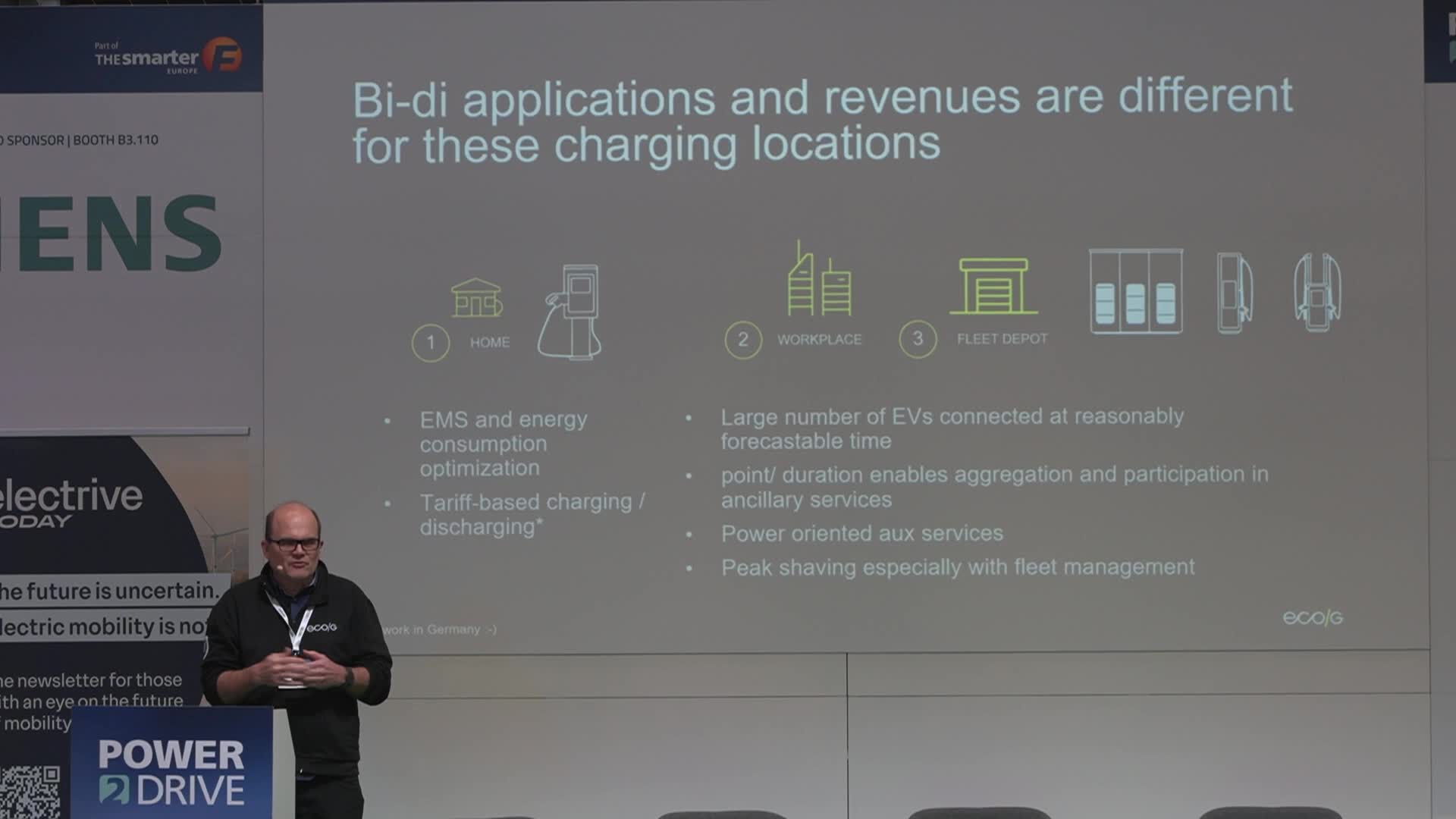
EcoG GmbH specializes in integrating electric vehicle (EV) charging systems into business processes, offering technology for building chargers and operating systems. The company has deployed over 60 charger series globally, ranging from wall boxes to high-performance depot chargers across Europe, India, and North America. EcoG explores smart or bidirectional charging scenarios where EV batteries can return energy to the grid as part of its services. Three main scenarios are highlighted: home charging with limited power connections around 11 kilowatts using DC setups; workplace charging at industrial sites capable of providing up to 40 megawatts collectively; and fleet operations involving trucks with significant power interfaces. These present opportunities for leveraging battery capacity through flexible DC interfaces while considering equipment compatibility and market dynamics. The focus is on centralized management rather than vehicle-specific allocation in EV infrastructure integration. This allows flexibility across various types including trucks reaching up to one megawatt capabilities. A "power block dispenser" concept is introduced for distributing dispensers based on desired parking site flexibility. For heavy-duty applications like city logistics, optimizing battery usage over short-term extreme charges is preferred. Bidirectional passenger car technology shows promise but faces challenges due to proprietary system dominance instead of standardized ones being developed globally such as standards by China’s contributions towards standardizing these interfaces—5118-20 and 61851 standards included—and issues related to high energy consumption during active states without adequate design support against prolonged electronic activity failures remain prevalent hurdles yet future strategies aim at shorter interaction periods until new compliant platforms emerge within two-to-three years.

Automated summarization by AI Conver

Dr. Jörg Heuer
CEO
EcoG GmbH

Innovative companies showcase how bidirectional charging integrates electric vehicles into intelligent energy systems. The session focuses on V2G, energy management, and microgrid solutions. What technologies enable grid stability and energy independence? Experts discuss the potential of decentralized and sustainable energy systems.

Further Talks of this session:

Speaker

Dennis Schulmeyer
CEO
LADE GmbH

To Talk

Speaker

Christoph Ebersdorfer
Regional Sales Manager D-A-CH
XCharge Europe GmbH

To Talk

Speaker

Carl Yan
Chief Technology Officer
AcePower and Technologie Co.,Ltd.

Recording of presentation not authorized for publication.

Speaker

Beat Kreuter
Vice President
DEKRA SE

To Talk

Further Content
The smarter E Europe Conferences 2026
Panel Discussion of the Session: User Success Stories and Best Cases

Tuesday, June 23, 2026, 02:30 pm

The smarter E Europe Conferences 2026 | Conference Program

premium account

For more than two decades, Norway has been steadily building a marketplace for electric transport. Having started out with inexpensive short-range electric cars and household charging sockets, Norway has now moved to mass-market solutions where fast charging (DC) and grid balancing (AC) plays an ever more vital role. With more than 1,000,000 electric cars and over 10,000 fast chargers in a relatively small market, Norway offers a rare early view of large-scale electrification. Over the past decade, electric cars have seen substantial improvements, which is now making it easier for new markets to advance electrification. At the same time, Norway has to deal with challenges years before other markets do. Yet despite different starting points, we can see that most markets are facing the same core challenges. From grid-smart charging strategies to innovative business models, there are excellent examples of best practices emerging elsewhere in Europe. What will the next thing in electrification be, both in mature and in emerging markets? And what will be possible when the right people and companies come together, sharing knowledge, solving common problems and accelerating the shift to cleaner mobility?

Gautham Ram Chandra Mouli, Ruben Valiente
Beating the Blockade with EVs and Batteries

The smarter E Podcast Episode 253 | Language: English

April 16, 2026

Flexibility as a hedge: How V2G and battery storage reduce fossil fuel reliance and turn electric transport into a strategic asset for grid stability.

James Allston, Marko Topič
Keep Calm and Deploy Solar (and Batteries)

The smarter E Podcast Episode 254 | Language: English

April 30, 2026

How European businesses use solar, batteries and EV fleets to manage volatile power prices and explore the future of perovskite solar.

Marcel Rümenapf
Will Soaring Fuel Costs Make eMobility Mass Market? – With Marcel Rümenapf

The smarter E Podcast Episode 256 | Language: English

May 28, 2026

Siemens’ Marcel Rümenapf explains why eMobility is becoming a strategic advantage for European logistics fleets.

The smarter E Europe Conferences 2026
Integrated Truck Charging: Challenges & Solutions Towards Zero-Emission Freight

Tuesday, June 23, 2026, 11:30 am

The smarter E Europe Conferences 2026 | Conference Program

premium account

The electrification of heavy-duty transport is more than just a goal - the transformation is already underway. But scaling up also means having to solve the big challenges: How can we build charging networks that keep pace with fleet electrification without overburdening grids or budgets? What innovations in AI, energy storage and smart infrastructure can turn today's pilot projects into tomorrow's industry standard? And how can OEMs, logistics operators and energy providers align their strategies to make zero-emission freight profitable rather than just possible? From truck manufacturers and charge point operators to logistics innovators and energy experts, this dynamic panel brings together the leaders driving change. We will dive into the real-world solutions making an impact now, like modular charging hubs that grow with demand, fleets and energy optimization solutions powered by AI and smart grid integration that cuts costs and boosts reliability. We will also ask the hard questions: Where are the gaps in collaboration, technology or policy that could slow progress, and how do we close these gaps?

You are using an outdated browser

The website cannot be viewed in this browser. Please open the website in an up-to-date browser such as Edge, Chrome, Firefox, or Safari.