Welcome and Introduction

premium account

Recording of Wednesday, June 19, 2024 | The smarter E Europe | Conference Program | Language: English | Duration: 2:55 .

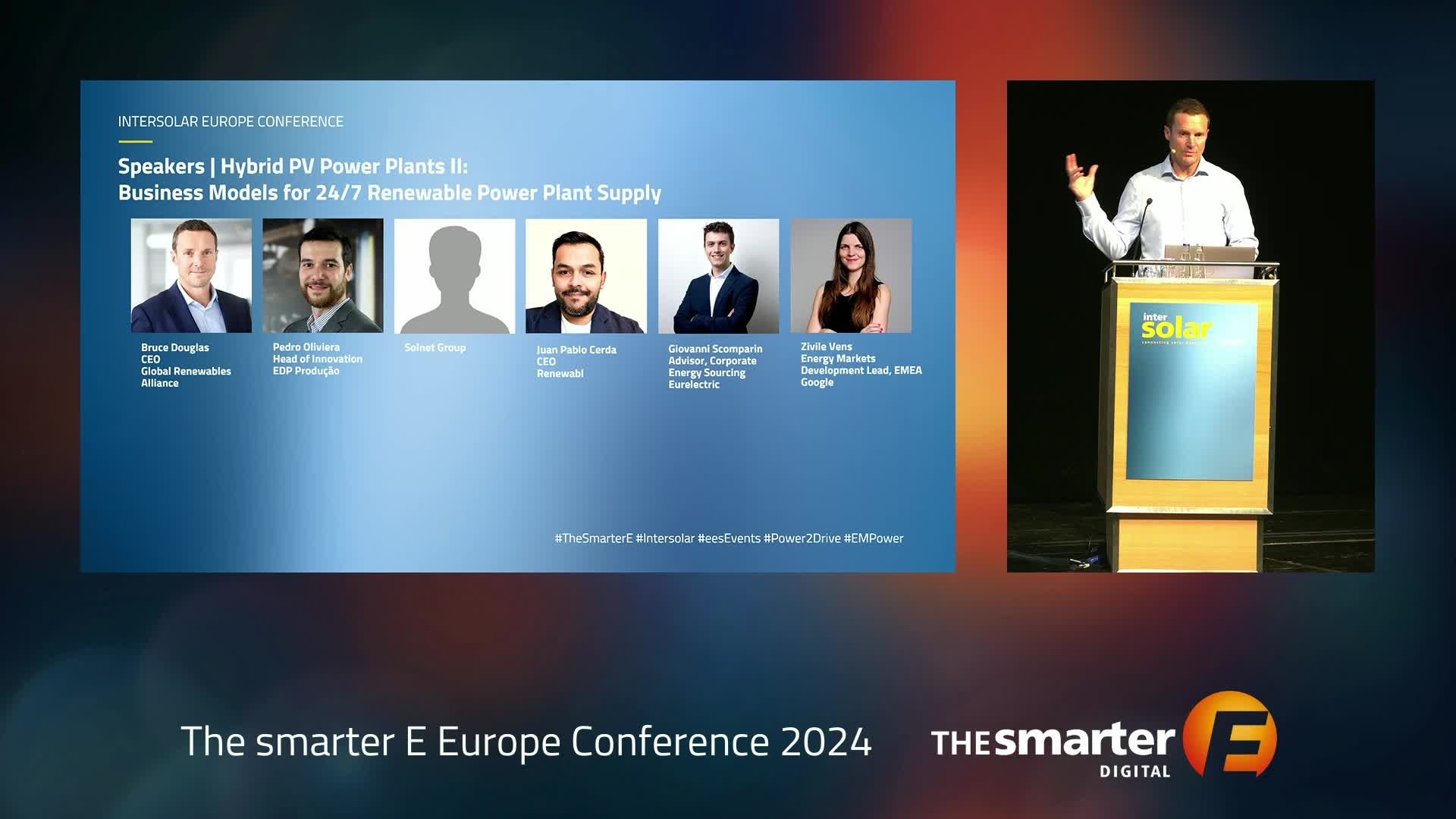
Global Renewables Alliance CEO Bruce Douglas Introduces 24-7 Green Power Discussion with Industry Experts

Bruce Douglas, CEO of the Global Renewables Alliance, kicked off a session on renewable energy by introducing his relatively new organization which encompasses various renewable technologies such as wind, solar, geothermal, and hydropower. The alliance also includes long-duration energy storage and green hydrogen sectors. Highlighting their interest in continuous renewable energy supply (24-7), he outlined the structure of the session: individual presentations from each speaker followed by Q&A segments after each presentation. This would culminate in a panel discussion where audience participation is encouraged. The main focus of the session revolves around understanding 24-7 renewable power—its demand trends, consumption versus production case studies, and its potential for future applications. Bruce invited Pedro Oliveira from EDP Produção to be the first speaker; Pedro is noted as being head of innovation at his organization. The intent was to provide insights into how constant green power can be achieved and sustained over time through different innovative approaches within renewables.

Automated summarization by AI Conver

Bruce Douglas
CEO
Global Renewables Alliance
Belgium

24/7 renewable power supply is a fairly new concept that ensures that the amount of green electricity companies require is met every hour of the day. 24/7 renewable power supply leads to increased transparency and trust in energy procurement, and it promotes the installation of new renewable power plants. Some world-leading IT companies have already opted for 24/7 green energy matching.

This session will discuss:

  • The concept of 24/7 renewable energy supply and energy matching '
  • 24/7 green power demand trends Real-time renewable 24/7 power production and consumption case studies
  • The potential of 24/7 RES matching (executive panel discussion)

Further Talks of this session:

Speaker

Pedro Oliveira
Head of Innovation
EDP Produção
Portugal

To Talk

To Talk

Speaker

Juan Pablo Cerda
CEO
Renewabl
United Kingdom

To Talk

Speaker

Giovanni Scomparin
Advisor, Corporate Energy Sourcing
Eurelectric
Belgium

To Talk

Speaker

Zivile Vens
Energy Markets Development Lead, EMEA
Google
United States of America

To Talk

To Talk

Further Content
Webinar
Growth of the European Solar Market, Specifically, Romania

February 24, 2026

Webinar: EU Solar Market Overview with Focus on Romania

Adriana Fricke, Robin Berg
Has Vehicle-to-Grid Reached the Tipping Point?

The smarter E Podcast Episode 248 | Language: English

February 5, 2026

Why 2026 could be a turning point for bidirectional EV charging – from regulation to large V2G fleets in Europe.

Webinar Collection
Mixed Investment Solar Projects in Mexico: The 54% Model Explained

January 29, 2026

Mexico has introduced a new mixed investment scheme for renewable power generation, requiring a minimum 54% direct or indirect participation by CFE.

Webinar
Mexico’s commercial and industrial solar thermal: from potential to projects

February 19, 2026

Discover Mexico’s C&I solar thermal market, opportunities, trends and successful projects

The smarter E Europe Conferences 2025
Factors That Influence the Success of a Minigrid Project

Wednesday, May 07, 2025, 11:00 am - 12:30 pm

The smarter E Europe Conferences 2025 | Conference Program

premium account

Off-grid solar systems are often the least expensive option for rural electrification. Solar home systems can power individual households, while mini-grids can supply entire villages. Each comes with its own advantages, disadvantages, and challenges. The aim of this session is to explore challenges as well as success stories. It takes well-functioning components such as battery systems, charge management and inverters to make projects successful. Proper system sizing, maintenance and repair management, as well as a robust financial concept are also necessary. If one of these elements is missing, the electrification will not be sustainable. This session will focus on the aspects mentioned above. The speakers will present successful and unsuccessful approaches and discuss what can be learned from them.

You are using an outdated browser

The website cannot be viewed in this browser. Please open the website in an up-to-date browser such as Edge, Chrome, Firefox, or Safari.