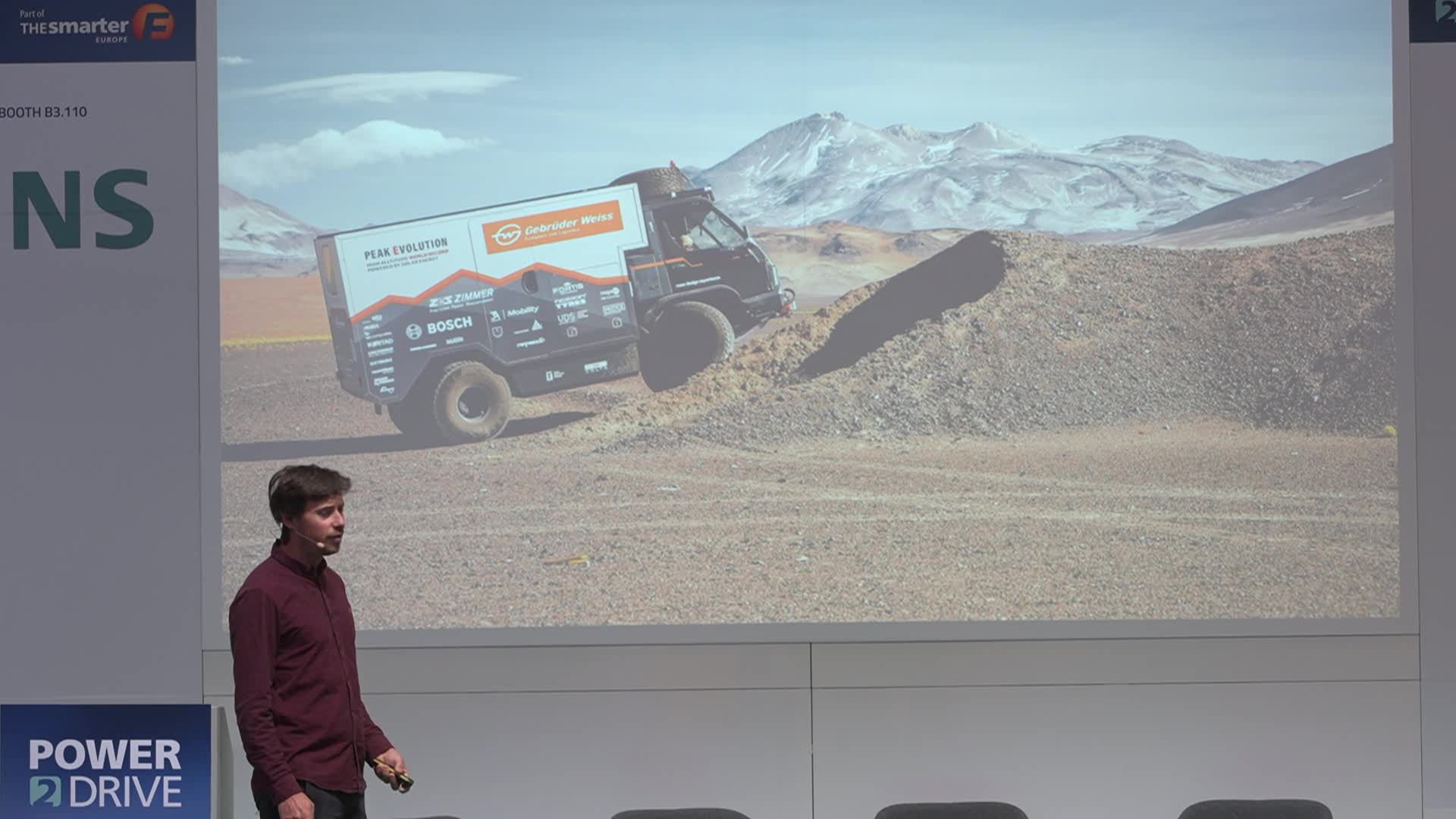
With Solar Power to the Highest Volcano in the World

premium account

Recording of Friday, May 09, 2025 | The smarter E Europe | Exhibition Program | Language: English | Duration: 16:27 .

Terran Electric Drive System Achieves World Record for Highest Altitude Ascent with Solar-Powered Vehicle on Atacama Desert Volcano Expedition

Terran Electric Drive System, founded by three childhood friends, embarked on an ambitious project to create a multipurpose electric transport vehicle. Facing initial funding and recognition challenges, they planned a record-setting expedition up Ojos del Salado in Chile—the world's highest volcano—using only solar power for their prototype vehicle. This journey required two months of isolation without grid electricity access. They innovatively integrated solar panels into the vehicle's design to supply energy for both transportation and daily needs like cooking and charging equipment. Their mission contrasted with another team's fossil fuel-based attempt from Porsche, underscoring sustainability differences between renewable resources versus traditional fuels. Despite high-altitude acclimatization challenges, Terran showcased sustainable technology's viability under extreme conditions while minimizing environmental impact compared to conventional methods used by others. The team utilized advanced features such as bidirectional charging within their prototype electric vehicle powered entirely by renewables; this allowed them to cook meals using appliances directly connected to the traction battery without additional sources—a feat including pizza baking at 5,500 meters altitude! Ascending further amidst harsh conditions (thin air/extreme cold), they remained self-sufficient inside warm shelters despite external adversities like strong winds reaching speeds of 100 km/h ultimately setting new world records: ascending nearly 1k+ vertical meters higher than previous achievements sans winches/external aid demonstrated immense potential behind sustainable tech even amid extremes environments - paving way towards future production improvements based upon insights gained throughout said endeavor.

Automated summarization by AI Conver

Patrik Koller
CFO & Founder
DDP Innovation GmbH

Companies and research institutions present pioneering projects on bidirectional charging in Europe. What challenges have been overcome? This session provides valuable insights into successful implementations and demonstrates how various stakeholders are driving the technology forward.

Further Talks of this session:

Speaker

Jakob Zahler
Senior Research Associate
FfE

To Talk

Speaker

Oluwapelumi Egunjobi
Lead Software Engineer
Smart Energy Lab

To Talk

Video is not available.

Further Content
James Allston, Marko Topič
Keep Calm and Deploy Solar (and Batteries)

The smarter E Podcast Episode 254 | Language: English

April 30, 2026

How European businesses use solar, batteries and EV fleets to manage volatile power prices and explore the future of perovskite solar.

Gautham Ram Chandra Mouli, Ruben Valiente
Beating the Blockade with EVs and Batteries

The smarter E Podcast Episode 253 | Language: English

April 16, 2026

Flexibility as a hedge: How V2G and battery storage reduce fossil fuel reliance and turn electric transport into a strategic asset for grid stability.

The smarter E Europe Conferences 2026
Panel Discussion of the Session: User Success Stories and Best Cases

Tuesday, June 23, 2026, 02:30 pm

The smarter E Europe Conferences 2026 | Conference Program

premium account

For more than two decades, Norway has been steadily building a marketplace for electric transport. Having started out with inexpensive short-range electric cars and household charging sockets, Norway has now moved to mass-market solutions where fast charging (DC) and grid balancing (AC) plays an ever more vital role. With more than 1,000,000 electric cars and over 10,000 fast chargers in a relatively small market, Norway offers a rare early view of large-scale electrification. Over the past decade, electric cars have seen substantial improvements, which is now making it easier for new markets to advance electrification. At the same time, Norway has to deal with challenges years before other markets do. Yet despite different starting points, we can see that most markets are facing the same core challenges. From grid-smart charging strategies to innovative business models, there are excellent examples of best practices emerging elsewhere in Europe. What will the next thing in electrification be, both in mature and in emerging markets? And what will be possible when the right people and companies come together, sharing knowledge, solving common problems and accelerating the shift to cleaner mobility?

Marcel Rümenapf
Will Soaring Fuel Costs Make eMobility Mass Market? – With Marcel Rümenapf

The smarter E Podcast Episode 256 | Language: English

May 28, 2026

Siemens’ Marcel Rümenapf explains why eMobility is becoming a strategic advantage for European logistics fleets.

Thomas Raffeiner and Petrouschka Werther
What EV Acceleration Means for the Grid

The smarter E Podcast Episode 260 | Language: English

July 9, 2026

Cars as batteries on wheels: Thomas Raffeiner and Petrouschka Werther discuss how V2G and smart charging turn EVs into critical grid assets.

You are using an outdated browser

The website cannot be viewed in this browser. Please open the website in an up-to-date browser such as Edge, Chrome, Firefox, or Safari.