3SUN the First PV European Gigafactory: Enabling Progress with Sustainable Energy

premium account

Recording of Wednesday, June 19, 2024 | The smarter E Europe 2024 | Exhibition Program | Language: English | Duration: 13:01 .

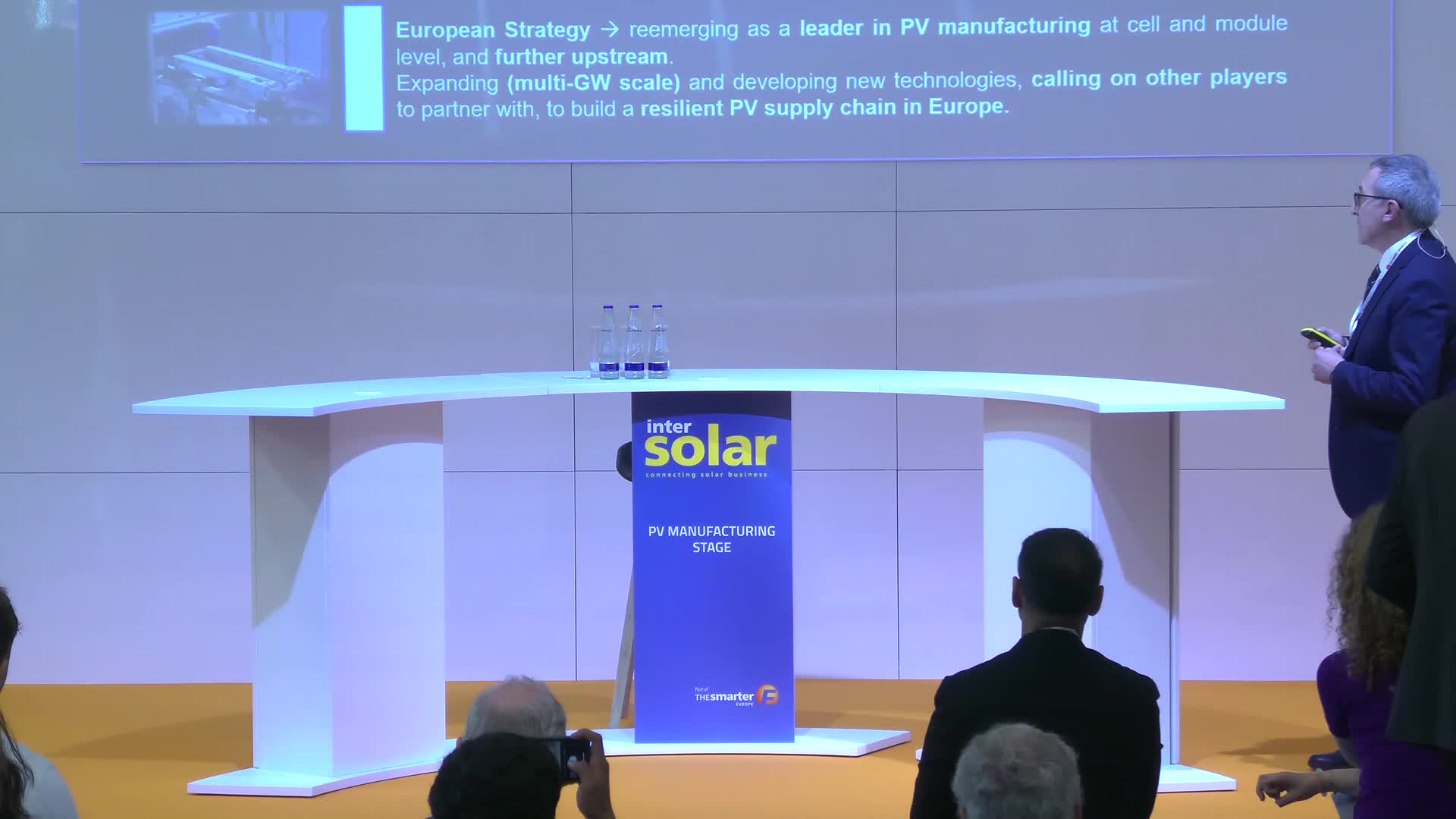
Cosimo Gerardi, CTO of 3SUN, announces Europe's largest Gigafactoryin Sicily focusing on advanced heterojunction solar technology with a €700 million investment and significant EU support

Cosimo Gerardi, CTO of 3SUN, discussed the establishment of Europe's first Gigafactory in Catania, Sicily. This plant is notable for its hydro junction technology known for high performance and reliability. Initially having a 200 MW capacity, the factory has been expanded to support up to 3 GW by adding a new building covering 50,000 square meters. The project aligns with European goals to reshore the PV value chain and received substantial financial backing: around €700 million invested alongside approximately €180-190 million from various grants including those from the European Commission's innovation fund and Italian government contracts. Gerardi highlighted that this expansion would create about 900 direct jobs plus over a thousand indirect ones. Trisan’s journey began as a joint venture in 2010 focusing on amorphous silicon thin film PV modules before becoming solely owned by Enel Green Power in 2015. By late 2023, they aim to start producing at least part of their targeted capacity using advanced automation systems integrated with AI for improved process control. The heterojunction technology used offers numerous advantages such as lower processing temperatures (below 200°C), higher efficiency margins approaching up to potentially beyond 27%, better thermal stability, enhanced resistance against reverse voltage stress leading to fewer hotspots or breakdowns, and more efficient use of materials like silver-reduced copper paste due to cost considerations. In conclusion, this facility not only aims at high-efficiency production but also strives toward sustainable practices through technological innovations tailored for both utility-scale deployments and residential markets.

Automated summarization by AI Conver

The technology for wafer, cell, and module production is continuously advancing. Currently, silicon-based solar modules hold approximately 97 percent of the global market share. While the passivated emitter and rear cell concept (PERC) remains prevalent, there is a notable shift towards tunnel oxide passivated contact (TOPCon), expected to lead in terms of market share by the end of 2024, alongside silicon heterojunction (SHJ), and interdigitated back contact (IBC) cells. The transition to these technologies is fast, for which innovative cell manufacturing approaches are considered.European machine manufacturers are at the forefront of providing solutions to the global market. Their cutting-edge equipment is designed to facilitate the high-quality and efficient production of solar cells. In this session, machine and equipment suppliers, together with European cell manufacturers, will discuss the current state-of-the-art production technology and future trends in the post-TW market.

To Talk

To Talk

To Talk

To Talk

To Talk

Further Content
Webinar
Mixed Investment Solar Projects in Mexico: The 54% Model Explained

January 29, 2026

Mexico has introduced a new mixed investment scheme for renewable power generation, requiring a minimum 54% direct or indirect participation by CFE.

Irene Guerra Gil, Mark Bruno
Staying Home, with Smart Energy Management

The smarter E Podcast Episode 245 | Language: English

December 11, 2025

Irene Guerra Gil and Mark Bruno explain how smart home energy systems and building initiatives cut costs and emissions.

The smarter E Europe Conferences 2025
Factors That Influence the Success of a Minigrid Project

Wednesday, May 07, 2025, 11:00 am - 12:30 pm

The smarter E Europe Conferences 2025 | Conference Program

premium account

Off-grid solar systems are often the least expensive option for rural electrification. Solar home systems can power individual households, while mini-grids can supply entire villages. Each comes with its own advantages, disadvantages, and challenges. The aim of this session is to explore challenges as well as success stories. It takes well-functioning components such as battery systems, charge management and inverters to make projects successful. Proper system sizing, maintenance and repair management, as well as a robust financial concept are also necessary. If one of these elements is missing, the electrification will not be sustainable. This session will focus on the aspects mentioned above. The speakers will present successful and unsuccessful approaches and discuss what can be learned from them.

The smarter E Europe Conferences 2025
Q&A Session of of the Session Off-Grid: Rural Electrification Based on Solar Systems - Lessons Learned

Wednesday, May 07, 2025, 11:00 am - 12:30 pm

The smarter E Europe Conferences 2025 | Conference Program

premium account

Off-grid solar systems are often the least expensive option for rural electrification. Solar home systems can power individual households, while mini-grids can supply entire villages. Each comes with its own advantages, disadvantages, and challenges. The aim of this session is to explore challenges as well as success stories. It takes well-functioning components such as battery systems, charge management and inverters to make projects successful. Proper system sizing, maintenance and repair management, as well as a robust financial concept are also necessary. If one of these elements is missing, the electrification will not be sustainable. This session will focus on the aspects mentioned above. The speakers will present successful and unsuccessful approaches and discuss what can be learned from them.

The smarter E Europe Conferences 2025
Panel Discussion of of the Session Off-Grid: When Will Off-Grid PV Follow the Affordability Trend?(BSW)

Wednesday, May 07, 2025, 04:00 pm - 05:30 pm

The smarter E Europe Conferences 2025 | Conference Program

premium account

Photovoltaic prices have fallen continuously in recent years - a trend that should translate into a growing market for off-grid solutions. Declining costs are crucial for rural electrification in particular, making sustainable energy supply economically viable in remote regions. However, so far many of these price advantages have not yet reached the people that need them most. Do existing framework conditions to foster rural electrification still work in this new market reality? Which measures are needed to ensure that cost reductions reach our target group? This session discusses strategies for improving the availability of low-cost off-grid solutions, financing and innovative business models. A look at successful practical examples shows which political, economic and technological levers need to be pulled to make off-grid PV accessible on a large scale.

You are using an outdated browser

The website cannot be viewed in this browser. Please open the website in an up-to-date browser such as Edge, Chrome, Firefox, or Safari.