High Performance c-Si Solutions for GW Scale PV Manufacturing

Premium Account

Recording of Wednesday, June 19, 2024 | The smarter E Europe 2024 | Exhibition Program | Language: English | Duration: 20:00 .

Dr. Holger H. Kuehnlein of RENA Technologies Discusses Gigawatt Scale Wet Chemical Processes for High-Performance Crystalline Silicon Solutions in PV Manufacturing

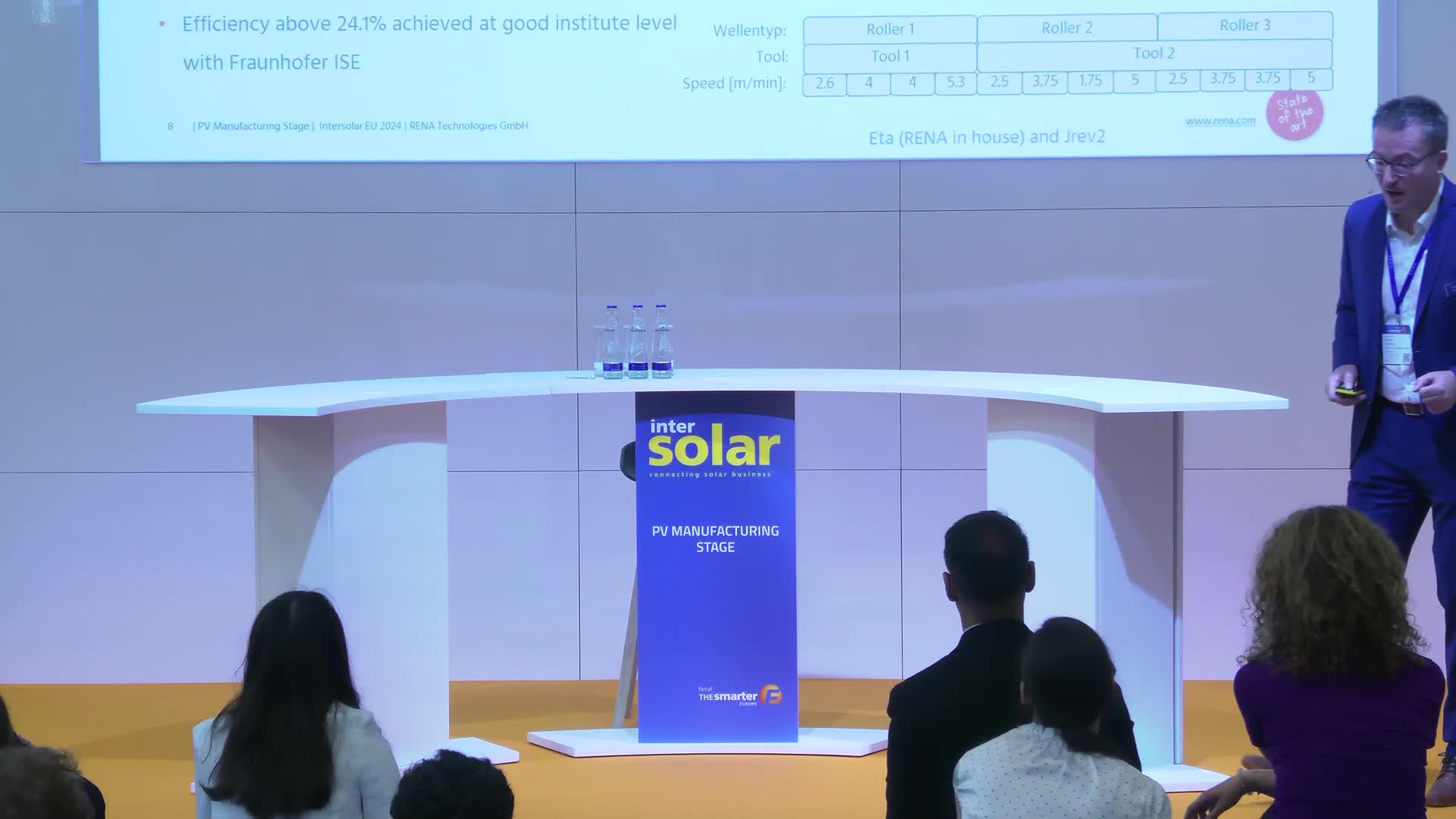
Dr. Holger H. Kuehnlein, Senior Vice President Technology of Rena Technologies, discusses high-performance crystalline silicon solutions for gigawatt-scale manufacturing with an emphasis on wet chemical processes. Rena Technologies, founded in 1993 and based in the Black Forest, employs around 1,200 people and has over 3,300 installations worldwide. The company focuses primarily on preparing surfaces through various wet chemical processes crucial for subsequent steps. Dr. Kuehnlein highlights TOPCon (Tunnel Oxide Passivated Contact) and heterojunction technologies as key to their approach while emphasizing only equipment above one gigawatt capacity. He explains that mainstream TOPCon production involves several essential wet chemical steps like texturing after boron diffusion and edge isolation using a combination of inline machines and batch processing tools. RENA was pioneering single-site treatments but now integrates specialized additives during the batch process to enhance efficiency further. Given new market demands from Europe, India, and the US focusing on cost-of-ownership aspects—like power consumption reduction—RENA is tailoring its innovations accordingly. Collaborations with institutions like Fraunhofer help push throughput limits while maintaining efficiency rates above industry standards at about four to five meters per minute transport speed within their systems.

Automatisierte Zusammenfassung durch AI Conver

The technology for wafer, cell, and module production is continuously advancing. Currently, silicon-based solar modules hold approximately 97 percent of the global market share. While the passivated emitter and rear cell concept (PERC) remains prevalent, there is a notable shift towards tunnel oxide passivated contact (TOPCon), expected to lead in terms of market share by the end of 2024, alongside silicon heterojunction (SHJ), and interdigitated back contact (IBC) cells. The transition to these technologies is fast, for which innovative cell manufacturing approaches are considered.European machine manufacturers are at the forefront of providing solutions to the global market. Their cutting-edge equipment is designed to facilitate the high-quality and efficient production of solar cells. In this session, machine and equipment suppliers, together with European cell manufacturers, will discuss the current state-of-the-art production technology and future trends in the post-TW market.

To Talk

To Talk

To Talk

To Talk

To Talk

Weiterführende Inhalte
Webinar
Mixed Investment Solar Projects in Mexico: The 54% Model Explained

January 29, 2026

Mexico has introduced a new mixed investment scheme for renewable power generation, requiring a minimum 54% direct or indirect participation by CFE.

Irene Guerra Gil, Mark Bruno
Staying Home, with Smart Energy Management

The smarter E Podcast Episode 245 | Language: English

December 11, 2025

Irene Guerra Gil and Mark Bruno explain how smart home energy systems and building initiatives cut costs and emissions.

The smarter E Europe Conferences 2025
Factors That Influence the Success of a Minigrid Project

Wednesday, May 07, 2025, 11:00 am - 12:30 pm

The smarter E Europe Conferences 2025 | Conference Program

Premium Account

Off-grid solar systems are often the least expensive option for rural electrification. Solar home systems can power individual households, while mini-grids can supply entire villages. Each comes with its own advantages, disadvantages, and challenges. The aim of this session is to explore challenges as well as success stories. It takes well-functioning components such as battery systems, charge management and inverters to make projects successful. Proper system sizing, maintenance and repair management, as well as a robust financial concept are also necessary. If one of these elements is missing, the electrification will not be sustainable. This session will focus on the aspects mentioned above. The speakers will present successful and unsuccessful approaches and discuss what can be learned from them.

The smarter E Europe Conferences 2025
Q&A Session of of the Session Off-Grid: Rural Electrification Based on Solar Systems - Lessons Learned

Wednesday, May 07, 2025, 11:00 am - 12:30 pm

The smarter E Europe Conferences 2025 | Conference Program

Premium Account

Off-grid solar systems are often the least expensive option for rural electrification. Solar home systems can power individual households, while mini-grids can supply entire villages. Each comes with its own advantages, disadvantages, and challenges. The aim of this session is to explore challenges as well as success stories. It takes well-functioning components such as battery systems, charge management and inverters to make projects successful. Proper system sizing, maintenance and repair management, as well as a robust financial concept are also necessary. If one of these elements is missing, the electrification will not be sustainable. This session will focus on the aspects mentioned above. The speakers will present successful and unsuccessful approaches and discuss what can be learned from them.

The smarter E Europe Conferences 2025
Panel Discussion of of the Session Off-Grid: When Will Off-Grid PV Follow the Affordability Trend?(BSW)

Wednesday, May 07, 2025, 04:00 pm - 05:30 pm

The smarter E Europe Conferences 2025 | Conference Program

Premium Account

Photovoltaic prices have fallen continuously in recent years - a trend that should translate into a growing market for off-grid solutions. Declining costs are crucial for rural electrification in particular, making sustainable energy supply economically viable in remote regions. However, so far many of these price advantages have not yet reached the people that need them most. Do existing framework conditions to foster rural electrification still work in this new market reality? Which measures are needed to ensure that cost reductions reach our target group? This session discusses strategies for improving the availability of low-cost off-grid solutions, financing and innovative business models. A look at successful practical examples shows which political, economic and technological levers need to be pulled to make off-grid PV accessible on a large scale.

Sie verwenden einen veralteten Browser

Die Website kann in diesem Browser nicht angezeigt werden. Bitte öffnen Sie die Website in einem aktuellen Browser wie Edge, Chrome, Firefox oder Safari.