A New Look at Energy Independence and How to Get There

Premium Account

Recording of Tuesday, June 18, 2024 | The smarter E Europe 2024 | Conference Program | Language: English | Duration: 19:11 .

SolarEdge's Gadi Hirsch Discusses Advancements and Challenges in Distributed Energy Markets with Emphasis on Energy Independence

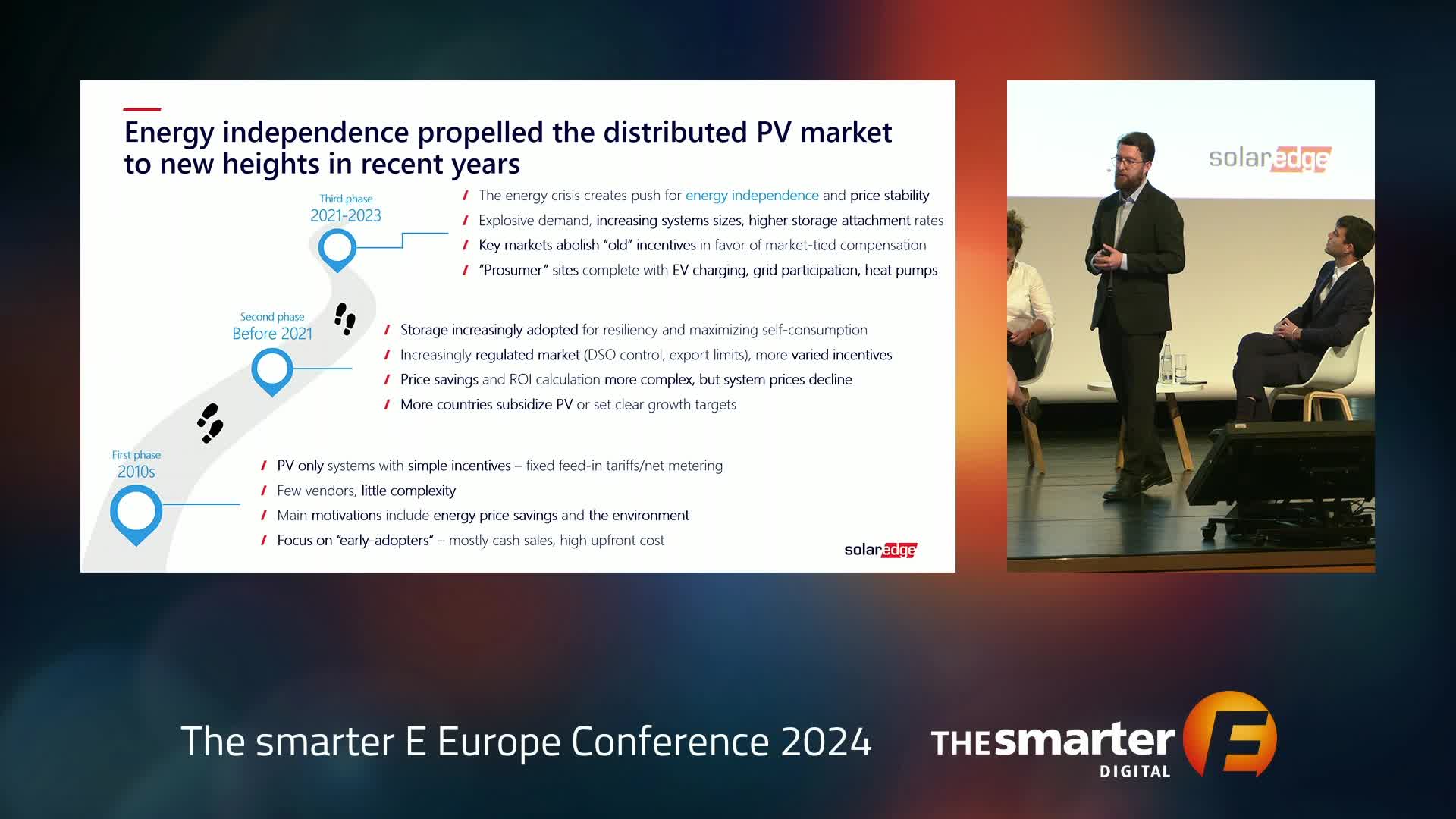
Gadi Hirsch, the lead analyst in SolarEdge Technologies' strategy group, provides an overview of energy independence within distributed energy markets. He explains that SolarEdge is a key tech provider specializing in solar and other components for such markets, initially focused on inverter technology but now expanding to various applications for homes, businesses, and small utilities globally. Emphasizing the evolution from subsidized PV-only stages to more complex storage-dependent systems with multiple integrated components, Gadi highlights the shift towards modularity and flexibility driven by economic factors like declining prices and increased customer interaction. Energy independence has gained prominence since 2022 due to geopolitical events like Russia’s invasion of Ukraine. This concept includes not just reducing reliance on external energy sources but also managing price volatility and ensuring autonomy over energy decisions amidst challenges such as interoperability among diverse players and technological standards. SolarEdge aims to provide adaptable solutions addressing these complexities through advanced control over production, exportation, storage, consumption management via their robust inverter and energy management systems. They focus on shielding customers from uncertainties—geopolitical or weather-related—and enhancing decision-making capabilities without additional controllers or providers. Their commitment extends globally with particular attention to power outages influenced by demand spikes or geopolitics.

Automatisierte Zusammenfassung durch AI Conver

Gadi Hirsch
Lead Analyst, Strategy Group
SolarEdge Technologies
Israel

More than two-thirds of all new solar capacity added in the EU in 2023 was distributed. The EU's Energy Performance of Buildings Directive (EPBD), which requires the installation of solar panels on buildings, will drive demand in the medium term. But what could speed up the deployment of rooftop solar installations on residential and commercial buildings in the short term? And how is the industry addressing the needs of these building types? This session will discuss:

  • Drivers & challenges for distributed solar PV in Europe
  • Technical solutions for high levels of solar self-consumption
  • Business models for prosumers and offers from utilities

Speaker

Juan Monge
Principal Analyst, Distributed Solar, Europe
Wood Mackenzie
United Kingdom

To Talk

Speaker

Alexander Vogt
Head of Product & Technology
LichtBlick Energy as a Service GmbH
Germany

To Talk

Speaker

Jan Osenberg
Senior Policy Advisor
SolarPower Europe
Belgium

Wannes Demarcke
Policy Expert Solar
ODE Vlaanderen
Belgium

To Talk

Speaker

José Queirós de Almeida
CEO
Greenvolt Communities

To Talk

Speaker

Dr. Stefanie Groll
Head of EU Affairs
Enpal B.V.
Germany

To Talk

Weiterführende Inhalte
Webinar
Mixed Investment Solar Projects in Mexico: The 54% Model Explained

January 29, 2026

Mexico has introduced a new mixed investment scheme for renewable power generation, requiring a minimum 54% direct or indirect participation by CFE.

Anna Darmani, Principal Analyst from Wood Mackenzie
Big BESS Is Here to Save the Day

The smarter E Podcast Episode 246 | Language: English

January 8, 2026

Utility-scale batteries are booming in Europe. Discover key BESS trends, market impacts, and what to expect for large-scale storage in 2026.

The smarter E Europe Conferences 2025
Setting the Scene "Off-Grid"

Wednesday, May 07, 2025, 04:00 pm - 05:30 pm

The smarter E Europe Conferences 2025 | Conference Program

Premium Account

Photovoltaic prices have fallen continuously in recent years - a trend that should translate into a growing market for off-grid solutions. Declining costs are crucial for rural electrification in particular, making sustainable energy supply economically viable in remote regions. However, so far many of these price advantages have not yet reached the people that need them most. Do existing framework conditions to foster rural electrification still work in this new market reality? Which measures are needed to ensure that cost reductions reach our target group? This session discusses strategies for improving the availability of low-cost off-grid solutions, financing and innovative business models. A look at successful practical examples shows which political, economic and technological levers need to be pulled to make off-grid PV accessible on a large scale.

The smarter E Europe Conferences 2025
Factors That Influence the Success of a Minigrid Project

Wednesday, May 07, 2025, 11:00 am - 12:30 pm

The smarter E Europe Conferences 2025 | Conference Program

Premium Account

Off-grid solar systems are often the least expensive option for rural electrification. Solar home systems can power individual households, while mini-grids can supply entire villages. Each comes with its own advantages, disadvantages, and challenges. The aim of this session is to explore challenges as well as success stories. It takes well-functioning components such as battery systems, charge management and inverters to make projects successful. Proper system sizing, maintenance and repair management, as well as a robust financial concept are also necessary. If one of these elements is missing, the electrification will not be sustainable. This session will focus on the aspects mentioned above. The speakers will present successful and unsuccessful approaches and discuss what can be learned from them.

The smarter E Europe Conferences 2025
Q&A Session of of the Session Off-Grid: Rural Electrification Based on Solar Systems - Lessons Learned

Wednesday, May 07, 2025, 11:00 am - 12:30 pm

The smarter E Europe Conferences 2025 | Conference Program

Premium Account

Off-grid solar systems are often the least expensive option for rural electrification. Solar home systems can power individual households, while mini-grids can supply entire villages. Each comes with its own advantages, disadvantages, and challenges. The aim of this session is to explore challenges as well as success stories. It takes well-functioning components such as battery systems, charge management and inverters to make projects successful. Proper system sizing, maintenance and repair management, as well as a robust financial concept are also necessary. If one of these elements is missing, the electrification will not be sustainable. This session will focus on the aspects mentioned above. The speakers will present successful and unsuccessful approaches and discuss what can be learned from them.

Sie verwenden einen veralteten Browser

Die Website kann in diesem Browser nicht angezeigt werden. Bitte öffnen Sie die Website in einem aktuellen Browser wie Edge, Chrome, Firefox oder Safari.