Mind the Upcoming Mandatory EU Solar Rooftop Regulations. Learnings From a Belgian Precursor

premium account

Recording of Tuesday, June 18, 2024 | The smarter E Europe | Conference Program | Language: English | Duration: 14:47 .

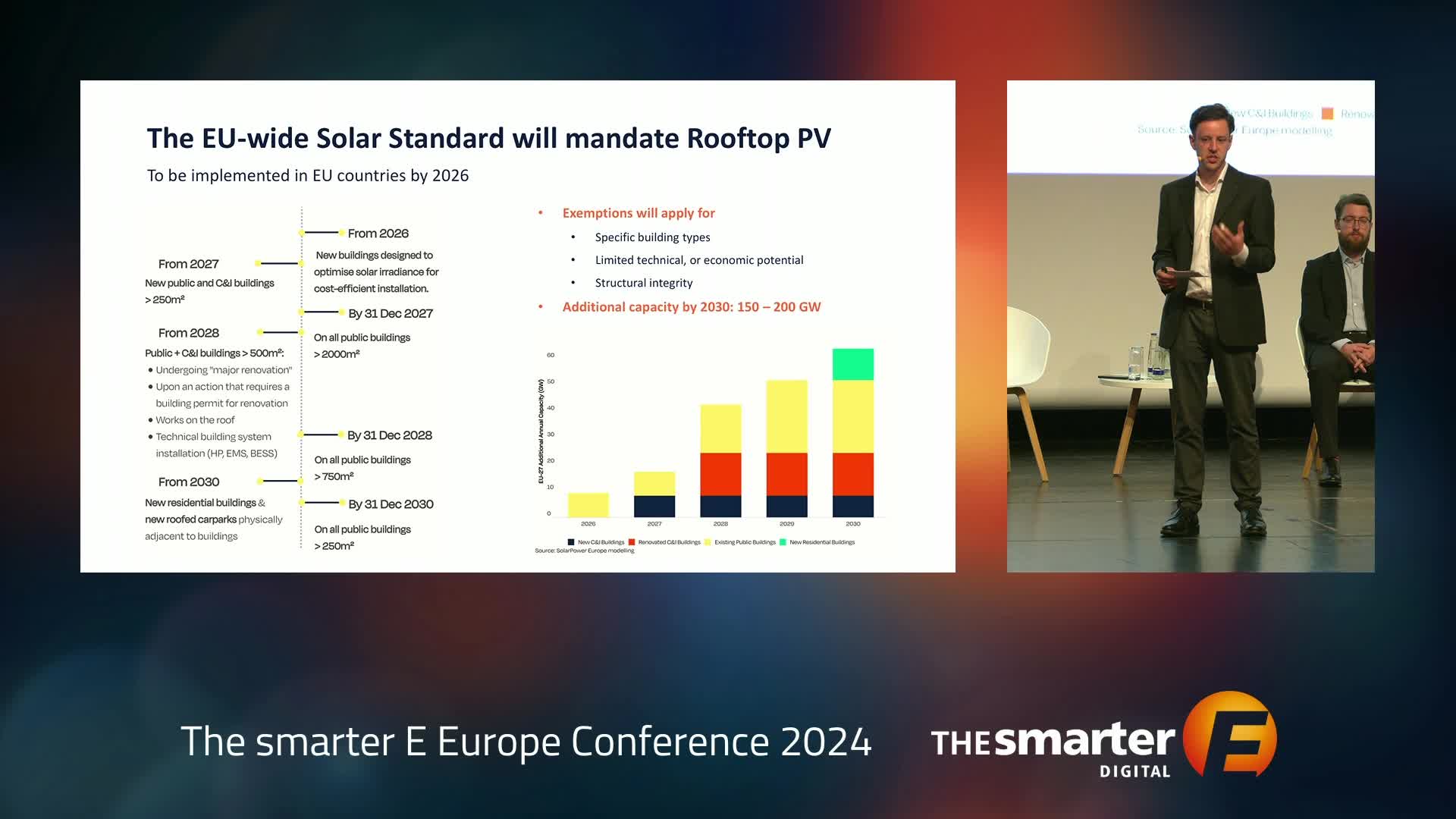
EU Solar Standard Mandates Rooftop Solar Integration on Buildings with Phased Implementation Starting 2026, Following Belgium's Example

The EU Solar Standard, adopted by the EU in spring 2023, mandates integrating rooftop solar into smart and flexible buildings. The implementation timeline is as follows: by 2026, new buildings must optimize for solar irradiance; from 2027, new commercial and industrial (C&I) buildings need to have solar installations; and starting in 2028, renovated C&I buildings over 500 square meters undergoing major renovations or certain upgrades must also include solar. Exemptions apply for historical buildings, those unsuitable technically or economically for rooftop solar. SolarPower Europe predicts this will add between 150 to 200 gigawatts of installations across various building types. Public building requirements are phased out through different deadlines ending in 2030 based on their size. Flanders’ experience with similar mandates since 2006 offers insights. Initial efforts focused on energy performance standards that evolved to emphasize solar integration significantly by now. They introduced mandatory labels post-ownership changes and upcoming rental contracts requiring adherence to these standards driven partly by grid offtake data—an easy-to-obtain metric indicating on-site self-consumption potential. Challenges noted include disputes between owners who pay versus occupants who benefit from the mandate-driven savings and market bottlenecks due to delayed investments aiming at ultimate compliance deadlines.

Automated summarization by AI Conver

Jan Osenberg
Senior Policy Advisor
SolarPower Europe
Belgium

Wannes Demarcke
Policy Expert Solar
ODE Vlaanderen
Belgium

More than two-thirds of all new solar capacity added in the EU in 2023 was distributed. The EU's Energy Performance of Buildings Directive (EPBD), which requires the installation of solar panels on buildings, will drive demand in the medium term. But what could speed up the deployment of rooftop solar installations on residential and commercial buildings in the short term? And how is the industry addressing the needs of these building types?This session will discuss:

  • Drivers & challenges for distributed solar PV in Europe
  • Technical solutions for high levels of solar self-consumption
  • Business models for prosumers and offers from utilities

Further Talks of this session:

Speaker

Juan Monge
Principal Analyst, Distributed Solar, Europe
Wood Mackenzie
United Kingdom

To Talk

Speaker

Gadi Hirsch
Lead Analyst, Strategy Group
SolarEdge Technologies
Israel

To Talk

Speaker

Alexander Vogt
Head of Product & Technology
LichtBlick Energy as a Service GmbH
Germany

To Talk

Speaker

José Queirós de Almeida
CEO
Greenvolt Communities

To Talk

Speaker

Dr. Stefanie Groll
Head of EU Affairs
Enpal B.V.
Germany

To Talk

Further Content
The smarter E Europe Conferences 2026
Is Solar Cooling a Viable Solution for Agricultural Value Chains? - Challenges and Findings From a Field Study in Kenya

Tuesday, June 23, 2026, 11:30 am

The smarter E Europe Conferences 2026 | Conference Program

premium account

For many years, the photovoltaic (PV) market was dominated by grid feed-in systems. Increasingly affordable solar modules and storage systems have been changing this picture. The resulting competitive situation is leading to new results when evaluating whether a grid connection makes sense for a particular use or not. However, off-grid applications for thermal energy are also gaining importance, such as solar-electric heating and cooking. Innovative system design as well as innovative storage and applications are shifting into focus.

The smarter E Europe Conferences 2026
Panel Discussion

Tuesday, June 23, 2026, 02:30 pm

The smarter E Europe Conferences 2026 | Conference Program

premium account

Discover how green hydrogen and fuel cell technologies are transforming decentralized energy systems worldwide. This session will be presenting hands-on experience from pioneering projects in Thailand, Ghana, Namibia and South Africa. Find out how solar-powered hydrogen microgrids can replace diesel generators, strengthen energy resilience and enable short- to long-term storage, while supporting environmental and climate goals. Project partners including German SMEs and research institutes, share insights on lessons learned, local benefits and the replication potential of these systems. Selected projects were implemented with the support from the Export Initiative Environmental Protection, a funding programme of the German Federal Ministry for the Environment, Climate Action, Nature Conservation and Nuclear Safety. 

The smarter E Europe Conferences 2026
Panel Discussion of the Session: Solar Made in the EU

Tuesday, June 23, 2026, 02:30 pm

The smarter E Europe Conferences 2026 | Conference Program

premium account

Despite strong research capabilities and the presence of leading production equipment suppliers, Europe has been struggling to rebuild competitive wafer-to-module manufacturing, while the USA and India have enabled a local renaissance in solar manufacturing. In Europe, even long-established inverter manufacturers have been losing considerable ground. With the EU's Net Zero Industry Act yet to deliver momentum, attention is turning to the upcoming Industry Accelerator Act. This session examines how policy, investment and value-chain strategies can strengthen domestic manufacturing and increase internal value creation.Key topics:Overview of EU and national policy frameworks to support local manufacturingStatus of Europe's solar manufacturing value chainInvestment gaps and competitiveness challenges Strategies for triggering a sustainable solar manufacturing revival 

The smarter E Europe Conferences 2026
From Sheep to Cows: Experience From a Cow-Pv Project in Germany and Its Potential in Europe

Tuesday, June 23, 2026, 02:30 pm

The smarter E Europe Conferences 2026 | Conference Program

premium account

Agricultural PV has been moving from pilot to scale, combining food and power production while addressing land scarcity and climate pressure. Yet large-scale deployment is still constrained as it depends on clear policy frameworks, viable business cases, and proven system concepts. Taking inspiration from global developments, this session explores Europe's market potential, diverse applications from livestock to greenhouses, and the economic drivers shaping profitable agriculturalPV projects.This session will address:  Agricultural PV outlook and key business enablers for scale-upReal-world case studiesProgressive policy frameworks in major agricultural PV markets System design options and corresponding business model approachesEconomic, technical and agricultural requirements for utility-scale projects 

The smarter E Europe Conferences 2026
Hybrid Horizons: Co-Location in Europe - Trends, Policy, and Business Models

Tuesday, June 23, 2026, 11:30 am

The smarter E Europe Conferences 2026 | Conference Program

premium account

Hybrid PV projects are transforming Europe's utility-scale solar sector. As battery sizes grow and grid constraints intensify, co-location and hybrid operation are becoming the key to accessing the grid and unlocking new value streams - from merchant optimization to industrial energy supply. This session examines real-world revenue models, policy trends and grid-forming requirements,providing background on how hybrid projects truly pay off.This session will address:Business cases for co-location, overplanting and shared grid connections of hybrid solar plantsGrid-forming and related services with regulatory drivers shaping hybrid economics Revenue-stacking strategies in merchant and contracted marketsIndustrial optimization and storage-led value creation in practice 

You are using an outdated browser

The website cannot be viewed in this browser. Please open the website in an up-to-date browser such as Edge, Chrome, Firefox, or Safari.