Recording of Monday, June 22, 2026 | The smarter E Europe Conferences 2026 | Language: English | Duration: 9:42 .
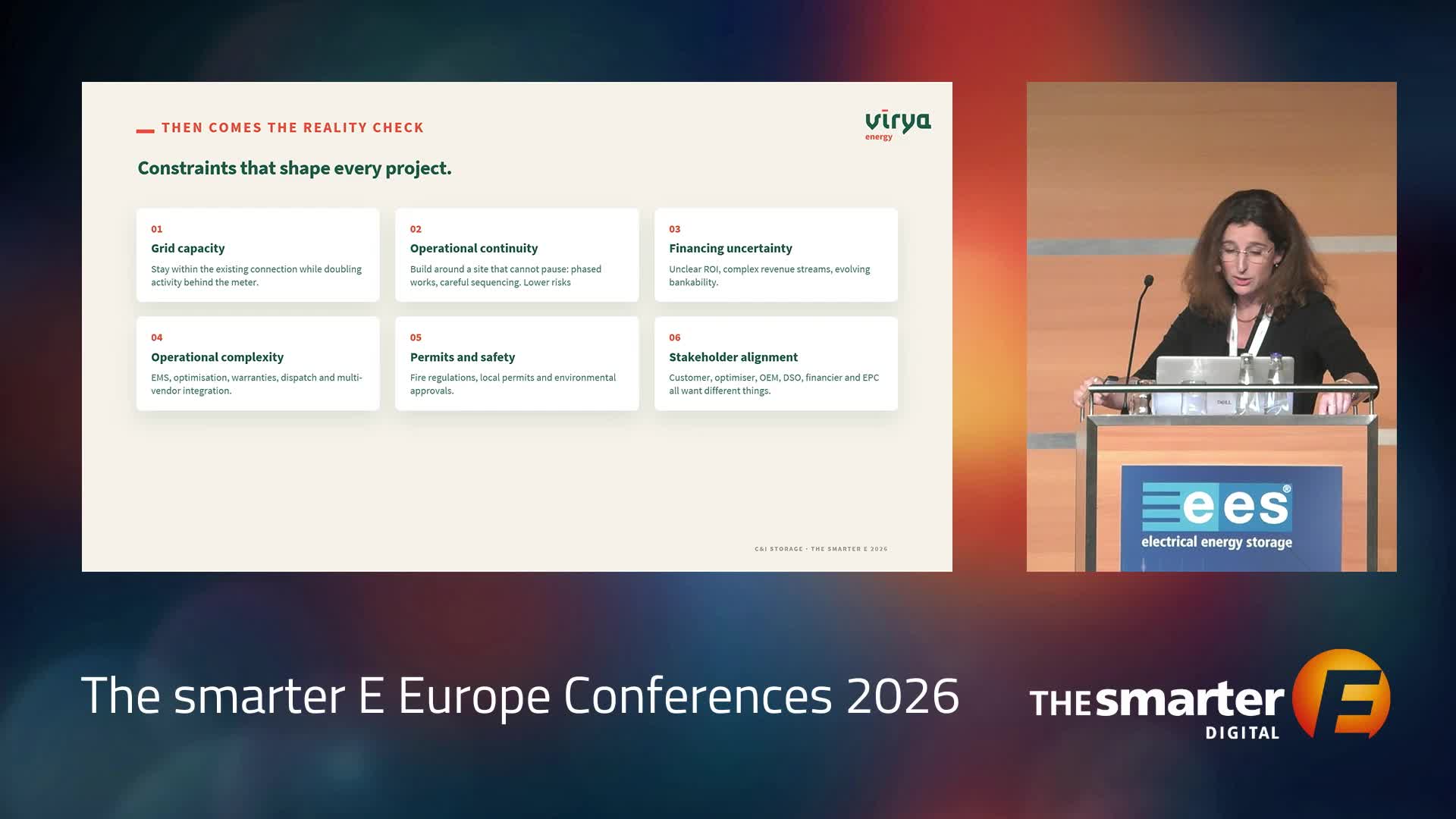
Julie Horn from Virya Energy highlights the role of batteries in commercial and industrial (C&I) energy solutions. Veria Energy aims for 4 gigawatts of renewable capacity by 2034 while currently managing 700 megawatts across 15 countries. The company transitions from merely providing clean energy to assisting clients in electrifying operations, including electric trucks and e-boilers, reflecting a market shift towards sustainability and cost management. Effective energy solutions necessitate a comprehensive understanding of system design, addressing customer-specific needs for technologies like photovoltaic (PV) systems and battery storage. Designing these systems involves careful planning, including equipment availability, grid capacity checks, and stakeholder alignment to ensure project success. The complexities arising from interactions within the C&I sector emphasize the importance of multifaceted energy solutions, especially under conditions of grid congestion. Optimizing energy for businesses requires sustainable strategies for lasting customer satisfaction. A practical example is Duval Mortier's investment in electric fleets paired with tailored solar installations and battery development, emphasizing efficient energy use within logistics.
Automated summarization by AI Conver
Speaker
Julie Horn
Senior Strategy and Business Development
Virya Energy
Germany
Commercial and industrial (C&II) storage is among the fastest-growing markets in Europe in terms of annual year-on-year growth, yet in absolute installed capacity, it remains five times smaller than the residential segment. Still, it is attracting strong attention: utility-scale developers and residential providers are now targeting C&I as their next growth area. EV players are also entering the space by adding storage to charging infrastructure and exploring second-life battery applications.This session explores whether future growth will create space for all players, the main business cases and technological solutions C&I developers are betting on, and the key markets most likely to shape the future of this segment.
Further Talks of this session:
Speaker
Dr. Alexander Hirnet
Vice President Device Development
sonnen GmbH
Speaker
Luis Manuel Haya Carballo
Solution Engineer, EMEA
HyperStrong
China
Speaker
Eleonora Potestio
Head of EU C&I Storage for Distribution
Sungrow Europe
Germany
Speaker
Antonio Arruebo
Market Analyst
SolarPower Europe
Belgium