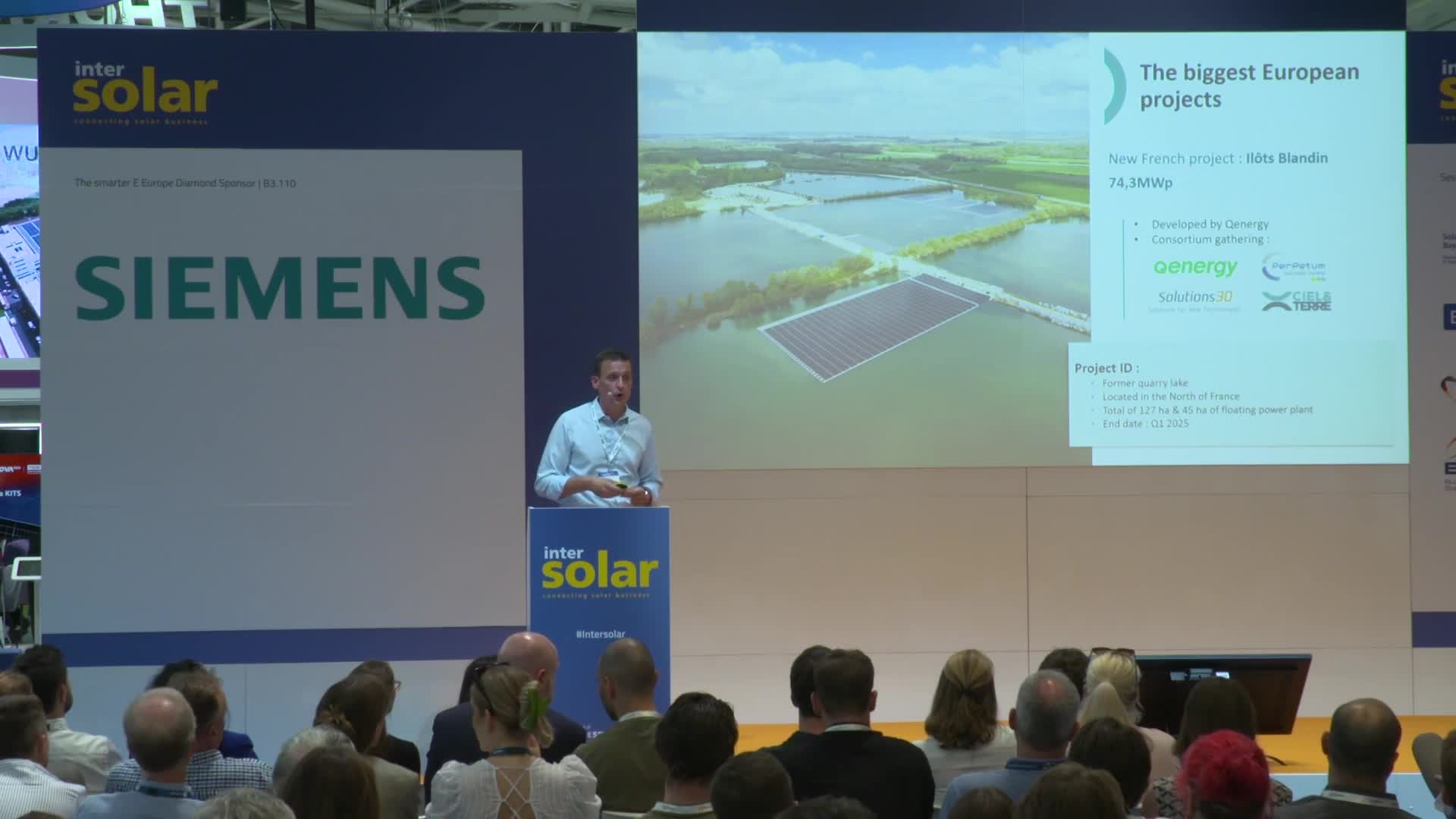
Dive in the Construction of the Biggest European Floating Solar Project: +73MWp in France

premium account

Recording of Wednesday, June 19, 2024 | The smarter E Europe | Exhibition Program | Language: English | Duration: 13:05 .

Construction of Europe's Largest Floating Solar Project Underway in France, Says Ciel & Terre International Director Vincent Grumetz

The discussion focuses on Europe's largest floating solar project—a 73-megawatt peak plant in France, with Mr. Vincent Grumetz from Ciel & Terre International providing insights into its construction and challenges. Ciel & Terre International specializes in floating solar projects, having installed over 300 globally, totaling nearly 1.6 gigawatts of capacity since starting in 2013. This French project, developed by Q-Energy and constructed by a consortium including Solution 30 and Perpetuum, spans six lakes covering more than 127 hectares—with the power plant itself occupying about 45 hectares. It involves significant logistical coordination due to limited storage space on site for the large volume of components like modules and floats. Key challenges include optimizing Levelized Cost of Energy (LCOE) despite higher initial capital expenditures for structures and mooring lines unique to floating setups. Operational expenses (OPEX) are also higher due to specialized equipment required for maintenance tasks performed far from shore. To enhance efficiency, design optimizations include self-oriented modules at a five-degree tilt with high packing density—achieving around 1.7 megawatt-peak per hectare compared to ground installations' lower densities. Detailed preparation is crucial; organized logistics minimize onsite stock while ensuring timely supply flow. Overall, Grumetz emphasizes that each floating solar project requires bespoke solutions tailored to specific sites’ conditions for long-term reliability over decades.

Automated summarization by AI Conver

Large installations are developing rapidly, and innovative applications in this area are on the rise: Hybrid power plants combine PV with wind or batteries or both, while floating PV uses water surfaces as power plant sites. This session will present projects such as Europe's largest floating PV installation and Sukari, the world's largest off-grid hybrid power plant. The latest trends in project development, EPC, O&M and Asset Management will also be discussed.

Further Talks of this session:

To Talk

To Talk

To Talk

To Talk

To Talk

Further Content
Webinar
Growth of the European Solar Market, Specifically, Romania

February 24, 2026

Webinar: EU Solar Market Overview with Focus on Romania

Webinar Collection
Mixed Investment Solar Projects in Mexico: The 54% Model Explained

January 29, 2026

Mexico has introduced a new mixed investment scheme for renewable power generation, requiring a minimum 54% direct or indirect participation by CFE.

Adriana Fricke, Robin Berg
Has Vehicle-to-Grid Reached the Tipping Point?

The smarter E Podcast Episode 248 | Language: English

February 5, 2026

Why 2026 could be a turning point for bidirectional EV charging – from regulation to large V2G fleets in Europe.

Webinar
Mexico’s commercial and industrial solar thermal: from potential to projects

February 19, 2026

Discover Mexico’s C&I solar thermal market, opportunities, trends and successful projects

The smarter E Europe Conferences 2025
Factors That Influence the Success of a Minigrid Project

Wednesday, May 07, 2025, 11:00 am - 12:30 pm

The smarter E Europe Conferences 2025 | Conference Program

premium account

Off-grid solar systems are often the least expensive option for rural electrification. Solar home systems can power individual households, while mini-grids can supply entire villages. Each comes with its own advantages, disadvantages, and challenges. The aim of this session is to explore challenges as well as success stories. It takes well-functioning components such as battery systems, charge management and inverters to make projects successful. Proper system sizing, maintenance and repair management, as well as a robust financial concept are also necessary. If one of these elements is missing, the electrification will not be sustainable. This session will focus on the aspects mentioned above. The speakers will present successful and unsuccessful approaches and discuss what can be learned from them.

You are using an outdated browser

The website cannot be viewed in this browser. Please open the website in an up-to-date browser such as Edge, Chrome, Firefox, or Safari.