Recording of Wednesday, June 19, 2024 | The smarter E Europe | Exhibition Program | Language: English | Duration: 11:36 .
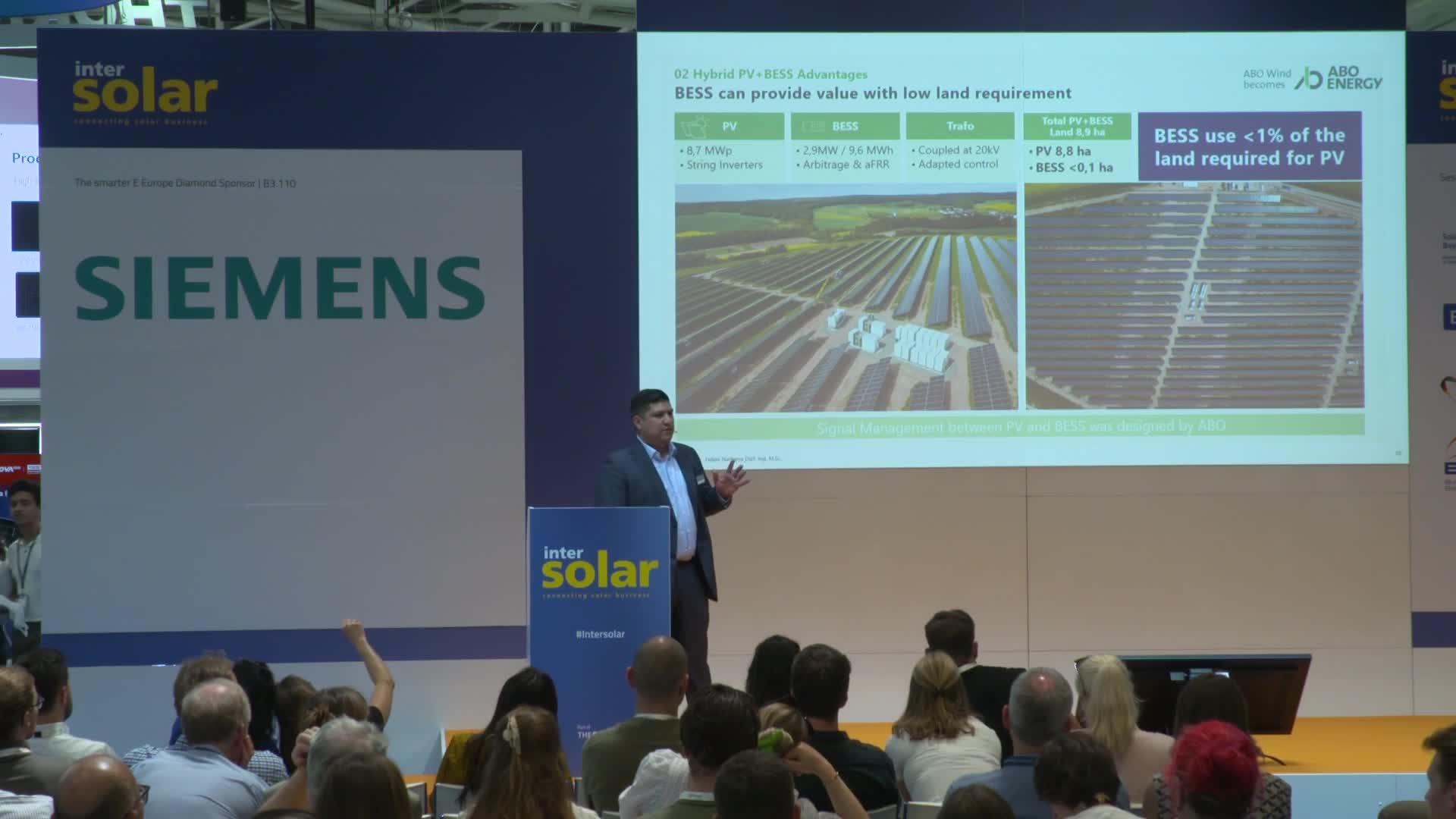
Felipe Narbona from ABO Wind discusses the benefits of hybrid energy projects, specifically combining photovoltaic (PV) systems with other renewable technologies like wind or batteries. AboEnergy, recently renamed from ABO Wind, focuses on project development, construction, operation, and maintenance across 16 countries with a pipeline of 23 gigawatts. They specialize in integrating different technologies such as wind, solar PV, storage solutions including batteries and hydrogen. Narbona emphasizes their success in developing hybrid projects that combine PV with battery storage across multiple countries. He details how these setups reduce costs by sharing injection points between PV arrays and batteries while enabling efficient energy management through strategies like arbitrage trading and secondary regulation services. Challenges include early consideration for battery integration during planning stages and coordination complexities during delivery phases but are manageable through good project management practices. The significant spatial efficiency of batteries compared to PV panels is also highlighted—batteries occupy just 1% of the land required for equivalent PV capacity. Ultimately, combining PV with battery technology offers several advantages: reduced installation costs due to shared infrastructure; avoiding grid curtailment; transferring surplus midday generation to peak demand times thereby reducing reliance on gas peakers; lower overall CO2 emissions; increased revenues from more flexible energy dispatching—all contributing positively towards decarbonization efforts.
Automated summarization by AI Conver
Large installations are developing rapidly, and innovative applications in this area are on the rise: Hybrid power plants combine PV with wind or batteries or both, while floating PV uses water surfaces as power plant sites. This session will present projects such as Europe's largest floating PV installation and Sukari, the world's largest off-grid hybrid power plant. The latest trends in project development, EPC, O&M and Asset Management will also be discussed.
Further Talks of this session: