Recording of Monday, June 22, 2026 | The smarter E Europe Conferences 2026 | Language: English | Duration: 10:29 .
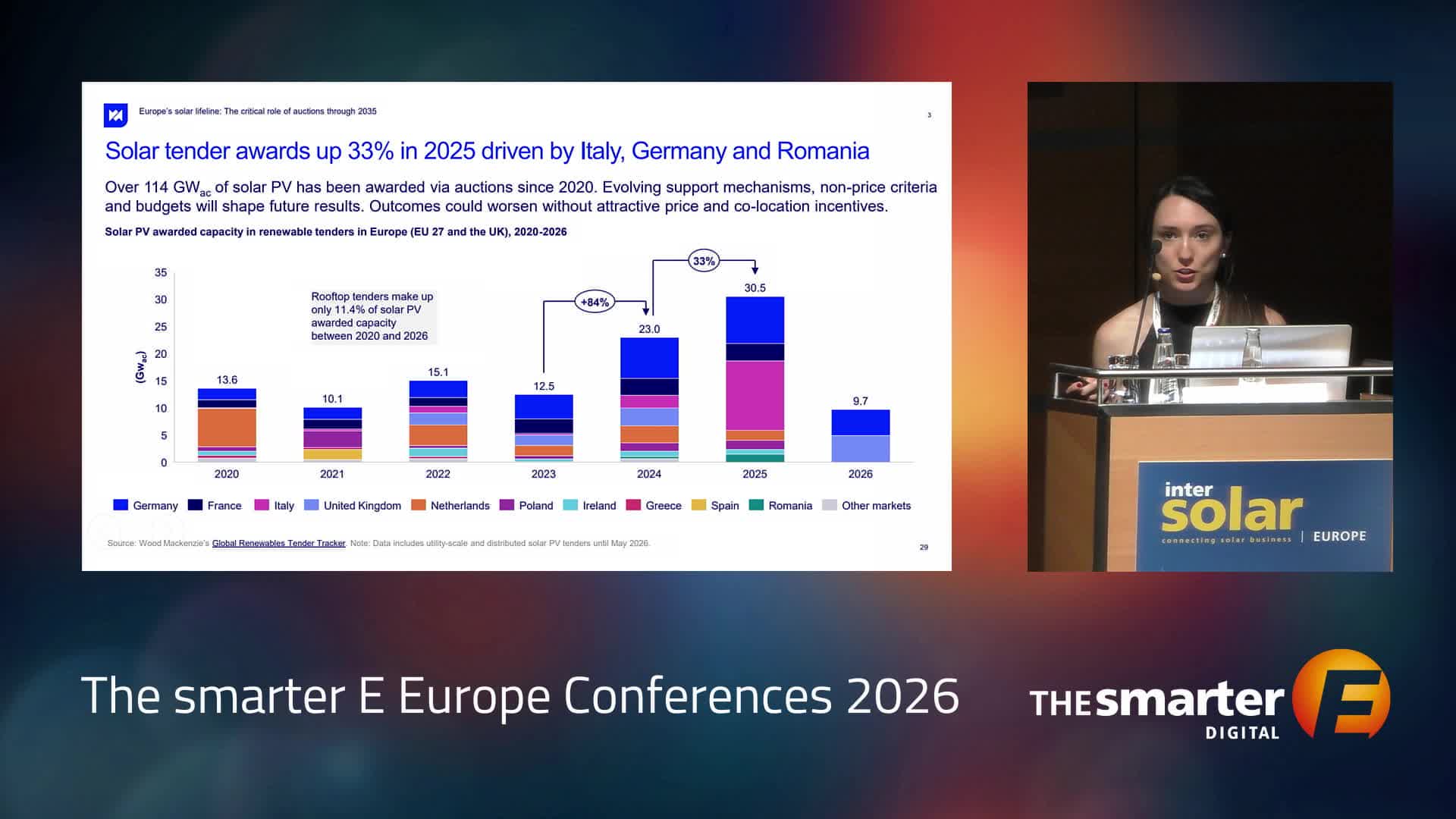
Auctions have been the primary procurement method for renewable energy in Europe, with solar PV constituting 42% of the awarded capacity from 2020 to 2026. Germany leads this market at 36%, followed by the UK at 14%, while Italy and Romania have significantly contributed to capacity growth in 2025, particularly through Italy's FERX auction. Spain has emerged as a dominant player, capturing 41% of the total contracted solar Power Purchase Agreements (PPAs) in Europe, driven by corporate demand and robust infrastructure. Auction dynamics are evolving, with emerging countries like Germany and the Netherlands proposing new mechanisms, potentially including two-sided Contracts for Difference starting in 2027. Although Spain has led in solar PPAs, market shifts have favored the UK, Poland, and Italy, which are gaining share as competition intensifies. The evolution of auction pricing, initially rising due to inflation, is now experiencing a slight reduction due to declining technology costs. Future predictions indicate that auctions will remain crucial, expected to account for 82% of utility-scale solar installations into 2030. However, the landscape also shows volatility, with changing auction quotas and the introduction of resilience auctions in Italy and Germany. By 2035, nearly 160 gigawatts of new solar capacity is projected, emphasizing the critical role of auctions in expanding solar capacity amid ongoing market adaptations.
Automated summarization by AI Conver
Speaker
Victoria Ortega
Analyst, European Power & Renewables, Solar
Wood Mackenzie
United Kingdom
As merchant and PPA revenues decline amid negative price trends and falling capture rates, auctions and Contracts for Difference (CfDs) are regaining strategic importance for large-scale solar and storage projects. CfDs remain the backbone of renewable financing, providing price certainty and lowering capital costs. At the same time, auction models must evolve to incentivize flexibility and prevent grid congestion. New EU rules permit non-price criteria in tenders and other publicprocurement processes in order to strengthen resilience and support EU supply chains. This session examines how auctions and CfDs can secure clean capacity, integrate storage and reinforce Europe's energy security and competitiveness.
Key topics:
Further Talks of this session:
Speaker
Tobias Biller
Senior Regulatory Affairs Manager
RWE Renewables Europe & Australia GmbH
Germany
Speaker
Chris Hewett
CEO
Solar Energy UK
United Kingdom
Speaker