Fostering the Uptake of Innovative Technologies to Support Grid Management

premium account

Recording of Tuesday, June 18, 2024 | The smarter E Europe 2024 | Conference Program | Language: English | Duration: 10:26 .

Addressing Innovation Barriers in Power Systems: European Technology Associations Highlight Need for Coordinated Regulatory Frameworks and Smart Grid Indicators to Foster Future Transformation

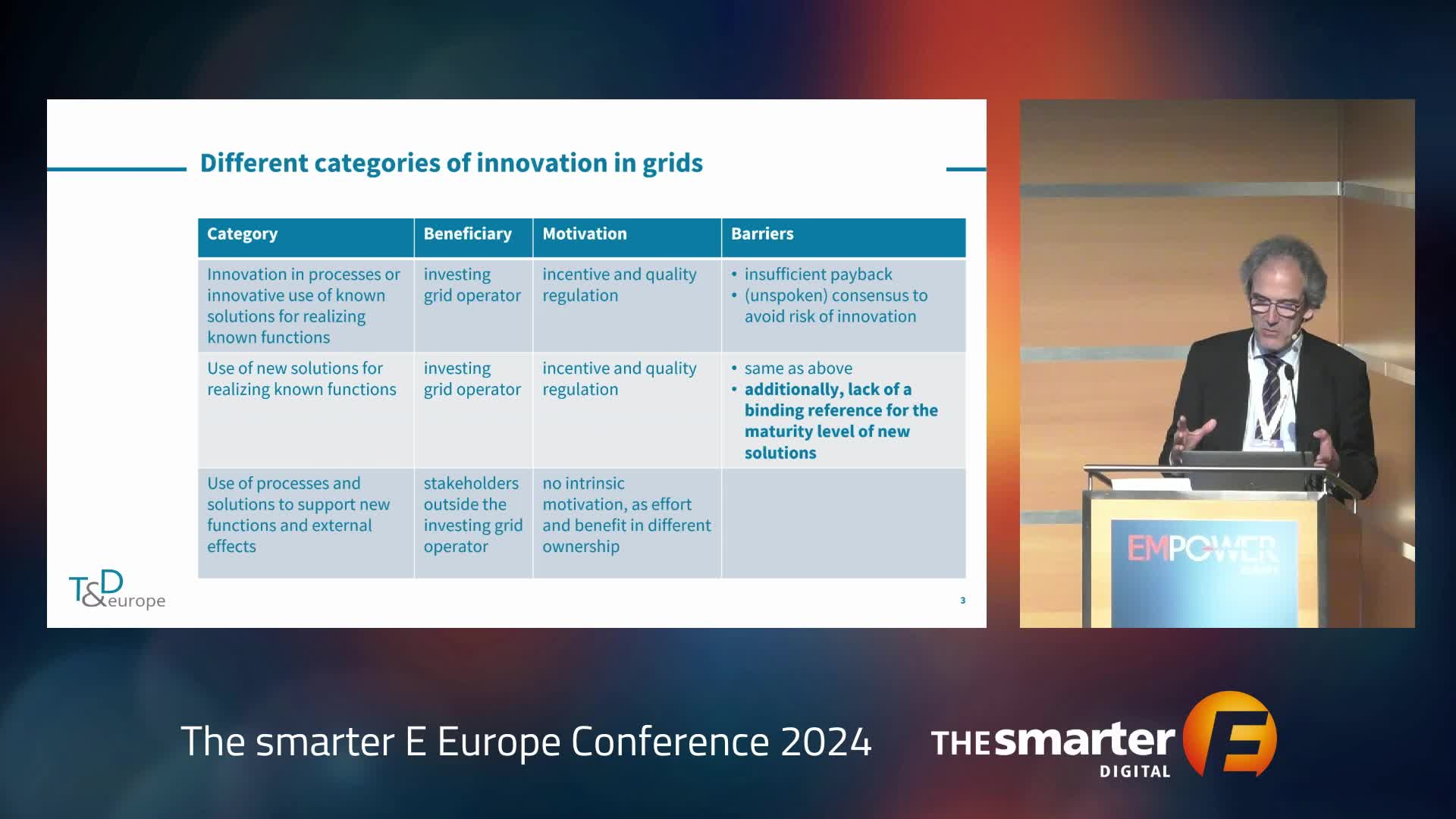
The speaker, representing European associations of technology providers, emphasizes the critical role of innovation in addressing future challenges. They discuss how their research focuses on transmission and distribution grids, both hardware and software. The presentation is structured around three main types of innovation: using known solutions for existing functions (continuous improvement), employing new or unconventional solutions for existing functions, and supporting new functions through innovative processes. Key points include: 1. Innovation Motivation: Innovation should provide clear benefits rather than being pursued as an end itself. 2. Regulatory Frameworks: Effective regulatory frameworks are essential to motivate grid operators towards continuous improvements and adoption of innovative technologies. 3. Barriers to Innovation: - Insufficient payback from investments can deter companies. - Lack of binding references for maturity levels creates uncertainty about deploying new technologies. A central theme is that while past regulatory frameworks focused merely on efficiency, today's needs involve transforming power systems toward variable renewable energy sources and actively managing newer appliances like charging points or heat pumps. This transformation necessitates a coordinated effort including defining system operations for the future, infrastructure requirements, regular reviews based on evolving learning experiences, and transparent measurement at the distribution level to manage local flexibilities effectively. In conclusion, widespread understanding among stakeholders about these needs is crucial for successful implementation across member states' legislation levels to achieve reliable electricity supply during this transformative journey.

Automated summarization by AI Conver

Prof. Dr. Jochen Kreusel
President T&D Europe, Member ETIP-SNET
T&D Europe & ETIP-SNET
Germany

As the recent Grid Action Plan has shown, the importance of grids has finally come to the forefront of discussions on European energy policy. The focus of this session is on grid innovations and the need for a sustainable electricity system that can adapt to the energy transition.

Speaker

Torsten Knop
European Regulation
E.ON SE
Germany

To Talk

Speaker

Adrian Gonzalez
Programme Officer- Innovation and End-use Sectors
IRENA International Renewable Energy Agency
Germany

To Talk

Speaker

Jan Kula
Business Development Expert
CEZ Distribuce, a. s.
Czech Republic

To Talk

Speaker

Matthew Billson
Director, Policy & Market Strategy
Piclo
United Kingdom

To Talk

Speaker

Torsten Knop
European Regulation
E.ON SE
Germany

To Talk

To Talk

Further Content
The smarter E Europe Exhibition Program 2025
DC Microgrids as the Next Frontier in Grid Modernization and DER Integration

Wednesday, May 07, 2025, 11:00 am - 12:25 pm

The smarter E Europe Exhibition Program 2025 | Exhibition Program

premium account

Discover how next-gen distribution grid technologies are addressing the challenges of renewable integration and dynamic energy demands. This session offers insights into the latest developments in AI-driven data analytics and the transformative role of IoT in grid management.

Irene Guerra Gil, Mark Bruno
Staying Home, with Smart Energy Management

The smarter E Podcast Episode 245 | Language: English

December 11, 2025

Irene Guerra Gil and Mark Bruno explain how smart home energy systems and building initiatives cut costs and emissions.

The smarter E Europe Conferences 2025
Optimizing Island Energy Systems: Modeling Hydrogen Integration in the Asia-Pacific

Wednesday, May 07, 2025, 02:00 pm - 03:30 pm

The smarter E Europe Conferences 2025 | Conference Program

premium account

This session explores how digitalization is revolutionizing off-grid energy projects, enabling scalability and efficiency in underserved areas. Experts will discuss cutting-edge solutions based on the use and application of digital tools to support planning, development, and operations ultimately enhancing affordability. Attendees will gain insights into leveraging digital tools for optimized planning and project management, customer engagement, monitoring, and sustainable growth. Real-world case studies will highlight successful implementations, showcasing how technology bridges the gap between innovation and impact in energy access.

The smarter E Europe Conferences 2025
Factors That Influence the Success of a Minigrid Project

Wednesday, May 07, 2025, 11:00 am - 12:30 pm

The smarter E Europe Conferences 2025 | Conference Program

premium account

Off-grid solar systems are often the least expensive option for rural electrification. Solar home systems can power individual households, while mini-grids can supply entire villages. Each comes with its own advantages, disadvantages, and challenges. The aim of this session is to explore challenges as well as success stories. It takes well-functioning components such as battery systems, charge management and inverters to make projects successful. Proper system sizing, maintenance and repair management, as well as a robust financial concept are also necessary. If one of these elements is missing, the electrification will not be sustainable. This session will focus on the aspects mentioned above. The speakers will present successful and unsuccessful approaches and discuss what can be learned from them.

The smarter E Europe Conferences 2025
Digital Tools for Planning and Monitoring: Insights from Mozambique

Wednesday, May 07, 2025, 02:00 pm - 03:30 pm

The smarter E Europe Conferences 2025 | Conference Program

premium account

This session explores how digitalization is revolutionizing off-grid energy projects, enabling scalability and efficiency in underserved areas. Experts will discuss cutting-edge solutions based on the use and application of digital tools to support planning, development, and operations ultimately enhancing affordability. Attendees will gain insights into leveraging digital tools for optimized planning and project management, customer engagement, monitoring, and sustainable growth. Real-world case studies will highlight successful implementations, showcasing how technology bridges the gap between innovation and impact in energy access.

You are using an outdated browser

The website cannot be viewed in this browser. Please open the website in an up-to-date browser such as Edge, Chrome, Firefox, or Safari.