Recording of Tuesday, June 23, 2026 | The smarter E Europe Exhibition Program 2026 | Language: English | Duration: 9:58 .
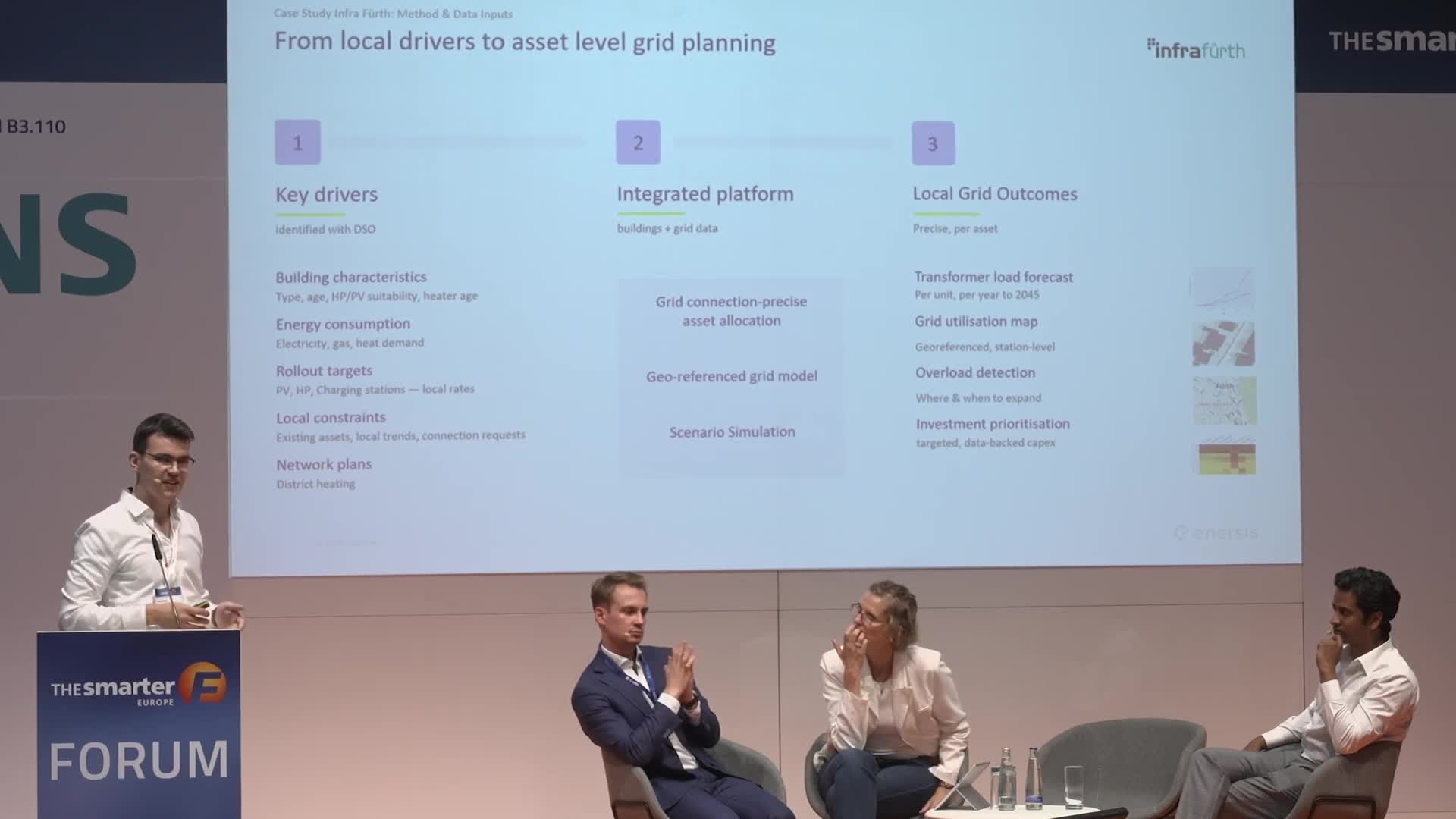
Grid operators in Germany face significant challenges in managing capacity due to the increasing demand driven by electrification in various sectors, such as electric vehicles and heat pumps. Effective modeling of power grid capacity relies on granular data to predict overload and congestion points, which remains a challenge due to existing data limitations. Current assessment methods for low voltage systems are inadequate, leading to oversights in critical data and ineffective decision-making. Investment needs are shifting, resulting in denied grid connection requests by Distribution System Operators (DSOs) as they seek to optimize lower voltage levels. A case study involving InfraFert, a Bavarian DSO, illustrates the need for enriched building data to accurately plan for heat pump installations and grid expansion, emphasizing the role of data-driven insights. A thorough analysis of existing grid connections for photovoltaic (PV) installations reveals that many urban areas, particularly in city centers, may face potential overloads as the demand for heat pumps and charging stations increases, necessitating careful capacity planning. Additionally, findings suggest that optimized planning processes can significantly reduce the need for excess heat pump stations by leveraging existing district heating grids, presenting a collaborative opportunity for stakeholders to enhance data transparency and overall grid understanding.
Automated summarization by AI Conver
Speaker
Matthias Knoblauch
Product Manager
enersis europe GmbH
As electrification, decentralised generation and sector coupling accelerate, energy infrastructure planning is becoming increasingly complex. This session explores how digital planning tools, integrated modelling approaches and grid-aware system design are helping utilities, developers and infrastructure operators manage constrained grids while enabling scalable renewable integration. From flexible connection agreements and digital twins to building-level grid planning and cross-sector infrastructure modelling, speakers will present practical approaches for designing resilient and future-ready energy systems.
Further Talks of this session:
Speaker
Margarete von Oppen
Rechtsanwältin und Partnerin
orka Partnerschaft mbB
Speaker
Steffen Schülzchen
CEO
Entrix
Speaker
Rohit Prasad
Head of Sales Germany
Second Foundation