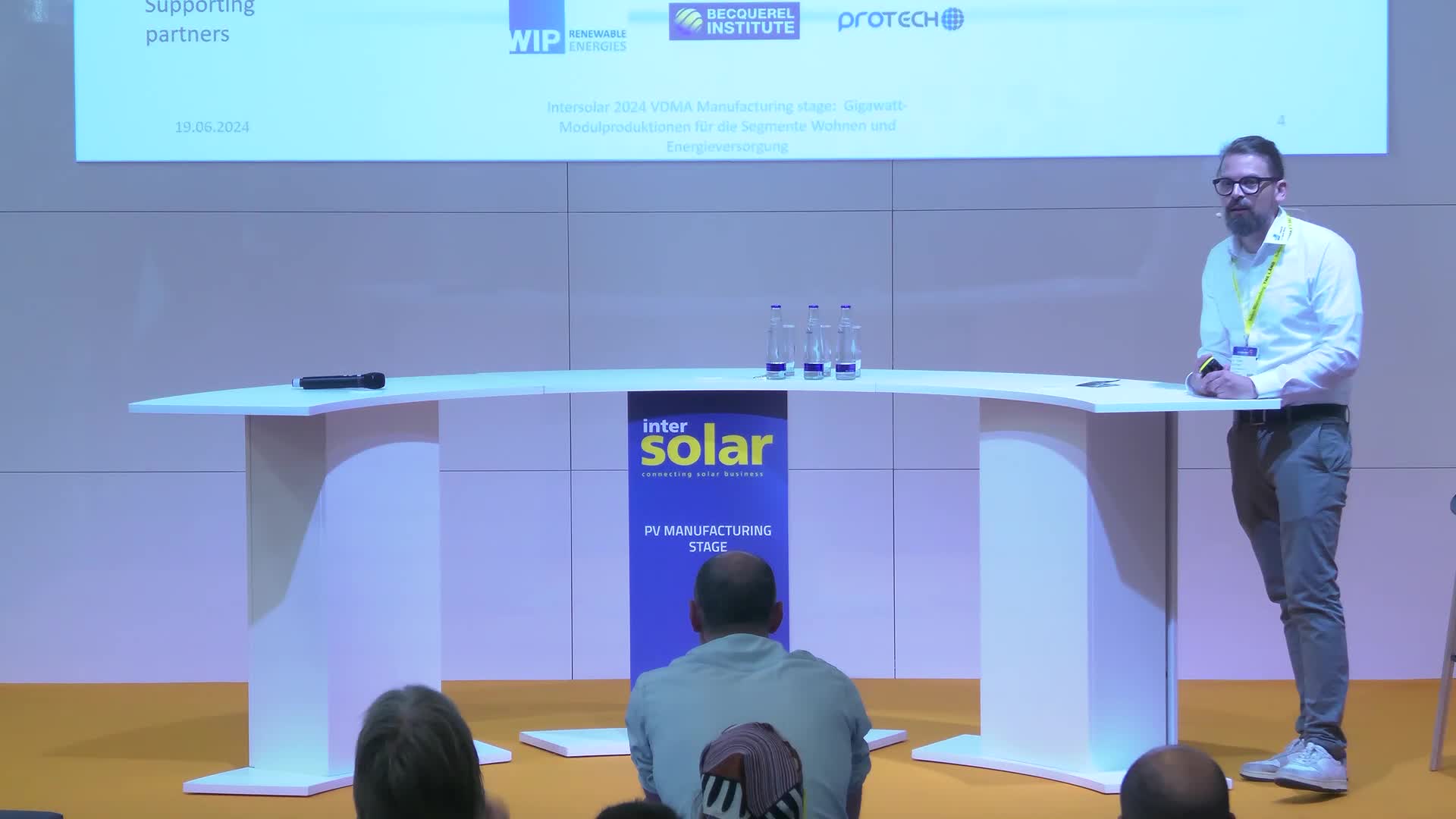
IBC4EU: Low Cost IBC Cells and Modules Made in Europe - a Horizon Europe Project's Take

premium account

Recording of Wednesday, June 19, 2024 | The smarter E Europe 2024 | Exhibition Program | Language: English | Duration: 17:24 .

IBC4EU Project Showcases European Consortium's Efforts in Advanced Solar Technology Amid Market Challenges, Focusing on Rooftop and Building-Integrated PV Applications with Promising Efficiency Improvements

The IBC4EU project is a European-funded Horizon Europe initiative with a budget of 17 million euros, involving 21 partners from various parts of the supply chain across Europe and beyond. The project's primary focus is to develop and enhance interdigitated back contact (IBC) solar cell technology, which offers promising potential for both rooftop installations and building-integrated photovoltaics (BIPV). Partners in the project include wafer suppliers like Norsan, solar cell producers such as Kalion and Value in Lithuania, material providers, research institutes, machine manufacturers, and companies involved in module production like Energira. IBC technology is considered advantageous due to its higher efficiency rates compared to conventional modules but faces challenges related to cost-effectiveness and market volatility. Aesthetic benefits are significant for BIPV applications because IBC cells can produce nearly all-black modules without visible front-facing metallization lines. Market analysis by Becquerel Institute identified high demand for rooftop systems despite cost concerns but also highlighted diverse opportunities within BIPV where aesthetics play an essential role. Two key technological advancements explored include Topcon-based Polo IBC cells achieving around 24% efficiency in lab conditions with expectations exceeding 25% in mass production. These technologies will be piloted by Futurasan among other partners aiming at advancing towards commercial viability amidst current funding dynamics.

Automated summarization by AI Conver

The International Technology Roadmap for Photovltaics outlines projected developments in module technology. The current global manufacturing capacity is rapidly approaching the terawatt (TW) levels by 2024, with most of the output serving the residential and utility markets. What technological advancements are global players working on? How will product quality impact systems? What are the main technology goals for the coming years, and what are companies' perspectives on emerging technologies such as tandem cells and modules?

To Talk

To Talk

To Talk

Further Content
Webinar
Mixed Investment Solar Projects in Mexico: The 54% Model Explained

January 29, 2026

Mexico has introduced a new mixed investment scheme for renewable power generation, requiring a minimum 54% direct or indirect participation by CFE.

Anna Darmani, Principal Analyst from Wood Mackenzie
Big BESS Is Here to Save the Day

The smarter E Podcast Episode 246 | Language: English

January 8, 2026

Utility-scale batteries are booming in Europe. Discover key BESS trends, market impacts, and what to expect for large-scale storage in 2026.

Irene Guerra Gil, Mark Bruno
Staying Home, with Smart Energy Management

The smarter E Podcast Episode 245 | Language: English

December 11, 2025

Irene Guerra Gil and Mark Bruno explain how smart home energy systems and building initiatives cut costs and emissions.

The smarter E Europe Conferences 2025
Factors That Influence the Success of a Minigrid Project

Wednesday, May 07, 2025, 11:00 am - 12:30 pm

The smarter E Europe Conferences 2025 | Conference Program

premium account

Off-grid solar systems are often the least expensive option for rural electrification. Solar home systems can power individual households, while mini-grids can supply entire villages. Each comes with its own advantages, disadvantages, and challenges. The aim of this session is to explore challenges as well as success stories. It takes well-functioning components such as battery systems, charge management and inverters to make projects successful. Proper system sizing, maintenance and repair management, as well as a robust financial concept are also necessary. If one of these elements is missing, the electrification will not be sustainable. This session will focus on the aspects mentioned above. The speakers will present successful and unsuccessful approaches and discuss what can be learned from them.

The smarter E Europe Conferences 2025
Panel Discussion of of the Session Off-Grid: When Will Off-Grid PV Follow the Affordability Trend?(BSW)

Wednesday, May 07, 2025, 04:00 pm - 05:30 pm

The smarter E Europe Conferences 2025 | Conference Program

premium account

Photovoltaic prices have fallen continuously in recent years - a trend that should translate into a growing market for off-grid solutions. Declining costs are crucial for rural electrification in particular, making sustainable energy supply economically viable in remote regions. However, so far many of these price advantages have not yet reached the people that need them most. Do existing framework conditions to foster rural electrification still work in this new market reality? Which measures are needed to ensure that cost reductions reach our target group? This session discusses strategies for improving the availability of low-cost off-grid solutions, financing and innovative business models. A look at successful practical examples shows which political, economic and technological levers need to be pulled to make off-grid PV accessible on a large scale.

You are using an outdated browser

The website cannot be viewed in this browser. Please open the website in an up-to-date browser such as Edge, Chrome, Firefox, or Safari.