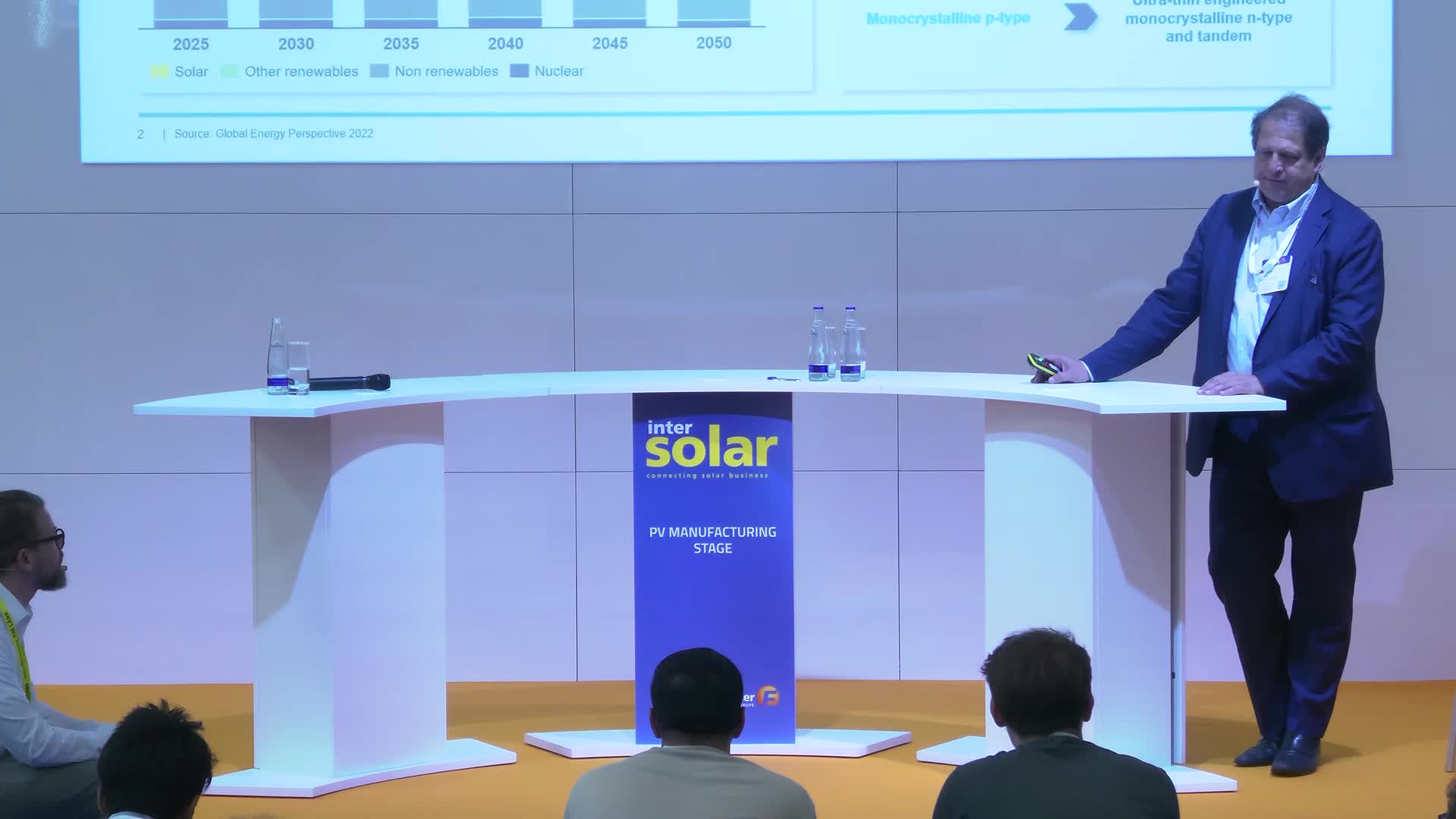
Recording of Wednesday, June 19, 2024 | The smarter E Europe | Exhibition Program | Language: English | Duration: 22:23 .
Davor Sutija , CEO of NextWafe, is enthusiastic about reshoring wafer manufacturing to Europe, specifically Germany. He highlights the importance of solar wafers in the photovoltaic (PV) supply chain and discusses an ongoing commercialization project in Freiburg. Sutija emphasizes that engineered wafers with superior material properties can enhance cell and module efficiency, aiding Europe's energy transition through technical innovation. The prototype scale tool used by NextWafe is substantial at 9 meters long and weighing 20 tons. Sutija notes the growing market for solar wafers, expected to reach $30 billion by 2030 with double-digit growth until 2050. He asserts that NextWafe's technology can significantly reduce costs, energy consumption, and CO2 emissions globally by over two to three percent between now and 2050. Their approach focuses on creating ultra-thin engineered wafers ideal for tandem devices aiming for a future efficiency target of around 30%. A critical industry challenge is that nearly all current wafer production capacity resides in mainland China or Chinese-controlled regions in Southeast Asia. This concentration poses risks due to potential supply chain disruptions impacting Europe and North America’s access to this essential resource. NextWafe employs epitaxy technology instead of conventional methods like Siemens process or Czochralski method. Their process yields higher silicon utilization (95% versus approximately 50%), reduces thermal cycling steps (making it more energy-efficient), decreases CO2 emissions by up to 60%, and produces cost-effective high-performance waivers since most silicon ends up as final product after one heating cycle. The unique method begins with porosifying a small layer on a seed wafer before using chemical vapor deposition (CVD) reactors—creating an efficient production pipeline beneficial for photovoltaics even under current market conditions
Automated summarization by AI Conver
The International Technology Roadmap for Photovltaics outlines projected developments in module technology. The current global manufacturing capacity is rapidly approaching the terawatt (TW) levels by 2024, with most of the output serving the residential and utility markets. What technological advancements are global players working on? How will product quality impact systems? What are the main technology goals for the coming years, and what are companies' perspectives on emerging technologies such as tandem cells and modules?
Further Talks of this session: