Modelling Future Failures on PV Plants to Plan O&M and Improve Design

premium account

Recording of Tuesday, June 18, 2024 | The smarter E Europe | Conference Program | Language: English | Duration: 15:37 .

ENGIE Group's Laborelec Research Center Develops Simulation Tool to Optimize PV Plant Lifetime and Minimize Failures

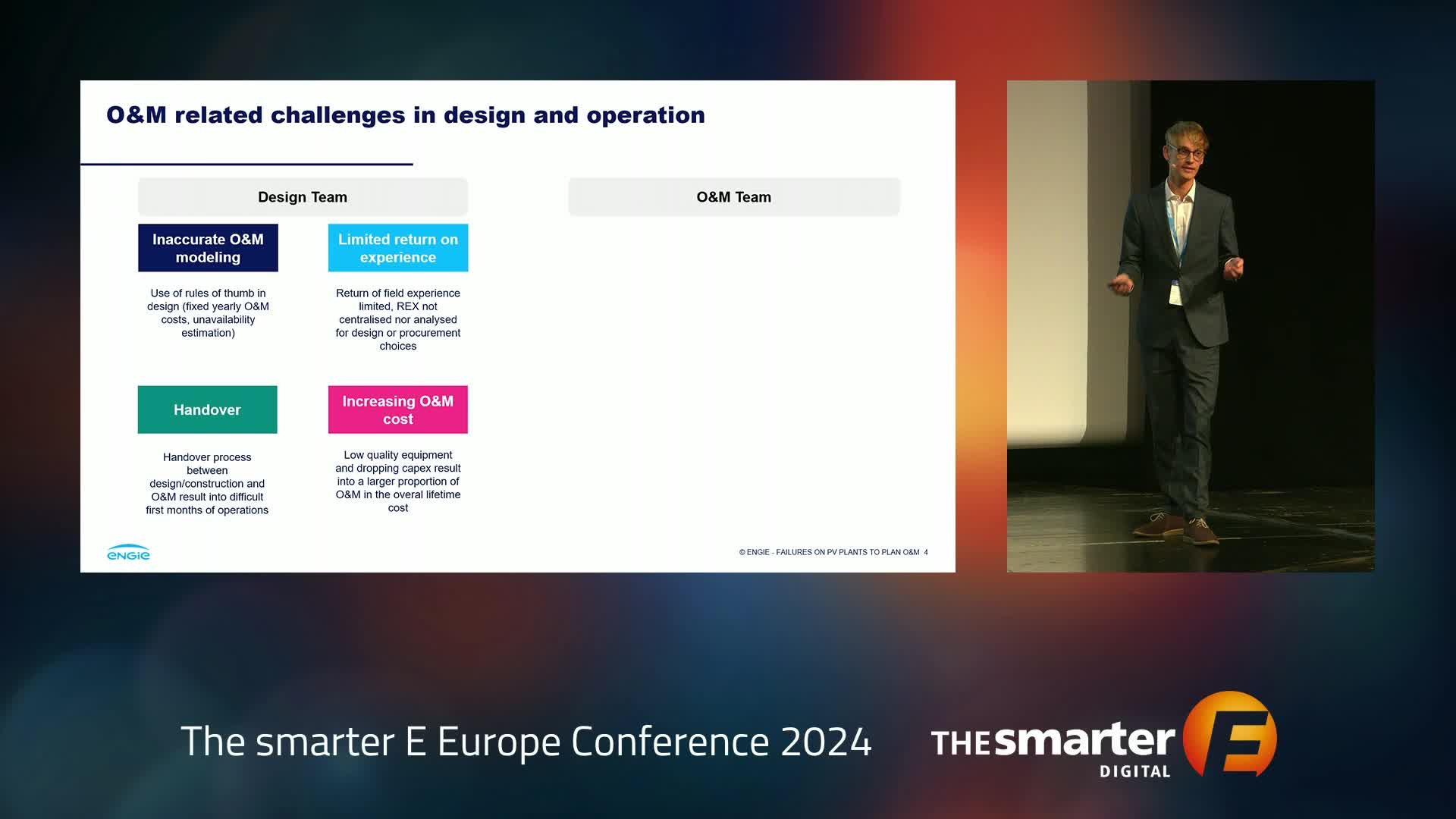
The speaker is a research engineer at Laborelec, the research and innovation center of the ENGIE Group, focusing on solar and hybrid systems. Located in Brussels, Laborelec undertakes various projects related to electricity including power networks, nuclear energy, renewables, carbon capture and storage. The current project discussed involves modeling failures in photovoltaic (PV) plants to optimize operations and maintenance (O&M) for longer plant lifespans. A specific use case highlighted involved unexpected losses of power due to cabinet fires caused by component failure within an inverter. These incidents indicate discrepancies between design assumptions—often based on inaccurate O&M models—and real-world operational costs and failures. Efforts are being made within ENGIE to centralize data from O&M teams for better design decisions. To address these challenges, they developed a simulation tool that predicts site-specific component failure rates over 20 years. This helps in estimating repair costs, delays, energy loss during downtime, and making cost-effective decisions about repowering or revamping sites while considering long-term service agreements with suppliers.

Automated summarization by AI Conver

Aquin Magnus
Project Engineer
ENGIE Laborelec
France

As regulatory requirements and margin pressure make project development increasingly challenging, EPCs are confronted with new system designs and high volatility in product supply and cost. Once a PV power plant has been built, the O&M needs to ensure a high output. This requires more and more digital analytics, while asset managers must deal with increasing reporting services. The session will cover:

  • Status of utility-scale solar power project development needs
  • How EPCs deal with rising costs and supply volatility pressure
  • Advanced analytics for effective O&M
  • Asset management throughout the entire project lifecycle
  • Q&A

Further Talks of this session:

Speaker

Dr. Benedikt Ortmann
Global Director Origination & Business Development Projects
BayWa r.e. AG
Germany

To Talk

Speaker

Martin Dennenmoser
Head of R&D
BayWa r.e. Solar Projects GmbH
Germany

To Talk

Speaker

Dan Garlin
COO Renewables
Uniper
Germany

To Talk

Speaker

Dr. Carlos Javier Sarasa
Managing Director
ELGIN ENERGY
United Kingdom

To Talk

To Talk

Further Content
Webinar
Growth of the European Solar Market, Specifically, Romania

February 24, 2026

Webinar: EU Solar Market Overview with Focus on Romania

Webinar Collection
Mixed Investment Solar Projects in Mexico: The 54% Model Explained

January 29, 2026

Mexico has introduced a new mixed investment scheme for renewable power generation, requiring a minimum 54% direct or indirect participation by CFE.

Adriana Fricke, Robin Berg
Has Vehicle-to-Grid Reached the Tipping Point?

The smarter E Podcast Episode 248 | Language: English

February 5, 2026

Why 2026 could be a turning point for bidirectional EV charging – from regulation to large V2G fleets in Europe.

Webinar
Mexico’s commercial and industrial solar thermal: from potential to projects

February 19, 2026

Discover Mexico’s C&I solar thermal market, opportunities, trends and successful projects

The smarter E Europe Conferences 2025
Factors That Influence the Success of a Minigrid Project

Wednesday, May 07, 2025, 11:00 am - 12:30 pm

The smarter E Europe Conferences 2025 | Conference Program

premium account

Off-grid solar systems are often the least expensive option for rural electrification. Solar home systems can power individual households, while mini-grids can supply entire villages. Each comes with its own advantages, disadvantages, and challenges. The aim of this session is to explore challenges as well as success stories. It takes well-functioning components such as battery systems, charge management and inverters to make projects successful. Proper system sizing, maintenance and repair management, as well as a robust financial concept are also necessary. If one of these elements is missing, the electrification will not be sustainable. This session will focus on the aspects mentioned above. The speakers will present successful and unsuccessful approaches and discuss what can be learned from them.

You are using an outdated browser

The website cannot be viewed in this browser. Please open the website in an up-to-date browser such as Edge, Chrome, Firefox, or Safari.