Monetizing Flexibility of Industrial Power-to-Heat

premium account

Recording of Friday, May 09, 2025 | The smarter E Europe 2025 | Exhibition Program | Language: English | Duration: 15:32 .

Entelios AG's Markus Fleschutz Discusses Power-to-Heat Market Growth and Energy Cost Savings at The Smarter E Platform.

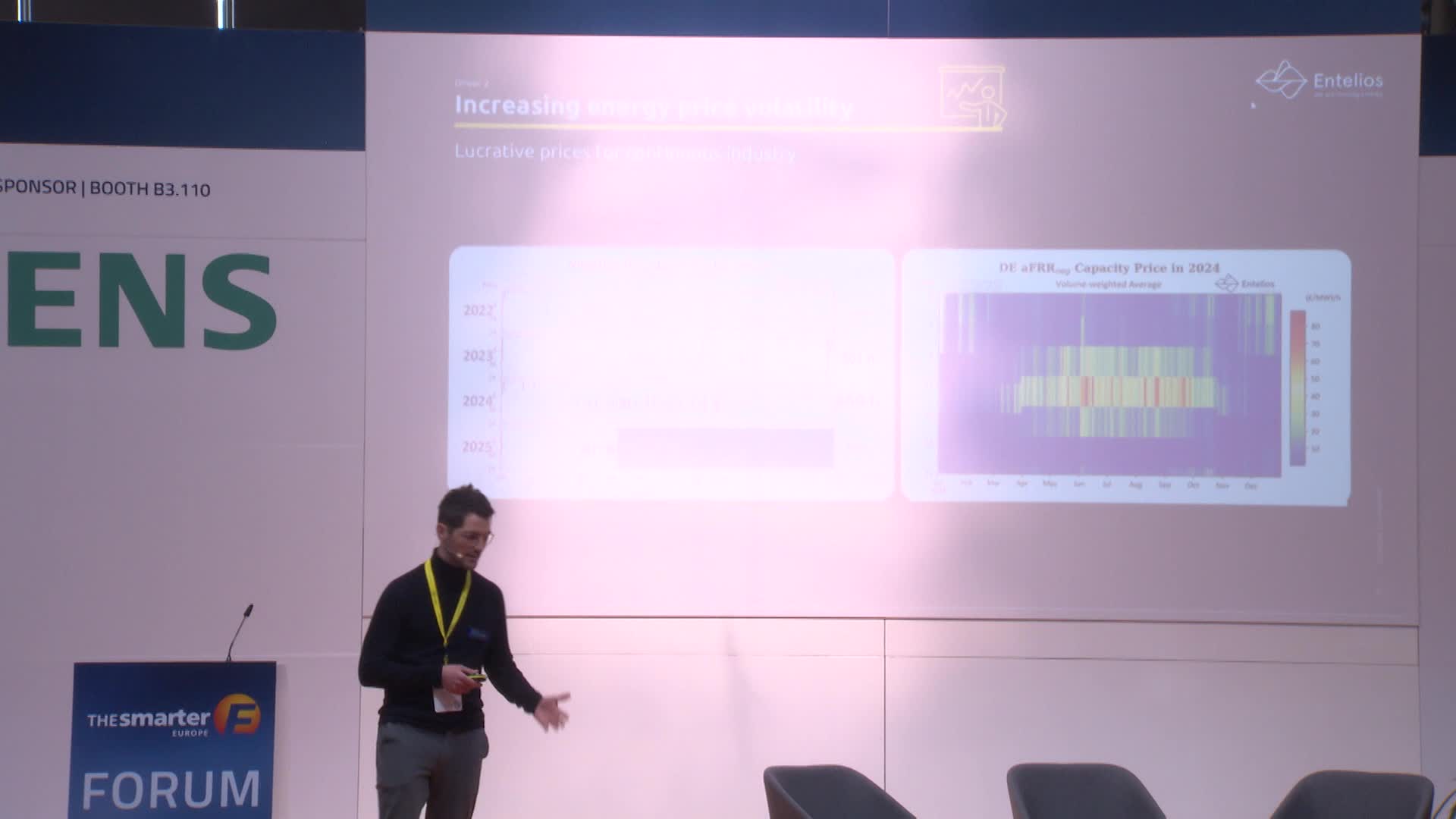
Markus Fleschutz from Entelios AG discusses the company's leadership in industrial demand response since 2010, emphasizing their extensive operations across Germany's control zones and connections to major spot markets. They optimize flexible assets like large-scale batteries and power-to-heat systems. A key trend is electrifying process heat due to decarbonization pressures, energy price volatility, and new regulations promoting flexibility in industries traditionally limited by grid charge discounts requirements. Currently, only 3% of Europe's industrial emissions from process heat are electrified; however, existing technology could increase this figure to 60%. The business case for power-to-heat strengthens with high capacity prices during summer midday periods when unused electricity can be efficiently utilized. Regulatory changes now support companies adopting flexible operations through potential grid charge discounts or incentives—transforming restrictive policies into supportive frameworks fostering innovative models such as e-boilers or ambitious decarbonization strategies involving heat storage solutions. Financial benefits include significant cost savings via optimized energy systems like a bivalent mode operating 30-megawatt e-boiler leading to substantial revenue enhancements through various market participations while contributing partially towards decarbonization efforts without explicitly targeting carbon reduction goals.

Automated summarization by AI Conver

Markus Fleschutz
Manager Product and Business Development
Entelios AG

Discover how commercial and industrial energy users can unlock new revenue streams through energy flexibility. This session will explore how to create revenue streams and save costs from making use of the latest flexibilty technologies, participating in demand response programs, make use of dynamic pricing, integrating energy storage systems and other approaches. Learn from successful case studies with examples of innovative approaches in flexible energy use in industrial/commercial settings.

Further Talks of this session:

Speaker

Lucinda Murley
Flexibility Specialist
LCP Delta

To Talk

Speaker

Romain Serres
CEO
Tilt Energy

To Talk

Speaker

Kai Becker
Chief Development Officer
Energy2market

To Talk

Speaker

Finn Neugebauer
Head of Sales
be.storaged

To Talk

Speaker

Dr. Lennard Wilkening
CEO
suena GmbH

To Talk

Video is not available.

Further Content
Webinar
Mixed Investment Solar Projects in Mexico: The 54% Model Explained

January 29, 2026

Mexico has introduced a new mixed investment scheme for renewable power generation, requiring a minimum 54% direct or indirect participation by CFE.

Anna Darmani, Principal Analyst from Wood Mackenzie
Big BESS Is Here to Save the Day

The smarter E Podcast Episode 246 | Language: English

January 8, 2026

Utility-scale batteries are booming in Europe. Discover key BESS trends, market impacts, and what to expect for large-scale storage in 2026.

The smarter E Europe Exhibition Program 2025
DC Microgrids as the Next Frontier in Grid Modernization and DER Integration

Wednesday, May 07, 2025, 11:00 am - 12:25 pm

The smarter E Europe Exhibition Program 2025 | Exhibition Program

premium account

Discover how next-gen distribution grid technologies are addressing the challenges of renewable integration and dynamic energy demands. This session offers insights into the latest developments in AI-driven data analytics and the transformative role of IoT in grid management.

The smarter E Europe Conferences 2025
Setting the Scene "Off-Grid"

Wednesday, May 07, 2025, 04:00 pm - 05:30 pm

The smarter E Europe Conferences 2025 | Conference Program

premium account

Photovoltaic prices have fallen continuously in recent years - a trend that should translate into a growing market for off-grid solutions. Declining costs are crucial for rural electrification in particular, making sustainable energy supply economically viable in remote regions. However, so far many of these price advantages have not yet reached the people that need them most. Do existing framework conditions to foster rural electrification still work in this new market reality? Which measures are needed to ensure that cost reductions reach our target group? This session discusses strategies for improving the availability of low-cost off-grid solutions, financing and innovative business models. A look at successful practical examples shows which political, economic and technological levers need to be pulled to make off-grid PV accessible on a large scale.

The smarter E Europe Conferences 2025
Factors That Influence the Success of a Minigrid Project

Wednesday, May 07, 2025, 11:00 am - 12:30 pm

The smarter E Europe Conferences 2025 | Conference Program

premium account

Off-grid solar systems are often the least expensive option for rural electrification. Solar home systems can power individual households, while mini-grids can supply entire villages. Each comes with its own advantages, disadvantages, and challenges. The aim of this session is to explore challenges as well as success stories. It takes well-functioning components such as battery systems, charge management and inverters to make projects successful. Proper system sizing, maintenance and repair management, as well as a robust financial concept are also necessary. If one of these elements is missing, the electrification will not be sustainable. This session will focus on the aspects mentioned above. The speakers will present successful and unsuccessful approaches and discuss what can be learned from them.

You are using an outdated browser

The website cannot be viewed in this browser. Please open the website in an up-to-date browser such as Edge, Chrome, Firefox, or Safari.