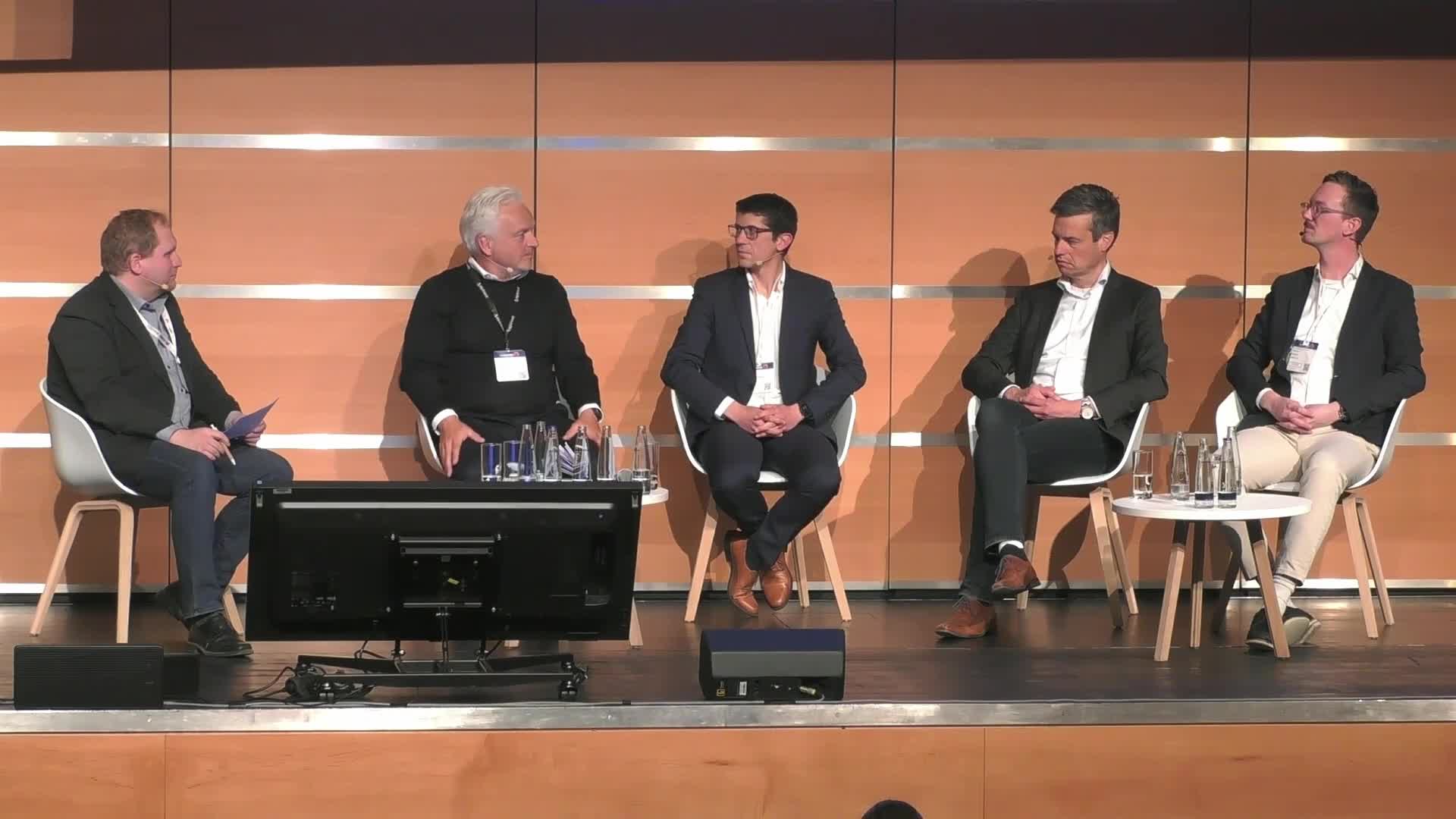
Panel Discussion of the session The Future of CCS Charging

premium account

Recording of Wednesday, May 07, 2025 | The smarter E Europe | Conference Program | Language: English | Duration: 42:19 .

Industry Experts Explore Challenges and Innovations in Electric Vehicle Charging Solutions and Infrastructure Standardization

The discussion on electric vehicle (EV) charging infrastructure highlights several challenges and innovations. Michel Mansour from SwissPost emphasizes the need for efficient solutions to adapt to new power levels, particularly in sales contexts. Ionity's introduction of a 400-kilowatt ion system is noted for its potential scalability but also presents planning complexities. The conversation underscores "on-the-go" charging where quick customer turnover is crucial, alongside increasing price sensitivity among consumers seeking value in power electronics investments. Scalability and modular design are vital for manufacturers aiming at diverse markets while maintaining quality standards. Data management plays a critical role; however, excessive data could overwhelm rather than assist customers if not handled effectively—optimizing demand predictions can prevent congestion during peak times. Standardization across tariffs enhances consumer choice by providing transparency into contract options at various stations. Challenges persist with 'plug-and-charge' technology due to inconsistent adoption by Charge Point Operators (CPOs), causing reliance on RFID cards despite preferences otherwise. Efforts focus on improving reliability and efficiency within EV infrastructure globally, addressing equipment reliability issues, grid alterations, copper usage concerns, testing protocols adherence—all essential factors impacting charger uptime and user satisfaction. While regional differences pose standardization hurdles like CCS implementation across LATAM or Southeast Asia regions—there’s optimism about overcoming these through stakeholder collaboration aimed at refining infrastructures further.

Automated summarization by AI Conver

This session will delve into the future of CCS (Combined Charging System) technologies, examining whether CCS has peaked or if there is more innovation on the horizon. Participants will explore emerging advancements, potential limitations, and the evolving role of CCS in the rapidly changing electric vehicle (EV) ecosystem. Key topics will include scalability, compatibility with next-generation vehicles, and how CCS can adapt to meet growing demands in the EV market.

Further Talks of this session:

Speaker

Dominik Ziriakus
Speaker Focus Group Charging Infrastructure
CharIN e.V.
Germany

Recording of presentation not authorized for publication.

Speaker

Wolfgang Ademmer
Chief Marketing Officer
Alpitronic
Italy

Recording of presentation not authorized for publication.

Speaker

Dr. Jesús Navarro Gallego
Technical Project Manager
CharIN e.V.
Germany

To Talk

Speaker

Manfred Maier
Teamlead Digital & Customer Experience
IONITY GmbH
Germany

To Talk

Speaker

Florian Kotsch
Program Manager Charging Experience
BMW AG
Germany

Recording of presentation not authorized for publication.

Further Content
The smarter E Europe Conferences 2026
Panel Discussion of the Session: User Success Stories and Best Cases

Tuesday, June 23, 2026, 02:30 pm

The smarter E Europe Conferences 2026 | Conference Program

premium account

For more than two decades, Norway has been steadily building a marketplace for electric transport. Having started out with inexpensive short-range electric cars and household charging sockets, Norway has now moved to mass-market solutions where fast charging (DC) and grid balancing (AC) plays an ever more vital role. With more than 1,000,000 electric cars and over 10,000 fast chargers in a relatively small market, Norway offers a rare early view of large-scale electrification. Over the past decade, electric cars have seen substantial improvements, which is now making it easier for new markets to advance electrification. At the same time, Norway has to deal with challenges years before other markets do. Yet despite different starting points, we can see that most markets are facing the same core challenges. From grid-smart charging strategies to innovative business models, there are excellent examples of best practices emerging elsewhere in Europe. What will the next thing in electrification be, both in mature and in emerging markets? And what will be possible when the right people and companies come together, sharing knowledge, solving common problems and accelerating the shift to cleaner mobility?

James Allston, Marko Topič
Keep Calm and Deploy Solar (and Batteries)

The smarter E Podcast Episode 254 | Language: English

April 30, 2026

How European businesses use solar, batteries and EV fleets to manage volatile power prices and explore the future of perovskite solar.

Gautham Ram Chandra Mouli, Ruben Valiente
Beating the Blockade with EVs and Batteries

The smarter E Podcast Episode 253 | Language: English

April 16, 2026

Flexibility as a hedge: How V2G and battery storage reduce fossil fuel reliance and turn electric transport into a strategic asset for grid stability.

Marcel Rümenapf
Will Soaring Fuel Costs Make eMobility Mass Market? – With Marcel Rümenapf

The smarter E Podcast Episode 256 | Language: English

May 28, 2026

Siemens’ Marcel Rümenapf explains why eMobility is becoming a strategic advantage for European logistics fleets.

The smarter E Europe Conferences 2026
Integrated Truck Charging: Challenges & Solutions Towards Zero-Emission Freight

Tuesday, June 23, 2026, 11:30 am

The smarter E Europe Conferences 2026 | Conference Program

premium account

The electrification of heavy-duty transport is more than just a goal - the transformation is already underway. But scaling up also means having to solve the big challenges: How can we build charging networks that keep pace with fleet electrification without overburdening grids or budgets? What innovations in AI, energy storage and smart infrastructure can turn today's pilot projects into tomorrow's industry standard? And how can OEMs, logistics operators and energy providers align their strategies to make zero-emission freight profitable rather than just possible? From truck manufacturers and charge point operators to logistics innovators and energy experts, this dynamic panel brings together the leaders driving change. We will dive into the real-world solutions making an impact now, like modular charging hubs that grow with demand, fleets and energy optimization solutions powered by AI and smart grid integration that cuts costs and boosts reliability. We will also ask the hard questions: Where are the gaps in collaboration, technology or policy that could slow progress, and how do we close these gaps?

You are using an outdated browser

The website cannot be viewed in this browser. Please open the website in an up-to-date browser such as Edge, Chrome, Firefox, or Safari.